Boxing Full Uppercut (With Dumbbell)
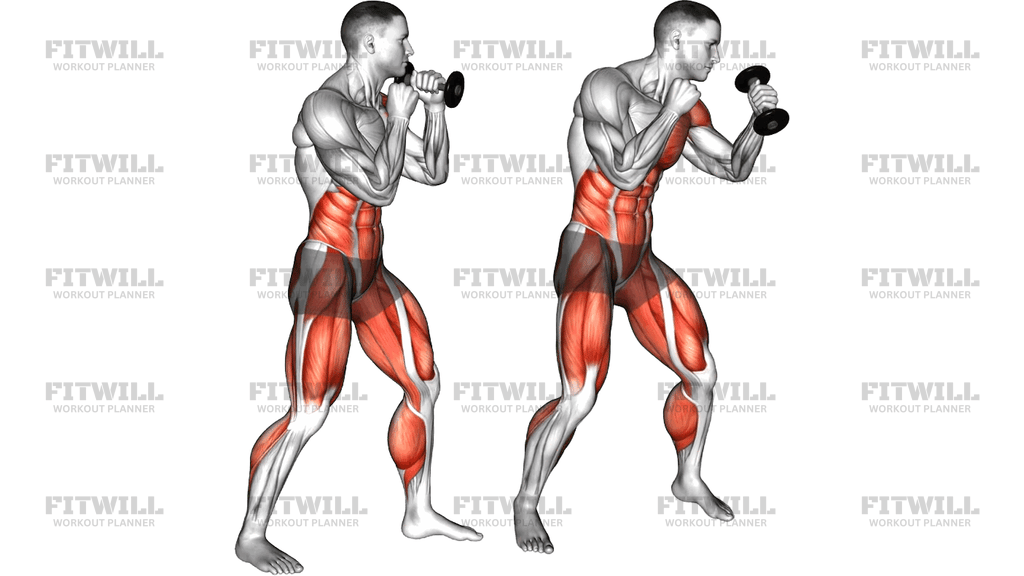
Boxing Full Uppercut (With Dumbbell) takes the classic uppercut punch out of the ring and loads it with a light dumbbell in each hand. You stand in a staggered boxing stance, hold the dumbbells at chin height with your elbows tucked close to your body, and drive each punch upward from hip rotation through the core and out through the fist. Because the weight travels in a rising diagonal path while your torso pivots, this is far more than an arm exercise — it is a rotational, full-body movement.
The biggest beneficiaries are people who want boxing-style conditioning without a heavy bag, as well as lifters looking to train hip-to-shoulder rotation under load. The obliques and deep core do most of the work as they decelerate and reverse each pivot, while the front delts and biceps drive the punch, the forearms and grip control the dumbbells, and the quads, glutes, and calves absorb and return force from the split stance. It also raises your heart rate quickly, so it fits well into circuit or conditioning work.
Setup matters more than most people expect. The stance should be staggered with your lead foot forward and rear heel slightly lifted, knees soft, and weight balanced over the middle of each foot. The dumbbells start at chin level, not hanging at your sides — this keeps the elbows protected and positions the punch to travel upward in front of your body rather than swinging behind your shoulder line.
To execute well, rotate from the hips and trunk first, then let the arm follow. The rear hand's palm turns toward you as the dumbbell rises to roughly eye or forehead height, and the same-side heel lifts and pivots inward, just like a real uppercut. The non-punching hand stays guarding your chin. Avoid leaning back or hyperextending the elbow at the top; the punch stops under control, then returns along the same path.
Common use cases include boxing-inspired conditioning circuits, core-focused rotation work, and warm-ups for combat sports training. Keep the dumbbells light — usually 2 to 8 kg depending on experience — because heavy weights turn the movement into a slow, jerky press that stresses the shoulders and lower back. Quality of rotation always beats the number on the dumbbell.
From a safety standpoint, the two things to watch are elbow position and lower back behavior. Keep the punching elbow under the dumbbell and close to the body on the way up, and keep your ribs stacked over your pelvis so the rotation comes from the hips rather than an arch in the spine. If you feel the movement in your lower back instead of your waist and hips, reduce the weight and slow the tempo before adding reps.
[ Workout Log & Planner ]
Put your next workout in Fitwill
Keep your plan and training log ready when you are.


Instructions
- Stand in a staggered boxing stance with your lead foot forward, rear foot turned out slightly, knees softly bent, and weight spread evenly across both feet.
- Hold a light dumbbell in each hand with a firm overhand-to-neutral grip and raise both fists to chin height, elbows tucked against your ribs.
- Brace your core as if expecting a light punch to the stomach, and keep your gaze forward with your shoulders relaxed down away from your ears.
- Shift your weight onto the rear leg, dip slightly through the knees, and load the rotation before the punch begins.
- Drive through the rear foot so the heel pivots inward and the hips rotate, letting the same-side arm punch upward along a diagonal path in front of your body.
- Finish with the palm facing toward you, the elbow still bent and under the dumbbell, and the dumbbell at roughly eye height — stop short of locking or snapping the elbow.
- Keep the opposite fist guarding your chin throughout so your guard never drops between punches.
- Reverse the path under control, bringing the dumbbell back to chin height as the hips return to square, then repeat on the other side for alternating full uppercuts.
- Exhale sharply on each punch and inhale as the hand returns to guard, keeping the breathing rhythm tied to the rotation.
- After your final rep, lower the dumbbells to your sides before straightening your legs, then reset your stance for the next set.
Tips & Tricks
- The most common mistake is punching with the arm first and letting the hips follow. If the dumbbell rises but your belt buckle barely moves, the core is being bypassed — start each rep by turning the rear hip toward the target line.
- Do not let the elbow flare out wide or drift behind your shoulder as the dumbbell rises. An elbow that passes behind the torso turns the uppercut into an arcing press and loads the shoulder capsule awkwardly.
- Watch for the ribs flaring and the lower back arching at the top of the punch. If you can see your belly button lifting toward the ceiling, drop to a lighter dumbbell and re-tighten the brace before each rep.
- Keep the rear heel alive. A rear foot glued flat to the floor blocks hip rotation and forces the knees and lower back to make up the range — let that heel pivot inward with every punch.
- Choose a dumbbell you could punch with for 30 seconds without slowing down. If the hand speed drops noticeably by the end of the set, the weight is stealing the purpose of the exercise.
- Alternate sides cleanly rather than throwing two punches with one arm. Alternating keeps the obliques working evenly and helps you maintain rhythm instead of rushing one side.
- Stay light on your feet with soft knees between punches. Stiff legs turn the movement into an upright arm swing and remove the leg drive that makes the uppercut feel authentic.
- Keep the non-working hand at your chin the entire time. If it drops to your chest or waist, you are training a lazy guard habit along with the punch.
- If your shoulders fatigue before your waist does, the dumbbells are too heavy or the elbows are drifting — reduce load and refocus on hip rotation driving the fist.
Frequently Asked Questions
What muscles does Boxing Full Uppercut (With Dumbbell) work most?
The obliques and deep core handle most of the rotational work, supported by the front delts and biceps driving each punch. The quads, glutes, and calves contribute through the staggered stance and heel pivot, and the forearms work hard to keep the dumbbells under control.
How heavy should the dumbbells be for Boxing Full Uppercut (With Dumbbell)?
Start with 2 to 4 kg per hand if you are new to the movement, and only go heavier when you can keep punch speed and hip rotation consistent for the whole set. This is a speed and rotation exercise, so a dumbbell that forces slow, grinding reps defeats the purpose.
Is Boxing Full Uppercut (With Dumbbell) suitable for beginners?
Yes, as long as the weight stays light and the tempo stays controlled. Beginners should master the staggered stance and hip rotation with empty hands or very light dumbbells before adding real load.
Why do my lower back and not my abs feel Boxing Full Uppercut (With Dumbbell)?
That usually means the rotation is coming from an arch in the spine instead of a turn at the hips, or the ribs are flaring at the top of the punch. Lighten the load, re-brace the core before each rep, and make sure the rear heel pivots so the hips can rotate freely.
How high should the dumbbell travel at the top of each uppercut?
Aim for roughly eye to forehead height with the elbow still bent and pointing down under the dumbbell. Punching higher than that tends to pull the elbow behind the shoulder and arch the lower back.
Can I do Boxing Full Uppercut (With Dumbbell) without equipment?
Yes — shadowboxing full uppercuts with empty hands is a valid substitute and a good way to learn the hip-to-fist sequencing. You lose the grip and forearm demand, but the rotation and coordination carry over directly.
Should my feet stay planted during Boxing Full Uppercut (With Dumbbell)?
The feet stay in the same staggered positions, but the rear heel lifts and pivots inward with each punch just like a real uppercut. Keeping the rear foot flat blocks hip rotation and shifts stress into the knees and lower back.
How many reps and sets of Boxing Full Uppercut (With Dumbbell) should I do?
For conditioning, work in time blocks of 20 to 40 seconds of alternating punches for 3 to 5 rounds. For strength-endurance, 10 to 15 controlled punches per side for 3 sets works well, resting enough to keep hand speed high.
Is Boxing Full Uppercut (With Dumbbell) safe for the shoulders and elbows?
It is generally safe when the elbow stays bent and under the dumbbell and the weight stays light enough to control the stop at the top. Problems usually come from heavy dumbbells, snapping the arm straight at the end range, or letting the elbow drift behind the torso.