Double Side Step Tricep Kickback
The Double Side Step Tricep Kickback combines a lateral footwork pattern with one of the most reliable arm-shaping movements there is. You stand tall, pin your upper arms against your ribs with elbows bent, then take two quick side steps in one direction while extending your forearms back into the kickback, and take two side steps back the other way as you bend the elbows again. The result is a movement that trains the back of the arms while keeping your legs, hips, and core busy with the stepping rhythm.
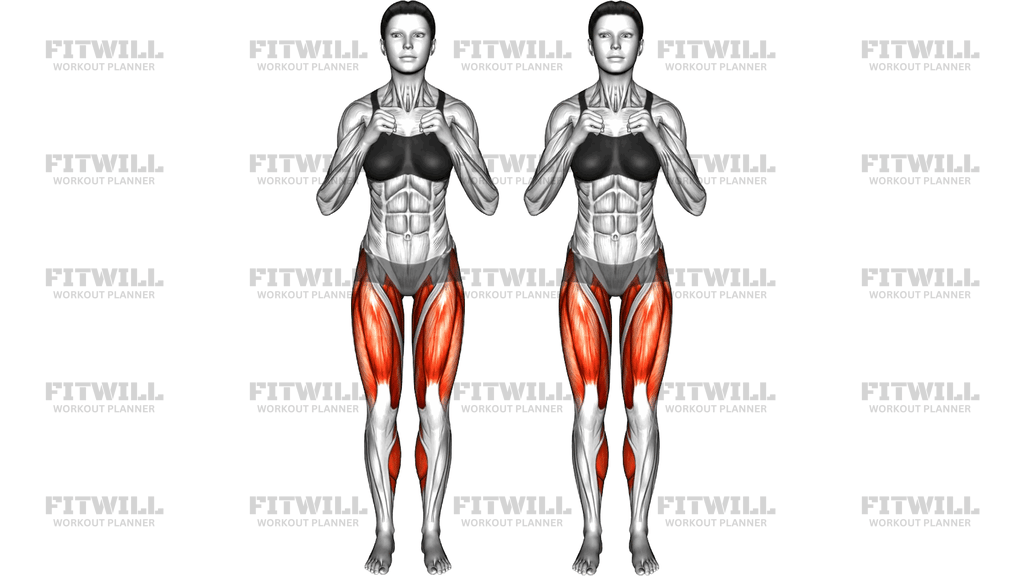
The triceps make up roughly two-thirds of the upper arm's muscle mass, and the kickback is one of the few exercises that places them under load in a fully shortened position. Because the Double Side Step Tricep Kickback asks you to time the arm extension with the footwork, it also challenges coordination and balance in a way a seated kickback never will. Your quads, calves, and glute muscles handle the lateral stepping, while your obliques and deep core stabilize your torso every time your feet leave center.
This setup works well for people who want more from their arm work than standing still. It suits home trainers with a pair of light dumbbells, group fitness formats, circuit training, and warm-ups where you want to raise the heart rate while prepping the upper arms. Because the stepping is low impact and the dumbbells stay light, it is approachable for beginners and still useful for experienced lifters as a finisher or conditioning piece.
Setup matters more here than in a standard kickback. If your elbows drift away from your sides, the extension stops being a triceps movement and starts pulling the shoulders into it. If your steps are sloppy, you will lean and swing the dumbbells instead of extending under control. Keep the stance narrow but stable, the chest lifted, and the elbows locked in place before you take the first step.
To execute it well, move the forearms only. Extend both arms back until they are straight alongside your hips and squeeze the triceps briefly at the top, then bend the elbows slowly as you step back toward the starting side. One full rep travels two steps out and two steps back. Breathe out on the extension, breathe in on the return, and let the rhythm of the steps set the pace of the arms rather than rushing one or the other.
The most common errors are easy to fix: too much weight turns the extension into a body-english swing, and too-wide steps roll the knees inward. Pick dumbbells you could kickback for fifteen or more reps in place, master the pattern standing still, then add the side steps. Stop the set the moment your elbows start to lift or your torso starts to rock, because both signal the triceps are no longer doing the work.
[ Workout Log & Planner ]
Put your next workout in Fitwill
Keep your plan and training log ready when you are.


Instructions
- Stand tall with your feet together or hip-width apart, holding a light dumbbell in each hand with a neutral grip so your palms face your body.
- Bend both elbows to about 90 degrees and pin your upper arms flat against your sides, forearms pointing down toward the floor.
- Brace your core, soften your knees slightly, and lift your chest so you can step side to side without your torso tipping forward.
- Take two quick side steps to the right, stepping out with the right foot and bringing the left foot to meet it.
- As the second step plants, extend both forearms straight back behind you until your arms are fully straight alongside your hips, keeping your upper arms glued to your ribs.
- Pause for a beat and squeeze the triceps at the back of the arm with your palms turned slightly toward the ceiling.
- Take two side steps back to the left while bending your elbows slowly, lowering the dumbbells under control to the start position.
- Exhale as you extend into the kickback and inhale as you step back and bend the elbows.
- Continue alternating directions for your target reps or time, keeping the stepping rhythm and the arm tempo matched.
- Reset your stance and elbow position at the start of each rep if your balance or arm position drifts.
Tips & Tricks
- If the dumbbells swing past your hips at the top of the kickback, you are using momentum from the step rather than triceps strength — slow the extension so it finishes after your feet plant.
- Watch your elbows in a mirror: if they lift away from your ribs during the side step, drop to a lighter dumbbell and re-drill the arm position standing still before adding footwork again.
- Keep your steps moderate in width. Overstriding sideways rolls the knees inward and makes it hard to stay tall through the extension.
- Do not lean your chest toward the stepping side. Imagine a string holding the crown of your head up so the movement stays in the forearms and legs.
- The palm rotation at the end of the kickback is optional, but turning the palms up as the arm straightens helps most people feel a fuller triceps squeeze.
- Aim to finish the kickback on the plant of the second step, not during the first. Timing the squeeze to the plant keeps the move crisp instead of floppy.
- If your shoulders shrug toward your ears, actively press your shoulder blades down and back before each extension.
- For a low-impact or equipment-free version, perform the same double side step pattern with bent-elbow arm sweeps or use a light resistance band anchored in front of you.
- This is a coordination drill as much as a strength drill — practice it at half speed for a session or two before chasing reps or load.
Frequently Asked Questions
Which muscles does the Double Side Step Tricep Kickback work?
The triceps are the primary mover during the kickback extension. The side stepping brings the quads, calves, and glute muscles into play, while the obliques and core stabilize your torso with every change of direction.
Is the Double Side Step Tricep Kickback suitable for beginners?
Yes, as long as you start with very light dumbbells or no weight at all. Practice the kickback standing still first, then add the double side step once your elbow position stays consistent.
Can I do the Double Side Step Tricep Kickback without dumbbells?
You can, though the triceps will get more of a coordination and endurance stimulus than a strength one. A light resistance band held behind your back or looped under your feet is a good way to add resistance without dumbbells.
Why do the elbows have to stay pinned to my sides during this exercise?
The triceps only extend the elbow, so any elbow drift turns the movement into a shoulder exercise. Keeping the upper arms fixed against your ribs ensures the extension actually loads the back of the arm.
How heavy should the dumbbells be for the Double Side Step Tricep Kickback?
Choose a weight you could kickback for fifteen or more strict reps standing in place. Because you are moving your feet at the same time, anything heavier usually turns into swinging.
Should the arm extension happen on the first step or the second step?
Aim to finish the extension as the second step plants. Extending on the first step usually means the dumbbells are swinging with momentum instead of being controlled by the triceps.
Is the Double Side Step Tricep Kickback safe for my knees?
For most people, yes, since the stepping is low impact and the knees stay soft rather than deep in flexion. Keep your steps moderate, your knees tracking over your toes, and avoid the exercise if a current knee issue makes lateral stepping painful.
What can I substitute if the side stepping is too difficult to coordinate?
Perform a standing tricep kickback with the feet planted, or use a static staggered stance. Once the arm pattern feels automatic, reintroduce the double side step at half speed.
How do I breathe during the Double Side Step Tricep Kickback?
Exhale as you extend both arms back into the kickback and inhale as you step back to the start and bend the elbows. Matching breath to the step rhythm keeps the pace controlled.
Where should the Double Side Step Tricep Kickback fit in my workout?
It works well as a mid-circuit conditioning and arm movement, a warm-up finisher, or a high-rep finisher after heavier pressing work. Because the load stays light, place it where a raised heart rate will not compromise your main lifts.