Dumbbell Renegade Row Walk
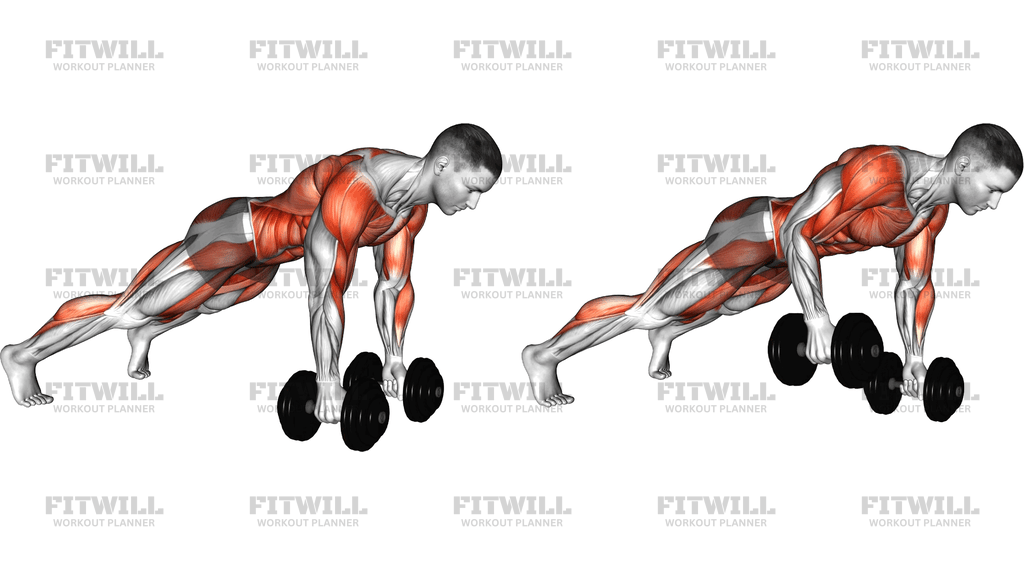
The Dumbbell Renegade Row Walk takes the familiar renegade row position — a high plank with each hand gripping a dumbbell — and turns it into a moving challenge. Instead of rowing in place, you step one hand forward at a time, crawling the dumbbells along the floor while your body travels with them. It blends the shoulder stability of a plank walkout with the anti-rotation demands of a renegade row, making it one of the most honest tests of trunk control you can do with just a pair of weights.
This movement is especially useful for lifters who already handle planks and push-ups comfortably but want to build the kind of midline strength that transfers to heavy squats, deadlifts, and presses. Because each hand leaves the floor independently, your obliques, deep core, and hip stabilizers have to fight the twist every single step. The shoulders, particularly the serratus and deltoids, work to keep the torso from sagging as the weight shifts from arm to arm, and the legs stay active to keep the hips from hiking.
Setup matters more here than in most core drills. Use hex-shaped dumbbells with flat sides so they will not roll out from under your hands, and pick a weight light enough to control but heavy enough to feel planted — many people start with 10 to 20 pounds per hand. A wider foot stance gives you a more stable base; as you improve, you can bring the feet closer to make the exercise harder. Your hands should sit directly under your shoulders at the start, with the wrists stacked and the elbows neither flared nor locked.
To execute it well, brace your core as if you were about to take a light punch, squeeze your glutes, and then step one dumbbell forward a short distance, followed by the other. Your hips should stay level and square to the floor throughout — no rocking side to side, no letting one hip spike toward the ceiling. Move in small, deliberate steps rather than long lunges forward, and keep your neck neutral by looking at a spot on the floor slightly ahead of your hands.
The Dumbbell Renegade Row Walk fits well as a finisher after upper body work, as a warm-up primer on pressing days, or as a standalone core block in circuit training. It is also a smart regression-friendly option: if you cannot hold a clean plank position while moving, you can practice the walk on lighter dumbbells or take fewer, shorter steps per set.
The main safety point is spinal position. If your lower back starts to arch or your hips start to sag as you fatigue, end the set rather than pushing through it — the exercise only trains the right muscles while your trunk stays rigid. Breathe steadily rather than holding your breath, and step the dumbbells with control instead of dropping your hand weight onto them with each step.
[ Workout Log & Planner ]
Put your next workout in Fitwill
Keep your plan and training log ready when you are.


Instructions
- Place a pair of hex dumbbells on the floor about shoulder-width apart and kneel behind them so you can grip each handle with the knuckles facing forward.
- Kick your legs back into a high plank with your hands on the dumbbells directly under your shoulders and your feet set wider than hip width for a stable base.
- Squeeze your glutes, brace your abs firmly, and form one straight line from your heels through your hips to your head before you move.
- Shift your weight slightly onto the left hand, then step the right dumbbell forward 6 to 12 inches, placing it down gently rather than dropping it.
- Bring the left dumbbell forward to match, keeping your shoulders square to the floor and your hips level as each hand takes its turn.
- Continue stepping one hand at a time to walk yourself forward across the floor, taking small controlled steps so your torso never twists.
- Keep your elbows soft but not bent, letting the shoulders stay stacked over the loaded wrist on each side.
- Breathe in a steady rhythm throughout — inhale on the brace, exhale as you step — instead of holding your breath.
- To finish, walk to your planned distance or step count, then crawl the dumbbells back or carefully release one at a time and step your feet in toward your hands to stand up.
- Reset your brace fully before the next set, and recheck that your hips have not drifted into a sagging or piked position.
Tips & Tricks
- The most common mistake is hip rotation — if your hips swing toward the side of the stepping hand, widen your feet slightly and slow the step down until the twist disappears.
- Avoid setting the dumbbells down with a thud each step; lowering them quietly forces you to control the descent and keeps the wrist and shoulder safe.
- If your lower back arches partway through the set, that is your cue that the core has fatigued — end the set there instead of letting the lumbar spine take over.
- Round or adjustable dumbbells with loose plates can shift under your hands; hex dumbbells or dumbbells with locked plates are the safer choice for this walk.
- Think about pushing the floor away with the support arm rather than passively hanging on it — this keeps the serratus and shoulder blade engaged and stops the chest from collapsing.
- Shorter steps make the drill harder, not easier: small steps keep your center of mass over the loaded hand longer, which increases the anti-extension demand.
- Do not let your head drop or crank up to look forward; keep a neutral neck by fixing your eyes on the floor a foot or so ahead of your hands.
- If your wrists get sore, grip the handles slightly deeper into the palm and keep the knuckles stacked over the wrist rather than letting the hand fold back.
- Progress by bringing your feet closer together over time, or by pausing one full breath with each hand lifted before stepping it forward.
Frequently Asked Questions
Which muscles does the Dumbbell Renegade Row Walk work the most?
The deep core and obliques do most of the work to keep your trunk from twisting while each hand steps forward. Your shoulders, lats, glutes, and grip all contribute as supporting muscles.
Is the Dumbbell Renegade Row Walk suitable for beginners?
Yes, as long as you can already hold a solid high plank for about 30 seconds. Start with light dumbbells, a wide foot stance, and short walks of just a few steps before extending the distance.
How does the walk differ from a standard renegade row?
A renegade row pulls one dumbbell off the floor toward your ribs while you hold the plank, whereas the walk alternates stepping each dumbbell forward so your whole body travels. Both challenge anti-rotation, but the walk adds locomotion and continuous weight shifting.
Why do my hips rock side to side during the walk?
That usually means your steps are too long or your feet are too close together. Widen your stance, shorten each step, and think about keeping both hips facing the floor as the weight shifts.
Can I add an actual row to the Dumbbell Renegade Row Walk?
You can pause after each step and row the dumbbell to your hip, but only if you can keep your hips completely square while doing it. Adding rows before you own the plank position usually turns the drill into a twisting mess.
What kind of dumbbells work best for this exercise?
Hex dumbbells with flat faces are ideal because they stay put under your hands. Round or adjustable dumbbells can roll or shift, which makes each step unpredictable.
How far should I walk in one set?
A good starting dose is 8 to 12 total hand steps, or about 10 to 15 feet, for two to three sets. Progress by adding steps or narrowing your foot stance rather than by grabbing heavier dumbbells right away.
What can I substitute if I do not have dumbbells?
A bodyweight plank walk on your palms trains the same forward-stepping pattern, though you lose the grip and wrist-stacking challenge. Kettlebells with flat, stable bases can also work if the handles sit low enough.
Should my lower back feel this exercise?
No — the work should sit in your abs, obliques, and shoulders. If your lower back fatigues or arches, your brace has given out, so end the set and rest rather than pushing through.
How do I breathe during the Dumbbell Renegade Row Walk?
Keep breathing continuously rather than holding your breath: brace your core, then exhale gently as you step each hand forward. Holding your breath for the whole walk spikes tension and blood pressure without improving control.