Standing Forward Bent Twist
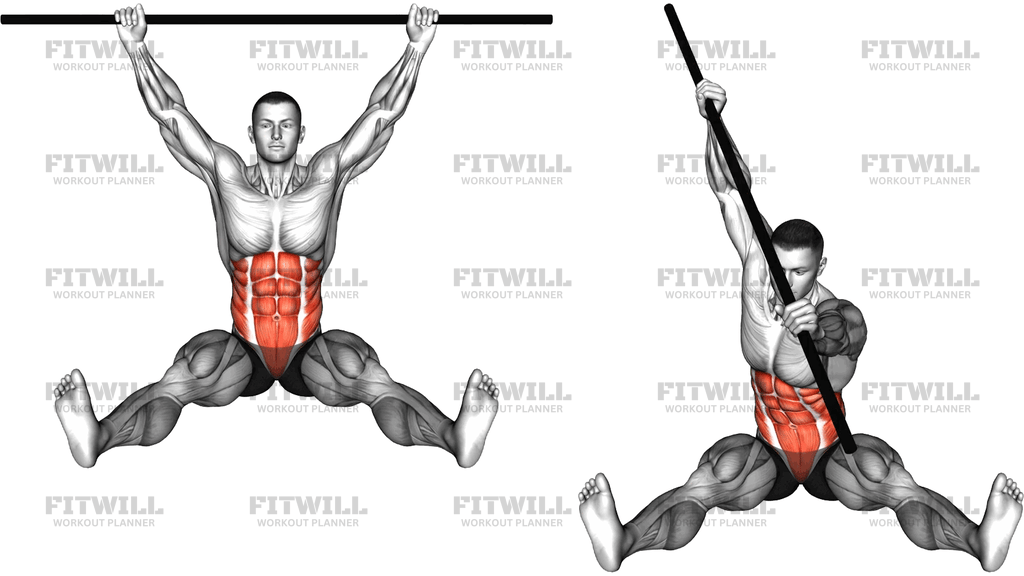
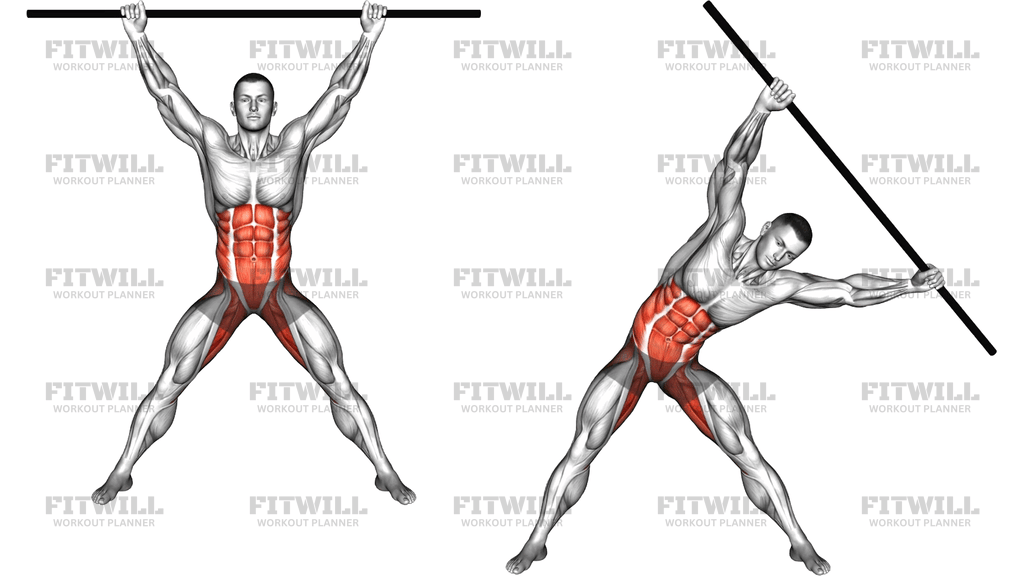
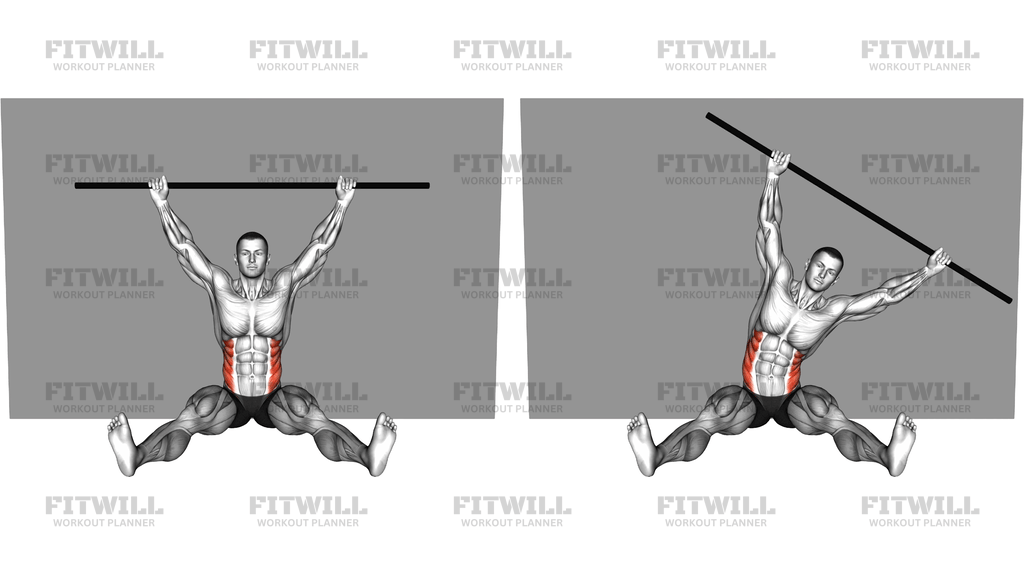
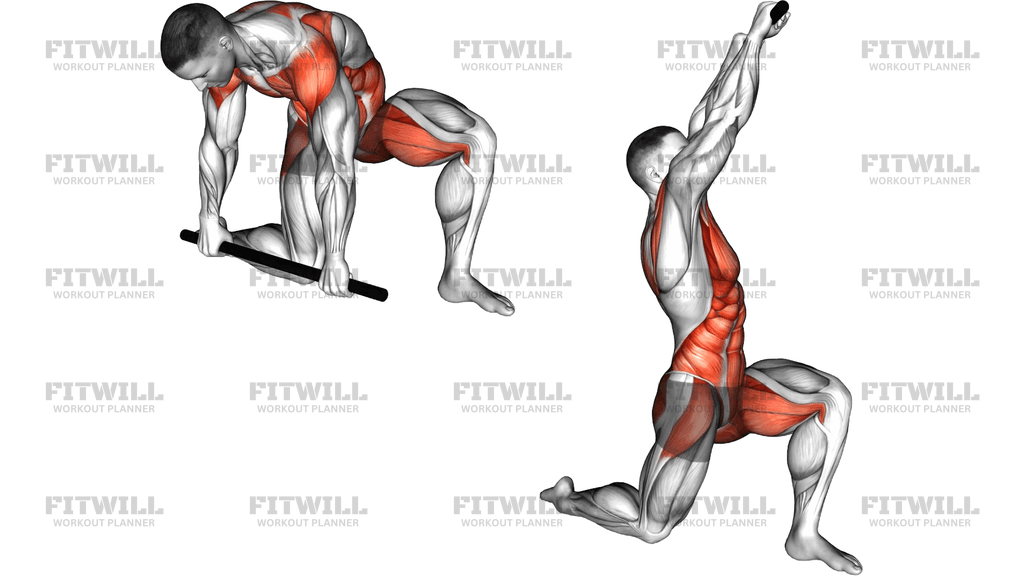
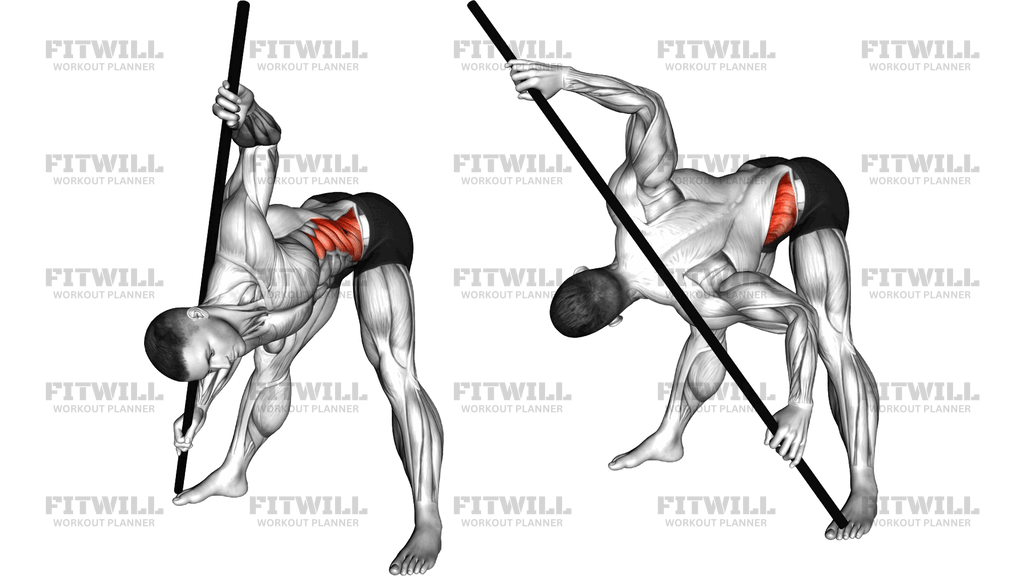
The Standing Forward Bent Twist is a rotational drill performed in a wide-legged forward hinge, using a simple stick or dowel held in both hands to guide the spine through a large twisting arc. One hand stays anchored low near the foot while the other arm lifts and reaches diagonally overhead, rotating the torso from the waist rather than the arms. The highlighted area along the side of the trunk tells you exactly what this movement is about: the obliques, which rotate and laterally flex the spine under load from the bent-over position.
Because the hips are held in a fixed, wide stance and the torso is hinged forward, the rotation has to come from the thoracic spine and waist instead of the pelvis swinging around. That makes this a useful drill for anyone whose rotational mobility is limited by stiff lats, tight obliques, or a locked-up upper back. Throwers, golfers, tennis players, and lifters who struggle to keep a braced, neutral spine under rotational stress all benefit from working this pattern slowly and deliberately.
Setup matters more than range here. A stance roughly one and a half shoulder-widths wide gives you a stable base so the twist travels up through the trunk instead of collapsing into the hips or knees. The stick acts as a reference line: when it rotates from vertical toward horizontal across your body, you can see whether the movement is coming from the waist or whether you are cheating by bending the elbows and swinging the arms.
To execute it well, hinge forward with a long, relatively flat back, soft knees, and the stick gripped wide. Keep the low hand firm and quiet while the high arm drives the rotation, letting your head and eyes follow the stick as it sweeps up and across. Move to a comfortable end range, pause briefly, and reverse the arc under control. The goal is a smooth, sweeping rotation, not a forced yank at the top.
Use the Standing Forward Bent Twist as a warm-up before rotational training, as a mobility reset between heavy sets, or as a cooldown stretch after sessions that load the waist and lower back. Keep the range moderate at first, especially if you feel any pinching in the lower back, and let the range grow over weeks rather than forcing depth in a single session.
[ Workout Log & Planner ]
Put your next workout in Fitwill
Keep your plan and training log ready when you are.


Instructions
- Stand with your feet roughly one and a half shoulder-widths apart, toes turned out slightly, and hold a stick in both hands with a grip wider than your shoulders.
- Hinge forward at the hips until your torso is angled down toward the floor, keeping your back long and your knees softly bent rather than locked.
- Let the stick hang toward vertical with one hand positioned low near your lead foot and the other hand up near your opposite shoulder.
- Brace your trunk lightly and keep your weight spread evenly across both feet so your hips stay square and still.
- Drive the rotation from your waist: pull the low hand down and across while the high arm lifts, sweeping the stick diagonally until it crosses your body and points up and away.
- Follow the stick with your head and eyes so the twist travels through your upper back instead of stopping at the neck.
- Pause for a breath at the end range, feeling the stretch along the side of the waist and upper back.
- Reverse the arc slowly, letting the stick travel back toward vertical without dropping the hinge or letting the hips rotate.
- Breathe steadily throughout: inhale as the stick rises, exhale as it sweeps down and back.
- Complete all repetitions on one side, then reset your stance and hinge before switching to the other side.
Tips & Tricks
- If your low hand drifts away from your foot, the rotation is coming from your shoulders instead of your waist; re-anchor that hand before each rep.
- A rounded, collapsed hinge shortens the twist and dumps stress into the lower back. Think about reaching the crown of your head toward the floor to keep the spine long.
- Do not chase height with the top arm by bending the elbow and cranking the stick. If the arm bends, the range you gained is fake; shorten the sweep and rebuild it with a straight arm.
- Keep your knees soft but still. Any side-to-side weight shift means the hips are rotating to make up for a stiff waist.
- The stick should stay in one straight line through the whole arc. If it wobbles or bends across your grip, slow the tempo down.
- Exhale into the end range to buy a little extra rotation; holding your breath usually tightens the obliques you are trying to lengthen.
- If your hamstrings limit the hinge, bend the knees more rather than rounding your back to reach deeper.
- Expect one side to rotate further than the other. Match your weaker side's range rather than maxing out the dominant side.
Frequently Asked Questions
What muscles does the Standing Forward Bent Twist work?
The obliques on the sides of the waist do most of the work, rotating and side-flexing the trunk while the torso is hinged. The lower back, upper back, and shoulders assist as you control the stick through the arc.
Why does the Standing Forward Bent Twist use a stick instead of being done empty-handed?
The stick acts as a visual and physical reference line, so you can see whether the rotation is sweeping evenly through the waist or whether your arms are doing the moving. It also encourages a straight-arm path that keeps the tension on the trunk.
How wide should my stance be for the Standing Forward Bent Twist?
Roughly one and a half shoulder-widths works for most people. The wide base keeps your hips from rotating, which forces the twist to come from the waist and upper back where you want it.
Is the Standing Forward Bent Twist suitable for beginners?
Yes, as long as the range stays comfortable and the hinge is controlled. Beginners should use a lighter, shorter sweep and focus on keeping the low hand anchored before trying to increase the arc.
Why do I feel the Standing Forward Bent Twist in my lower back instead of my waist?
That usually means your hinge has collapsed into a rounded back or your hips are twisting to compensate. Re-set with a longer spine, softer knees, and a smaller arc so the rotation travels through the obliques.
Should the Standing Forward Bent Twist be done fast or slow?
Slow and controlled. A sweeping tempo with a brief pause at the end range builds usable rotational mobility, while fast whipping tends to load the lower back with momentum.
Can I substitute a broomstick or resistance band for the Standing Forward Bent Twist?
A broomstick or any light dowel works exactly the same way. A band changes the feel because it pulls rather than guides, so it is a reasonable option but less useful for checking your rotation path.
How many reps and sets of the Standing Forward Bent Twist should I do?
Five to eight slow sweeps per side, for one to three sets, fits most warm-up or cooldown routines. Treat it as a mobility drill, so go by quality of movement rather than fatigue.
Is it safe to do the Standing Forward Bent Twist with a history of back problems?
If you have a current or past back injury, check with a qualified professional before adding loaded rotation. Keep the range small, stay pain-free, and stop immediately if the movement produces any sharp or radiating symptoms.