Bear Plank Floating Leg Extension
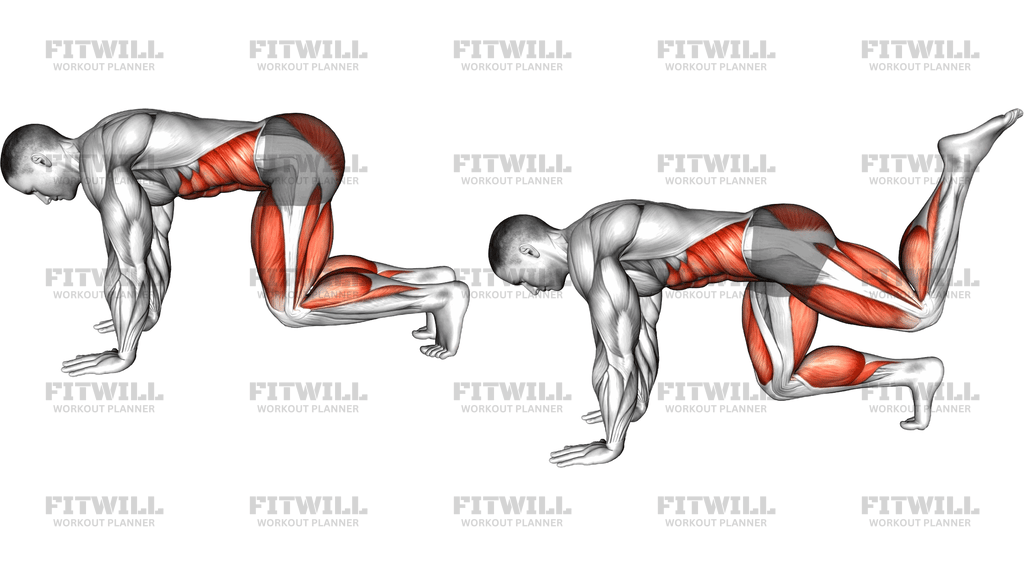
The Bear Plank Floating Leg Extension is a body weight core and glute exercise that starts from the bear plank position, where you hover on hands and the balls of your feet with your knees lifted just off the floor. From that hold, one leg stays floating while the other extends back and up behind you with the knee bent, so the foot travels toward the ceiling. The leg then returns to the hovered bear position, and you repeat before switching sides.
This movement is useful for anyone who wants to train hip extension without loading the spine with a barbell or dumbbell. Because the supporting knee never touches the ground during the set, your trunk has to resist both rotation and sagging the entire time. The extending glute drives the leg up, the hamstrings assist, and the deep core, obliques, and shoulder stabilizers hold the frame steady.
The setup matters more than most people expect. In the bear plank your knees sit directly under your hips, your back stays flat, and your weight is balanced evenly between hands and the toes of both feet. If your hips drift sideways or your lower back rounds or arches when the leg lifts, the glutes stop doing the work and the lumbar spine starts absorbing stress. Keeping the range modest and controlled protects that position.
To execute it well, brace your core as if bracing for a light punch, then push one foot back and up by squeezing that glute, letting the knee stay bent at roughly 90 degrees. Think about driving the heel toward the ceiling rather than swinging the leg long and high. Pause briefly at the top, lower the knee back to its hovered position under control, complete your repetitions on one side, then switch legs.
You will see this exercise in warm-ups for lower body training, in glute-focused circuits, and in core routines for people who find bird dogs or quadruped hip extensions too easy. It is also a solid choice for home training because it needs only a small patch of floor and, ideally, an exercise mat for comfort under the hands and toes. For safety, stop the set as soon as your hips start twisting or your wrists and shoulders feel strained; fatigued form in this position tends to fail at the trunk first.
[ Workout Log & Planner ]
Put your next workout in Fitwill
Keep your plan and training log ready when you are.


Instructions
- Place an exercise mat on the floor and set up on all fours with your hands under your shoulders and your knees under your hips.
- Tuck your toes, press the floor away, and lift both knees an inch or two off the mat so you hover in a bear plank with a flat back.
- Brace your core and squeeze your glutes lightly so your hips stay level and your lower back stays neutral before any leg moves.
- Keep your weight balanced across both hands and both feet, with your neck relaxed and your gaze down toward the mat.
- Exhale and extend one leg back and up behind you, keeping the knee bent around 90 degrees and driving the heel toward the ceiling by squeezing that glute.
- Pause for a second at the top with the leg floating, making sure your hips have not rotated open or dropped toward the floor.
- Inhale and lower the leg under control until the knee returns to its hovered starting spot, without letting it touch down.
- Complete all repetitions on one leg, then switch sides and match the rep count with the other leg.
- Between sets, rest your knees down on the mat, shake out your wrists, and reset your brace before the next round.
Tips & Tricks
- The most common mistake is extending the leg too high, which forces the lower back to arch; cut the height until your hips stay square to the floor.
- If your hips twist open as the leg extends, imagine a glass of water balanced on your lower back and do not spill it.
- Keep the working knee bent at about 90 degrees; straightening the leg turns this into a longer-lever hold that shifts work away from the glute and into the lumbar area.
- Check that both knees stay lifted throughout the set; if the support knee drops to the mat, you have lost the bear plank and the anti-rotation demand.
- Spread your fingers and press evenly through your palms, since the wrists often take on extra load when the core fatigues.
- Move at a tempo of about two seconds up and two seconds down; fast swings use momentum instead of muscle.
- If you feel it only in your hip flexors of the supporting leg, shorten the hold time per set and build up gradually.
- Start with 5-8 reps per side and prioritize a rock-still torso over total volume.
- A mirror to your side can help you confirm your back stays flat and your hips stay level from the first rep to the last.
Frequently Asked Questions
What muscles does the Bear Plank Floating Leg Extension work?
The main mover is the glute of the extending leg, with the hamstrings assisting hip extension. Meanwhile the deep core, obliques, and lower back work to keep your trunk from rotating or sagging.
Why does the knee stay bent during the leg extension?
The bent knee shortens the lever, which keeps the emphasis on squeezing the glute rather than on lumbar extension. It also makes the top position easier to hold with square hips.
Is the Bear Plank Floating Leg Extension suitable for beginners?
Yes, but start by simply holding the bear plank with both knees hovered until you can keep a flat back for 20-30 seconds. Then add the single-leg extension with a small, controlled range.
My hips rotate every time I extend my leg. How do I fix that?
Reduce the height of the lift, re-brace your core before each rep, and think about pressing the supporting foot firmly into the mat. Slowing the tempo also makes it easier to keep both hip points facing the floor.
Can I do this exercise without a mat?
Yes, on carpet or grass the exercise works fine. On a hard floor a mat makes the hovering toes and palms much more comfortable over a full set.
How does this differ from a donkey kick?
A donkey kick is done with the support knee resting on the floor, so the core does far less work. Here the support knee floats the whole time, adding an anti-rotation and anti-extension demand on top of the glute drive.
How many reps and sets should I do?
Two to three sets of 5-10 controlled reps per side works well as a glute activation drill or as part of a core circuit. Stop the set once your hips start twisting, since clean reps beat extra volume here.
What can I use instead if the bear position bothers my wrists?
Try the same leg extension from a standard quadruped position with the support knee resting on the mat, or perform it on fists or with hands elevated on a low bench to reduce wrist extension.
Should I feel this in my lower back?
You should feel mild work in the trunk muscles, but not strain or pinching in the lumbar spine. If your lower back hurts, the leg is likely lifting too high or arching your back, so lower the range and re-brace.