Weighted Dumbbell Kneeling Sissy Squat
The Weighted Dumbbell Kneeling Sissy Squat is a kneeling body-extension exercise that loads the front of the thighs from an angle most squatting variations never touch. You start in a tall kneeling position with a dumbbell held against your chest, then lean your entire body backward as one rigid line from your knees to your head while your hips stay fully extended. The quadriceps work hard to control that backward tilt and to pull you back upright, which makes this one of the most direct ways to challenge the quads and hip flexors without any squat rack or machine.
The kneeling setup is what separates this from the classic standing sissy squat. Because both knees stay planted on the floor, the knee joint is never loaded through a deep bend, which makes the movement feel far friendlier to the knees while still creating a long, demanding lever arm. The dumbbell held at the chest shortens the distance the load travels and shifts your center of mass, letting you add meaningful resistance without your lower back or arms taking over the work.
This exercise suits lifters who want extra quad and hip flexor volume without heavy axial loading, home trainees with limited equipment, and anyone who struggles to feel their quads in conventional squats. It also carries over well to jumping, sprinting, and kicking-style movements, since the hip flexors and quads are trained together through a long range. Athletes recovering from heavy squatting blocks often use it as a lower-stress way to keep the front of the thigh working.
Setup quality matters more here than in most knee-dominant drills. Your knees, hips, and shoulders should stack in a vertical line at the top, and your ribs should stay down over your pelvis. If your hips drift back toward your heels during the lean, the quads lose tension and the lower back picks up the job instead. Thinking of your body as a plank that pivots at the knees is the most reliable mental cue.
To execute it well, squeeze the glutes and brace the trunk before you move, then lower backward slowly under control rather than letting gravity tip you. Go only as far back as you can reverse without jerking or arching the lower back, drive the top of the body forward again, and finish each rep in the same tall, stacked position you started from. Most people should begin with a light dumbbell or no weight at all and build range gradually before chasing load.
A cushioned surface under the knees is strongly recommended, and stopping the set the moment your form breaks down is the smartest approach. The movement looks simple but the eccentric demand is real, so expect your thighs to work harder than the short range suggests.
[ Workout Log & Planner ]
Put your next workout in Fitwill
Keep your plan and training log ready when you are.


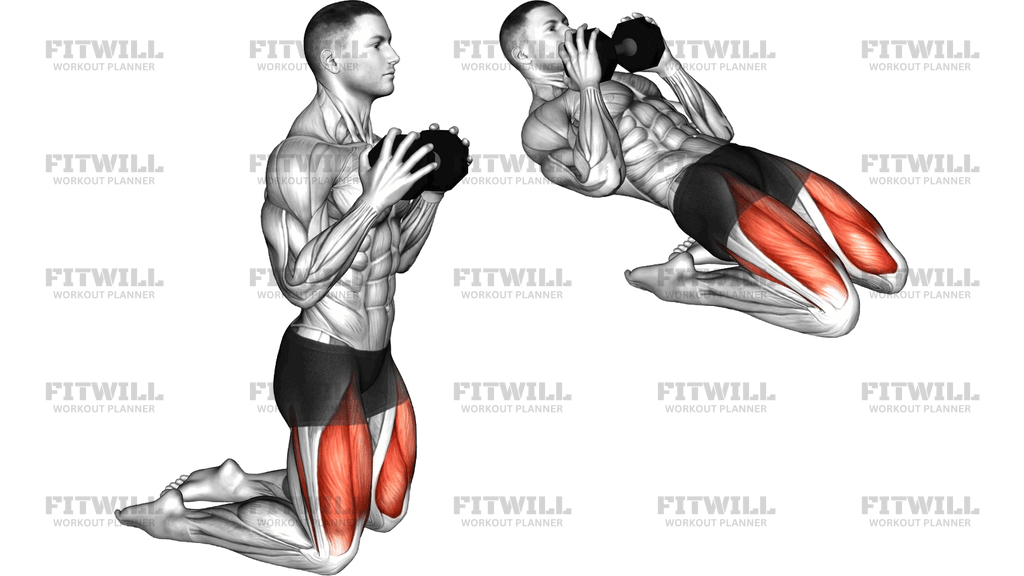
Instructions
- Place an exercise mat on the floor and kneel down onto both knees, with your shins resting flat and your feet relaxed behind you.
- Hold a dumbbell with both hands at chest height, cupping it close to your body so it stays anchored against your sternum.
- Stack your body upright: knees directly under your hips, hips directly under your shoulders, head neutral, and eyes forward.
- Squeeze your glutes and brace your abdominal wall so your hips are fully extended and there is a straight line from your knees through your head.
- Inhale, then slowly lean your entire body backward from the knees, keeping the hips locked out and the dumbbell glued to your chest.
- Descend under control until your body is angled back as far as you can manage without your hips collapsing or your lower back arching.
- Pause briefly in the leaned-back position, keeping tension across the fronts of your thighs.
- Pull your torso forward from the top of the body to return to the tall kneeling position, exhaling on the way up.
- Complete the rep fully upright before starting the next one, and reset your glute squeeze and brace between reps if you feel your posture slip.
Tips & Tricks
- The most common failure is the hips drifting backward toward the heels during the lean, which turns the drill into an arching motion. Cue yourself to push the hips forward and keep a straight knee-to-head line for the whole rep.
- Keep the dumbbell pressed against your chest rather than letting it drift forward or away. A dumbbell that travels away from the body multiplies the lever arm and can yank you out of position at the bottom.
- If the backward lean tips over into a lower back arch, shorten the range. End the descent earlier and only extend the range once the upright line stays intact.
- Start with a very light dumbbell or none at all. The eccentric load on the quads and hip flexors is larger than it looks, and adding weight before your range is solid usually shows up as a collapsing torso.
- Move slowly on the way back down and faster on the way up. Rushing the descent is the usual reason people lose the straight-body position mid-rep.
- Kneel on a mat or padded surface rather than bare flooring. Knee discomfort makes people subconsciously shift their hips back to unload the kneecaps, which ruins the movement.
- Do not let your head drop forward or look at your knees as you lean back. Keep the neck in line with your torso so the whole body moves as one rigid piece.
- Breathe in at the top, hold the brace through the descent, and exhale on the pull back up. Exhaling too early usually coincides with losing the glute squeeze.
- If you cannot feel your quads working, the likely cause is that your hips are flexing during the lean. Film one set from the side and check that your thigh stays in line with your torso.
Frequently Asked Questions
Which muscles does the Weighted Dumbbell Kneeling Sissy Squat target?
The quadriceps are the primary muscle, working to control the backward lean and return you upright. The hip flexors work hard as well, with the abs and glutes stabilizing the trunk and holding the hips extended.
How is the Weighted Dumbbell Kneeling Sissy Squat different from the standing sissy squat?
In the kneeling version both knees stay planted on the floor and the body pivots backward from the knees, so the knee joint is not loaded through a deep bend. The standing sissy squat involves the knees traveling far forward over the toes, which is far more demanding on the knees.
Can beginners do the Weighted Dumbbell Kneeling Sissy Squat?
Yes, but beginners should start with no weight and a short range of motion. Once a full lean-back can be performed with a straight knee-to-head line, a light dumbbell held at the chest is an easy way to progress.
Why hold the dumbbell at the chest instead of at the sides or overhead?
Holding the dumbbell against the chest keeps the load close to your center of mass, so it adds resistance without pulling your torso out of alignment. A weight at arm's length would lengthen the lever and make the straight-body position much harder to hold.
How far back should I lean during the Weighted Dumbbell Kneeling Sissy Squat?
Lean back only as far as you can while keeping the hips fully extended and the lower back from arching. For most people that is roughly a 30 to 45 degree angle from vertical, and range should grow gradually over weeks.
What is the most common mistake with this movement?
Letting the hips fold back toward the heels during the descent, which shifts work away from the quads and hip flexors and into the lower back. Keep the glutes squeezed and move the whole torso as one rigid block.
What can I use if I do not have a dumbbell?
A kettlebell or weight plate held to the chest works the same way, and a bodyweight version is a solid substitute while you build range. A resistance band anchored behind you can also provide counterbalance if the lean feels unstable.
Is the Weighted Dumbbell Kneeling Sissy Squat safe for the knees?
The knees stay flexed at roughly 90 degrees on a padded surface and do not travel through a loaded deep bend, so many people find it easier on the knees than deep squatting. If kneeling itself is uncomfortable or you have a current knee issue, choose a different quad exercise and stop if you feel pain.
How many sets and reps should I do?
Because the movement is heavily eccentric, moderate reps work best, something like 3 to 4 sets of 8 to 15 controlled repetitions. Prioritize a slow descent and a clean upright finish over adding weight.