Standing Spine Rotation Chest Opener
The Standing Spine Rotation Chest Opener is a body-weight stretch that combines a fixed, crossed-leg stance with a deliberate rotation of the upper body away from the hips. One arm extends straight out to the side at shoulder height while the other rests across the front of the waist, anchoring the lower body so the twist travels through the thoracic spine rather than the pelvis. As you rotate, the chest muscles lengthen across the front of the torso while the obliques on the trailing side work to control and deepen the turn.
This movement is especially useful for anyone who spends long hours sitting at a desk, driving, or training pressing exercises like bench presses and push-ups. Those activities keep the shoulders rounded forward and the chest shortened, and this stretch directly reverses that posture by opening the front of the shoulders and sternum. Because the legs are crossed and the hips stay quiet, it also gives the obliques and deep core muscles a gentle rotational stretch that is hard to isolate in most standing movements.
The crossed stance is the detail that makes this version work. By placing one foot over the other, you effectively lock the pelvis in place, so when the upper body turns, the rotation has to come from the spine and ribcage. The extended arm acts as a lever and a guide: reach it back at shoulder height and the pectorals and front shoulders get a full opening, but let it drift low or bend the elbow and the stretch loses its line of pull.
To perform it well, keep the movement slow and rotational rather than bouncy. Turn the head with the extended arm so the neck stays neutral relative to the rest of the spine, and breathe steadily through the hold instead of bracing. You should feel a broad stretch across the chest and up the side of the waist on the trailing side, with no pinching in the lower back or shoulder joint.
Use this stretch as a warm-up before upper-body training, as a reset between long blocks of sitting, or as part of a cool-down after pressing days. It needs no equipment and very little space, which makes it an easy addition to office breaks and travel routines. Two to three holds of twenty to thirty seconds per side is enough for most people, and the stretch should ease slightly as the tissues lengthen — if it sharpens instead, back out of the range.
[ Workout Log & Planner ]
Put your next workout in Fitwill
Keep your plan and training log ready when you are.


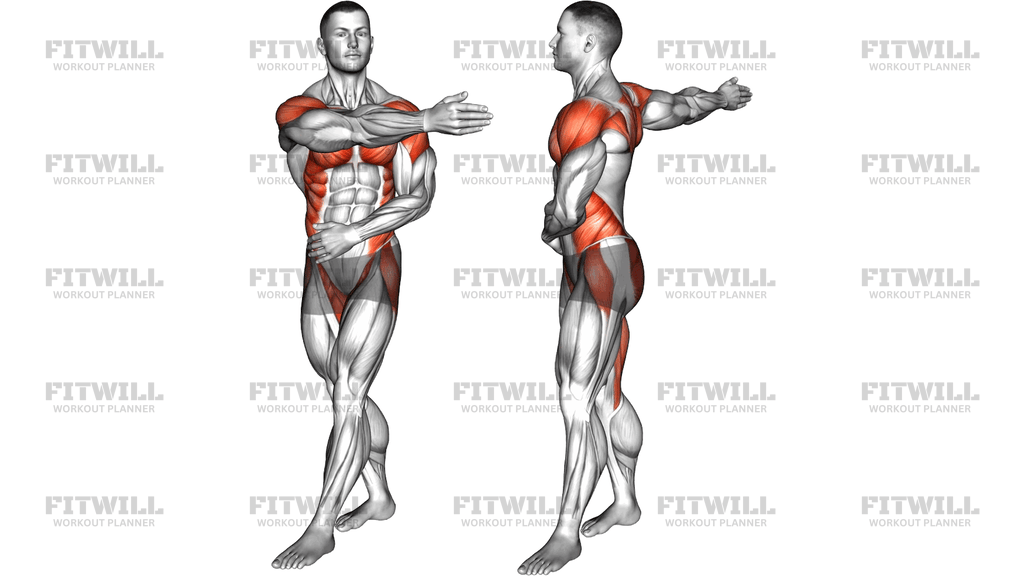
Instructions
- Stand tall with your feet together, then cross one foot over the other so the legs are touching and the pelvis is squared forward.
- Extend one arm straight out to your side at shoulder height, palm open and fingers reaching back.
- Place your other hand across the front of your waist or hip to anchor the lower body and keep the pelvis from turning.
- Brace lightly through the core and take a tall posture through the spine before you begin the rotation.
- Rotate your upper body in the direction of the extended arm, letting the ribcage turn while the crossed legs and hips stay facing forward.
- Turn your head to follow the extended hand so the neck stays in line with the rest of your spine.
- At the end of the rotation, hold the position for twenty to thirty seconds, feeling the stretch across the chest and along the side of the waist.
- Keep breathing steadily throughout the hold; exhale slowly to soften into a slightly deeper range if it feels comfortable.
- Rotate back to center in a slow, controlled manner and release the crossed stance.
- Switch the crossing of the feet and repeat the full sequence on the opposite side for a matched hold.
Tips & Tricks
- The most common mistake is letting the back foot and pelvis rotate with the torso, which turns this into a hip movement. Press the outside edge of the back foot into the floor to keep the lower body fixed.
- If you feel pinching at the front of the shoulder, lower the extended arm an inch or two below shoulder height rather than forcing the reach higher.
- Do not yank or bounce at the end of the rotation; the crossed stance gives you plenty of leverage, so a small additional turn goes a long way.
- Keep both knees soft instead of locking them. Locked knees, especially with the legs crossed, make balance harder and reduce blood flow comfort during the hold.
- Check that the stretch is felt across the chest and side of the waist, not as a twist in the lower back. If the low back complains, reduce the rotation depth by a few degrees.
- The trailing hand on the waist is an anchor, not a pusher. Rest it there lightly instead of shoving the hip to force more range.
- Perform the stretch after your workout or after sitting for long periods, when the chest tissue is warm — cold stretching in the morning often feels far tighter.
- Hold for a consistent count on each side. Most people are tighter on their dominant side's opposite direction, and equal holds keep the rotation balance even.
- If your balance is unsteady in the crossed stance, stand next to a wall and place one fingertip on it for support while keeping the rotation pattern intact.
Frequently Asked Questions
What muscles does the Standing Spine Rotation Chest Opener stretch?
It primarily lengthens the chest muscles and the front of the shoulders during the rotation. The obliques and abdominal wall on the trailing side also receive a rotational stretch, and the crossed-leg stance adds a mild inner thigh involvement.
Why are the legs crossed in the Standing Spine Rotation Chest Opener?
Crossing the feet locks the pelvis so it cannot rotate with the torso. This forces the twist to come from the thoracic spine and ribcage, which is exactly where you want the rotation to happen.
Is the Standing Spine Rotation Chest Opener good for beginners?
Yes, it requires no equipment and the range can be scaled by how far you rotate. Beginners should start with a modest turn and a shorter hold, focusing on keeping the hips squared forward.
Should I feel the Standing Spine Rotation Chest Opener in my lower back?
No, the sensation should sit across the chest and along the side of the waist. If you feel a twist in the lower back, you are rotating too far or letting the pelvis turn — ease back a few degrees and re-anchor the trailing hand on the hip.
How long should I hold the Standing Spine Rotation Chest Opener?
Twenty to thirty seconds per side works well, repeated two to three times. Keep the holds equal on both sides so rotational range stays balanced.
When is the best time to use the Standing Spine Rotation Chest Opener?
It fits well as a warm-up before upper-body pressing, as a break during long stretches of sitting, or as part of a cool-down. The chest tissue responds better when warm, so it often feels deeper after training than first thing in the morning.
What can I use instead of the Standing Spine Rotation Chest Opener if the crossed stance is uncomfortable?
Stand with feet hip-width apart and simply keep the pelvis facing forward by bracing the legs, or use a doorway chest stretch for a similar opening without the rotational demand. The wall-supported version mentioned in the tips is another easy substitute.
Can I do the Standing Spine Rotation Chest Opener every day?
Yes, gentle rotational stretching like this can be performed daily, especially if you sit a lot. Just keep the intensity moderate — the goal is a comfortable lengthening sensation, not maximum effort.
Which arm should be extended in the Standing Spine Rotation Chest Opener?
The arm on the side you are rotating toward extends out to the side at shoulder height, while the opposite hand anchors across the front of the waist. Then switch both the arm and the crossed feet for the other side.