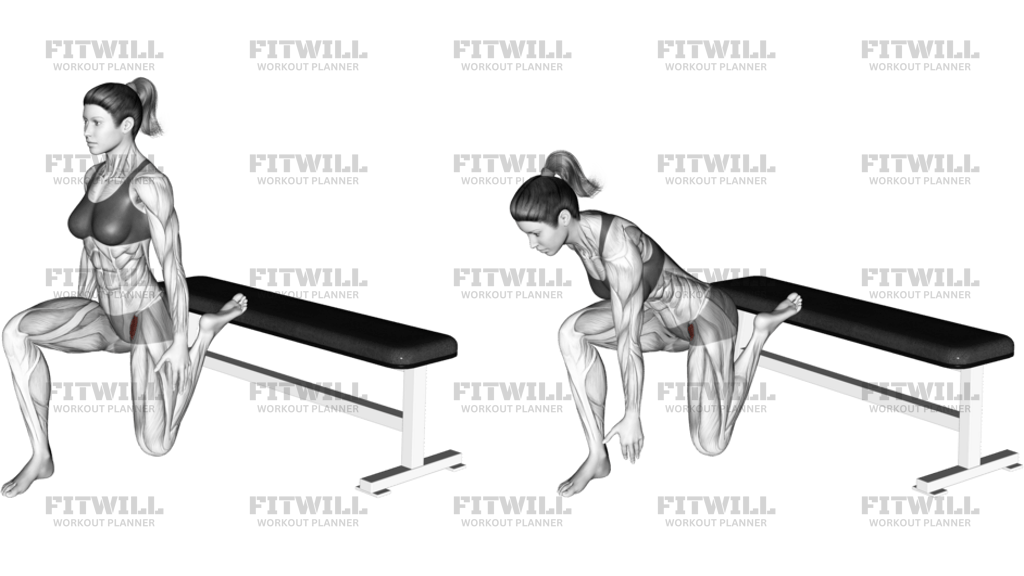
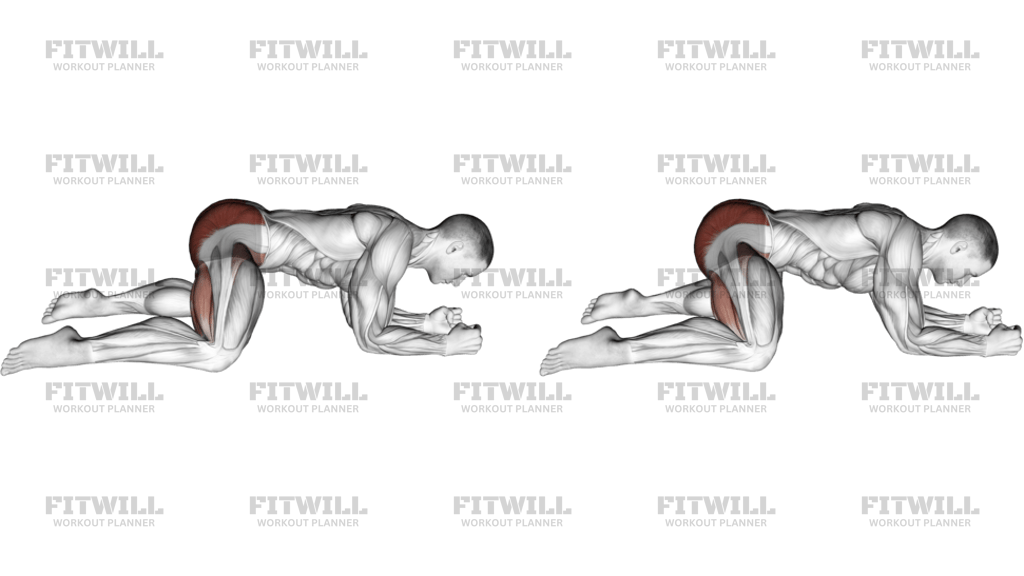
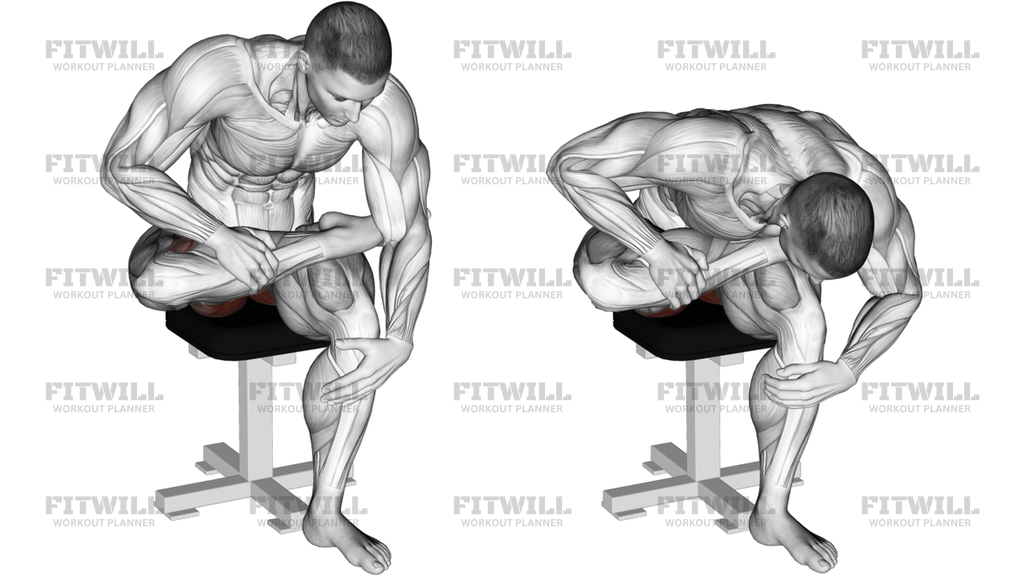
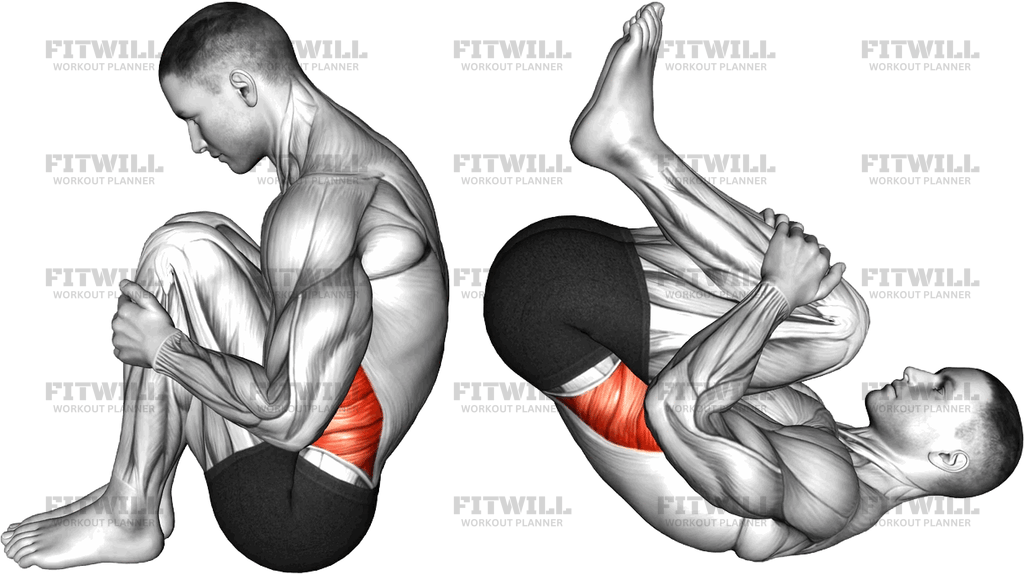
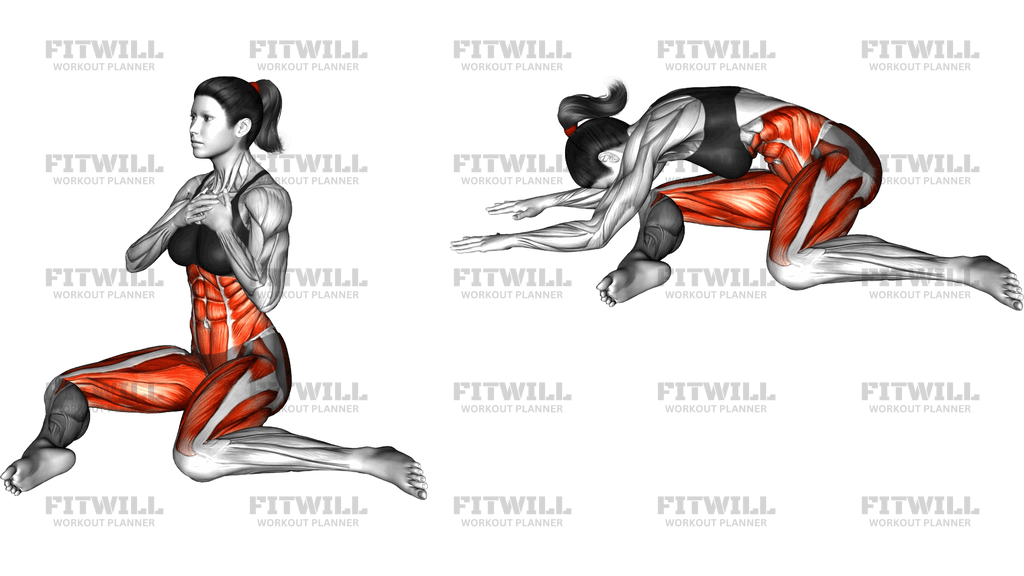
Sitting Crossed Legs Forward Bending
Sitting Crossed Legs Forward Bending is a seated stretch that combines a cross-legged position with a long forward fold over the legs. You start sitting upright on the floor with your shins crossed and each foot resting beneath the opposite knee, then hinge forward from the hips and let your upper body settle down toward your feet and the floor in front of you. The fold is the entire movement, and the crossed-leg setup is what separates it from a standard seated forward bend.
Because the legs are crossed rather than extended, the stretch targets the outer hips and glutes more than the hamstrings. Each hip is held in flexion with slight external rotation, which places the gluteal muscles and the deep hip rotators under tension, while the crossed position also lengthens parts of the inner thigh. As the torso folds, the muscles along the spine and lower back are gently elongated as well, which is why the highlighted areas in the movement are the glutes, hips, and lower back.
This stretch is useful for anyone who spends long hours sitting, since prolonged chair time tends to leave the hips stiff and the glutes dormant. It also works well as part of a cool-down after lower body training, as a mobility drill for squatters and runners who need more hip rotation, or as a calming floor stretch at the end of a yoga-style session. People with generally tight hips often find the crossed-leg fold more accessible than deeper hip stretches because they can control the intensity simply by how far they fold.
Setup matters more than it looks. Sitting on a folded towel, cushion, or thin pad lifts the hips and makes it much easier to tilt the pelvis forward instead of rounding away from a slouched start. Keeping the weight even on both sitting bones and the legs crossed without forcing the knees down determines whether the stretch lands in the hips or gets dumped into the lower back and knees.
To perform it well, lengthen the spine first, then hinge forward from the hip crease, leading with the chest and letting the hands walk or rest on the floor in front of you. The fold should feel like a long, gradual descent rather than a yank toward the legs, and breathing should stay slow and relaxed the whole time. With each exhale you can allow the torso to sink a little closer.
Keep the movement pain-free and patient. Sharp pulling in the knees, pinching in the groin, or strain in the lower back are signals to back off, elevate the hips higher, or reduce the depth of the fold. Two to four rounds of 20 to 40 seconds per side, switching the cross of the legs between rounds, is a practical dose for most people.
Fitwill
Log Workouts, Track Progress & Build Strength.
Achieve more with Fitwill: explore over 9600 exercises with images and videos, access built-in and custom workouts, perfect for both gym and home sessions, and see real results.
Start your journey. Download today!




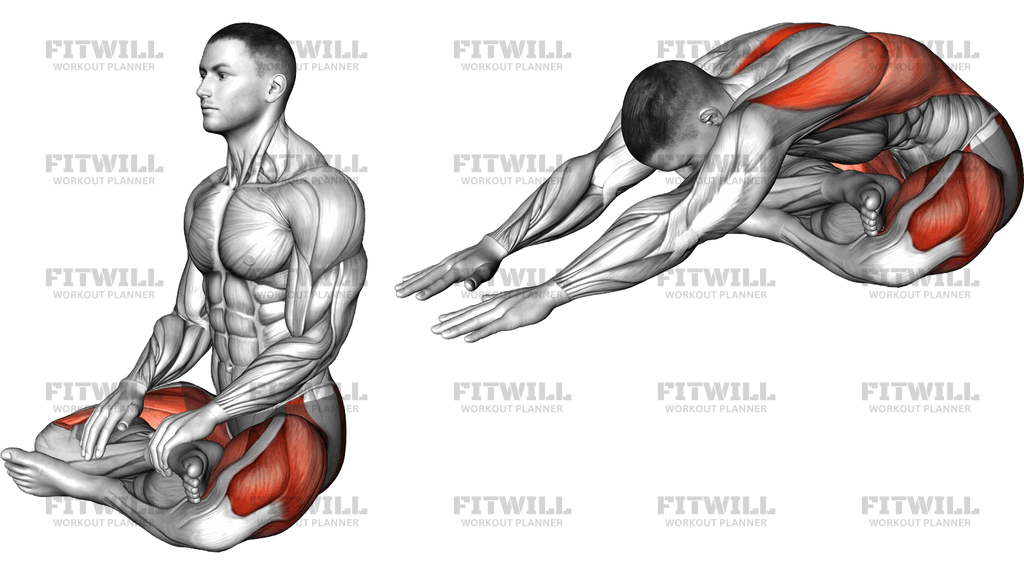
Instructions
- Sit on the floor or an exercise mat with your legs crossed, placing each foot beneath the opposite knee so both sitting bones rest evenly on the ground.
- If your hips sit lower than your knees, place a folded towel, cushion, or thin pad under your sitting bones before you cross your legs.
- Rest your hands on your knees or on the floor beside your hips and sit tall, stacking your spine over your pelvis without forcing your chest up.
- Take a slow breath in, and as you exhale, tilt your pelvis forward and begin hinging at the hips, leading with your chest toward the floor in front of your crossed shins.
- Let your hands walk forward onto the mat and lower your torso down over your legs, allowing your head and arms to relax toward the floor as you reach the edge of the stretch.
- Hold the folded position for 20 to 40 seconds, keeping your neck loose and your shoulders relaxed away from your ears, and let gravity settle you slightly deeper with each exhale.
- Keep your breathing steady and never hold your breath while you are folded forward.
- To come out, press your hands into the floor and slowly roll your spine back up to sitting tall, one vertebra at a time, without jerking.
- Uncross your legs, shake them out briefly, then re-cross them with the opposite leg on top and repeat the fold for balanced stretching on both sides.
Tips & Tricks
- If your knees hover high off the floor when you cross your legs, elevate your hips on a cushion first; trying to press the knees down only strains the knees and shifts tension out of the hips.
- The most common mistake is rounding the lower back immediately instead of hinging from the hips, which turns a hip stretch into a low-back strain; think chest-forward for the first half of the fold.
- Alternate which leg is crossed on top between rounds, since the leg on top usually gets a stronger outer-hip stretch and skipping the swap creates imbalance.
- Do not chase your forehead to the floor. Depth in this stretch comes from pelvic tilt, not from how close your head gets.
- Keep the feet relaxed and the ankles unclenched; gripping the feet is a common sign you are forcing the position rather than relaxing into it.
- Warm hips stretch better, so place this after training or a short walk rather than as the very first thing you do cold.
- If you feel pinching in the groin rather than a pull in the glutes, narrow the cross slightly or back out of the fold a few degrees.
- Let the arms hang and rest on the floor instead of actively pulling yourself down; pulling with the arms tends to tension the neck and shoulders.
- Come out of the fold as slowly as you went in. Popping up quickly from a deep forward fold often causes lightheadedness.
Frequently Asked Questions
What muscles does Sitting Crossed Legs Forward Bending stretch?
It primarily stretches the glutes and the deep muscles of the outer hips, with additional lengthening in the inner thighs and the muscles along the lower back as the torso folds forward.
Why cross the legs instead of extending them like a normal seated forward fold?
Crossing the legs rotates and flexes the hips, shifting the stretch away from the hamstrings and into the glutes and outer hip muscles that a straight-leg fold barely reaches.
Is Sitting Crossed Legs Forward Bending suitable for beginners?
Yes, it is one of the gentler hip stretches because you control the intensity with how far you fold. Beginners should sit on a cushion and keep the fold shallow at first.
Why do my knees sit high off the floor in the crossed-leg position?
That usually means the hips are tight relative to your leg length. Raise your sitting bones on a folded towel or cushion rather than pressing the knees down, which stresses the knee joints.
I feel this mostly in my lower back instead of my hips. What should I change?
You are probably rounding your spine too early. Sit taller at the start, hinge from the hips with your chest leading, and only fold as far as you can before the lower back starts to round.
How long should I hold Sitting Crossed Legs Forward Bending?
Hold for 20 to 40 seconds per side, breathing steadily, and repeat 2 to 4 rounds total. Longer holds of up to a minute or two work well in a relaxed cool-down setting.
Can I do this stretch if I have knee problems?
Be cautious. Crossed-leg sitting puts the knees into flexion with rotation, so if you feel sharp knee pain, reduce the cross, sit higher on a cushion, or choose a straight-leg seated forward fold instead.
What can I use as a substitute if I cannot sit cross-legged comfortably?
A seated figure-four stretch or a supine glute stretch with one ankle across the opposite knee targets the same outer-hip area without requiring a cross-legged seat.
Should I switch which leg is crossed on top?
Yes. The top leg's hip usually gets the stronger stretch, so perform one fold with each crossing to keep both sides even.
Is it better to do this stretch before or after a workout?
It fits best after training or on its own, when the muscles are warm and you can relax into the fold. Save deeper, longer holds for the cool-down rather than a strength-focused warm-up.