Single Arm 45 Degrees Chest Stretch Against Wall
The Single Arm 45 Degrees Chest Stretch Against Wall is a static stretch that uses a plain wall to open up one side of the chest at a time. You place the palm and forearm of one arm against the wall at roughly a 45-degree angle above shoulder height, then rotate your body away from that arm until you feel a clear stretch across the pectoral muscle. Because each side is stretched on its own, it is easy to notice and address differences in tightness between your left and right chest.
This stretch is especially useful for anyone whose shoulders roll forward for long stretches of the day. Desk workers, drivers, and people who spend hours on a phone tend to develop shortened chest muscles that pull the shoulders into a rounded posture. It is also a go-to for lifters who bench press, do push-ups, or train heavy pressing movements, since a tight chest limits overhead range and can contribute to shoulder discomfort when the front of the shoulder is constantly compressed.
The main tissue being lengthened is the pectoralis major, with extra emphasis on the clavicular portion when the arm is set above shoulder height. The anterior deltoid and the biceps, which run across the front of the shoulder joint, also receive a meaningful stretch as the arm extends behind the body. Keeping the ribs from flaring means the upper abdominals and the muscles between the ribs are quietly working to hold trunk position while the chest lengthens.
The wall angle is what makes this version work. With the hand set at about 45 degrees rather than straight out to the side or straight overhead, the stretch follows the natural diagonal fiber direction of the chest, running from the sternum up toward the shoulder. Standing close enough that your palm stays flat and your elbow stays soft lets the tension land on the chest instead of straining the shoulder capsule or the wrist.
Execution is simple but easy to rush. Set the arm, keep the torso tall, and rotate slowly away from the wall until you feel the stretch, then breathe there instead of forcing deeper. The stretch should feel like a pulling sensation across the chest and front of the shoulder, never a sharp pain in the shoulder joint, and the arm should stay relaxed rather than actively pushing into the wall.
Because it needs nothing but a clear patch of wall, this stretch fits easily into warm-ups before upper body training, cool-downs after pressing sessions, or short breaks during a workday. Hold each side for 20 to 40 seconds, repeat two to three times if the chest feels particularly tight, and let the range increase gradually over weeks rather than chasing depth in a single session.
[ Workout Log & Planner ]
Put your next workout in Fitwill
Keep your plan and training log ready when you are.


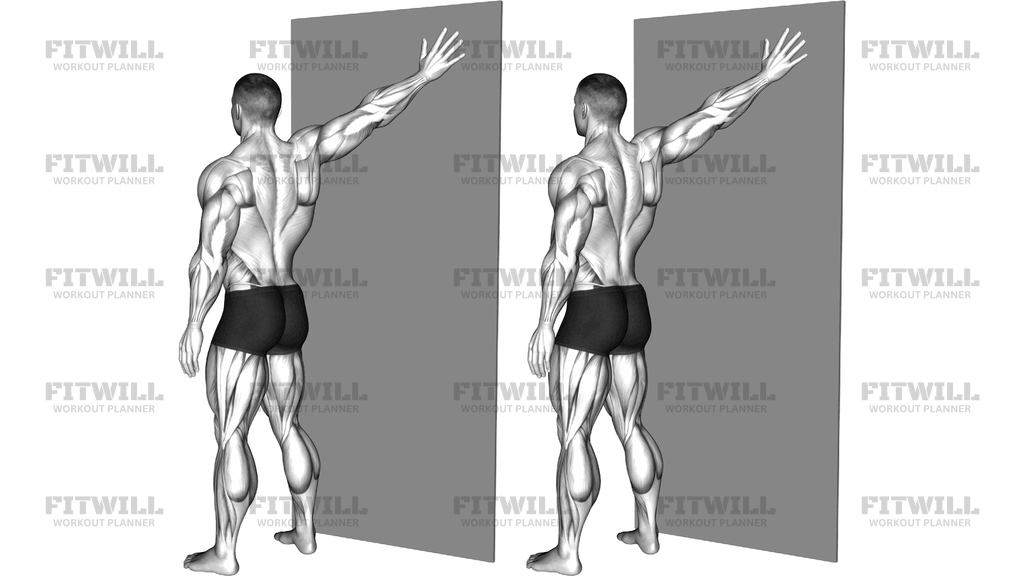
Instructions
- Stand sideways to a clear, flat wall with your feet about hip-width apart and a soft bend in both knees.
- Raise the arm closest to the wall and place your open palm flat against it, with the hand positioned up and out at roughly 45 degrees above shoulder height.
- Keep your elbow slightly bent rather than locked, and let the whole arm from palm to upper arm rest in contact with the wall.
- Stand tall and gently draw your lower ribs down so your trunk stays stacked over your pelvis before you begin the stretch.
- Slowly rotate your chest and torso away from the wall, letting your body weight shift onto the far leg as the arm extends behind you.
- Continue turning until you feel a steady stretch across the chest and the front of the shoulder on the working side, then stop and hold that position.
- Breathe slowly through the hold, exhaling as you allow the chest to relax and lengthen a little further with each breath.
- After 20 to 40 seconds, rotate your torso back toward the wall in a controlled manner until the arm is vertical again.
- Release the hand from the wall, shake out the shoulder and arm, then turn around and repeat the full setup on the other side.
Tips & Tricks
- If the stretch feels sharp in the front of the shoulder rather than across the chest, lower the hand a few inches on the wall so the arm sits closer to shoulder height.
- A common mistake is rotating from the lower back instead of the whole torso, which turns the move into a spine twist; keep your hips facing your starting direction and rotate as one unit.
- Do not push hard into the wall with your palm. The wall is a fixed point, not resistance, and pushing tends to tense the very muscles you are trying to lengthen.
- If your ribs flare and your back arches as you turn away, brace your trunk lightly as if bracing for a light cough, then re-attempt the rotation with less range.
- Keep the fingers relaxed and pointing up or slightly outward; gripping the wall or hyperextending the wrist shifts tension into the forearm and away from the chest.
- The height of your hand changes the emphasis. Higher on the wall biases the upper chest fibers, while closer to shoulder level biases the mid-chest, so pick the height that matches where you feel tightest.
- Ease out of the end position instead of stepping away suddenly, since the shoulder is in a lengthened, externally rotated position and responds better to a gradual return.
- Warm the area first if you are stretching before pressing; a few arm circles or light push-ups make the chest more receptive than stretching it cold.
- Expect the two sides to feel different. Spend an extra round on the tighter side rather than forcing the looser side to match a deeper angle.
Frequently Asked Questions
Which muscles does the Single Arm 45 Degrees Chest Stretch Against Wall target?
The primary target is the pectoralis major, particularly the upper clavicular fibers because the arm is set at 45 degrees above shoulder height. The anterior deltoid and the biceps across the front of the shoulder are stretched as secondary areas.
Why is the hand placed at a 45-degree angle instead of straight out to the side?
The chest fibers run diagonally from the sternum toward the shoulder, so angling the arm up at 45 degrees follows the line of those fibers and produces a more complete stretch. A straight side position tends to hit only the mid-chest and can pinch the shoulder.
Is this stretch suitable for beginners?
Yes, it is one of the most beginner-friendly chest stretches because the wall controls the range and your own body determines the depth. A beginner only needs to rotate away until a mild stretch appears, which is usually a small turn.
How far should I rotate my body away from the wall?
Rotate only until you feel a moderate pulling sensation across the chest and front of the shoulder, then hold. There is no target angle; chasing a large rotation usually just arches the lower back and dulls the stretch.
Should my elbow be straight or bent during the stretch?
Keep a slight, soft bend in the elbow rather than locking the arm straight. A fully locked elbow loads the joint and the biceps attachment instead of letting the chest tissue take the stretch.
What is the most common mistake with this stretch?
Twisting only at the lower back while the hips stay glued to the wall, which fakes extra range without lengthening the chest. Keep the pelvis still and rotate the entire torso as one block.
Can I do this stretch if my shoulder hurts when my arm goes overhead?
Lower your hand on the wall so the arm sits near shoulder height, which reduces the overhead demand while still stretching the chest. If pain persists in the shoulder joint itself, stop and consult a qualified professional before continuing.
What can I use instead if no wall is available?
A doorway works well with the same arm position and body rotation, and a corner lets you stretch both sides at once. You can also do a standing single-arm chest stretch in open space by reaching the arm back and rotating, though you lose the fixed reference point.
How long should I hold the Single Arm 45 Degrees Chest Stretch Against Wall?
Hold each side for 20 to 40 seconds and repeat two to three rounds per side. Before a pressing workout, shorter holds of 15 to 20 seconds are enough; after training or for posture work, use the longer holds.
Should I feel this stretch in my biceps and forearm too?
A mild pull along the front of the shoulder and upper arm is normal because those tissues cross the same area. If the biceps or forearm sensation dominates, lower the hand slightly, soften the elbow, and relax your grip on the wall.