Hyperextension On A Exercise Ball
Hyperextension On A Exercise Ball is a bodyweight back extension performed face-down over a stability ball, with the ball supporting your hips and upper thighs while your torso hangs forward toward the floor. From there, you raise your chest by contracting the muscles along the spine until your body forms one long line, then lower back down under control. It is essentially the same hinge-and-extend action you would perform on a Roman chair or 45-degree bench, but the unstable ball surface changes the demands considerably.
The main movers are the erector spinae running up the lower and mid back, assisted strongly by the glutes and hamstrings as they anchor and stabilize the pelvis. Because your feet stay on the floor and the ball rolls beneath you, your deep core, hip stabilizers, and even your upper back have to work continuously just to keep you balanced. That stabilization component is what separates this version from machine-based back extensions.
This exercise suits intermediate trainees who want posterior chain work without loading the spine with a barbell, as well as lifters looking for a higher-rep, lower-load back extension alternative. It is also popular in general strength and conditioning because one ball replaces a dedicated hyperextension bench, making it practical for home training. Beginners can do it too, but they should start with a smaller range of motion and keep the ball under the thighs for better support.
Setup matters more here than in almost any other back extension. Where the ball contacts your body determines your effective leverage: under the hips gives you a longer, harder movement arm, while under the thighs shortens the lever and makes the extension easier. Your feet need a solid, braced position against a wall or the floor, and your hands should rest lightly behind your head or across your chest rather than pulling on your neck. If the ball is underinflated or your feet slip, the whole exercise becomes a balancing act instead of a back exercise.
Executed well, the movement is a smooth spinal extension with the hips pressed into the ball, not a jerky arch driven by momentum. Think of extending your chest up and slightly back while squeezing the glutes, pausing briefly at the top, and lowering over two to three seconds. The ball should stay quiet under you; if it rolls forward and back, you are losing hip position.
Keep the range honest. Going a few degrees past a straight body line is enough for most people, and rounding or snapping hard into arch at the top is where form usually breaks down. Treat this as a controlled strength and endurance movement rather than a test of how high you can lift your torso, and it will serve your lower back training well.
[ Workout Log & Planner ]
Put your next workout in Fitwill
Keep your plan and training log ready when you are.


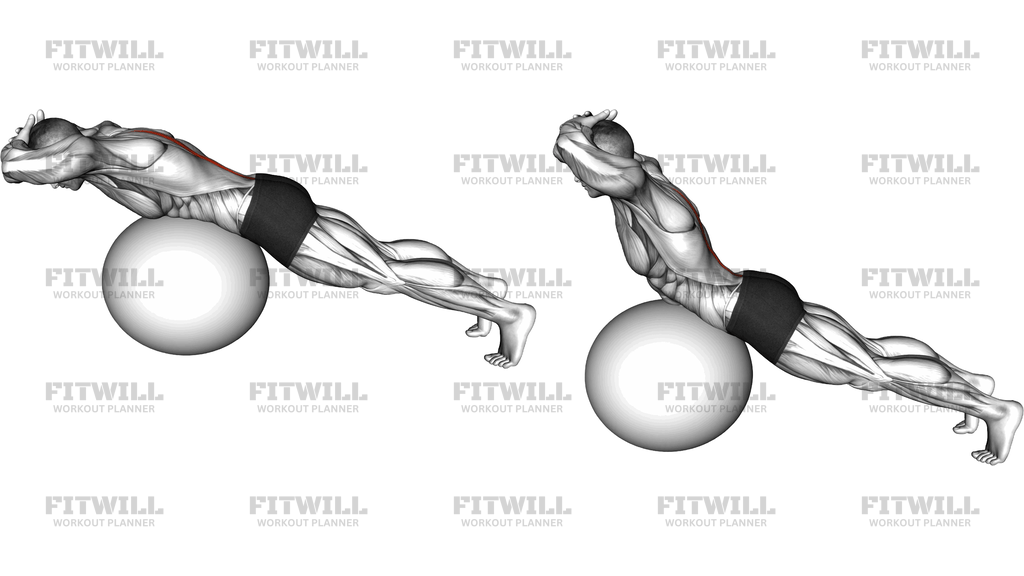
Instructions
- Inflate the stability ball so it is firm with only slight give, and place it on a non-slip surface with enough clear space behind you to extend your legs.
- Lie face down over the ball so it sits under your hips and upper thighs, with your torso draped forward and your hands resting lightly behind your head or crossed at your chest.
- Walk your feet back until your legs are nearly straight and place the balls of your feet on the floor, braced against a wall if available, with toes turned slightly out for grip.
- Brace your abdominals, squeeze your glutes to set your pelvis, and let your torso hang down in a controlled forward curve over the ball as your starting position.
- Exhale and lift your chest by extending your spine, pressing your hips down into the ball and driving the pelvis forward slightly until your head, spine, and hips form one long line.
- Squeeze briefly at the top without hyperextending or craning your neck back; keep your elbows wide and your hands from pulling on your head.
- Inhale and lower your torso back down over the ball over two to three seconds, resisting gravity the whole way.
- Complete your reps with the same tempo, then walk your hands forward and roll your body off the ball to dismount safely rather than hopping off with a rounded back.
- If your balance wobbles, widen your feet and move the ball slightly toward your thighs until you can control the path consistently.
Tips & Tricks
- Ball placement is your difficulty dial: under the hips makes the extension longer and harder, under the thighs shortens the movement and adds support, so adjust it before adding reps.
- The most common mistake is yanking the torso up with momentum; the ball tends to roll and bounce, which turns the exercise into a rocking motion. Slow the lowering phase and the rocking disappears.
- Do not interlock your fingers and pull on the back of your head; rest your fingertips there or cross your arms over your chest so your neck stays neutral.
- If your feet slide on a smooth floor, brace them against the base of a wall or wedge your toes under a sturdy rail, since a slipping foot wrecks the anchor for your whole body.
- Stop at a straight body line or just a few degrees past it; forcing a deep arch at the top squeezes the lumbar spine without adding useful muscle work.
- Keep your glutes actively squeezed through the entire rep; if your hips sag off the ball mid-set, your pelvis loses its base and the lower back starts compensating.
- On a slippery or fatigued set, hold a broomstick or lightly touch a wall with your hands for balance rather than cutting the range short.
- Your hamstrings may fatigue before your lower back on this exercise; that is normal given the foot-anchored position, but if they cramp, move the ball slightly forward under the hips to shorten the lever.
- Exhale on the way up and inhale on the way down; holding your breath while balancing on an unstable surface spikes tension and makes the wobble worse.
Frequently Asked Questions
What muscles does Hyperextension On A Exercise Ball work?
The primary muscles are the erector spinae of the lower back, with strong assistance from the glutes and hamstrings. Because you balance on the ball, your abs and hip stabilizers also work continuously to keep your pelvis and trunk aligned.
Where should the stability ball sit during this exercise, under the hips or under the thighs?
Under the hips gives you the full range and the hardest version, while under the thighs shortens the lever and is better for learning the movement. Start under the thighs and roll the ball toward your hips as your control improves.
Is Hyperextension On A Exercise Ball safe for beginners?
Yes, if you keep the ball under the thighs, limit your range to a straight body line, and brace against a wall for foot stability. Beginners should master the tempo first before trying the longer hip-supported version.
How is this different from a Roman chair or 45-degree back extension?
The working muscles are the same, but the unstable ball surface adds a constant balance demand and lets you adjust the difficulty simply by rolling the ball forward or back. The Roman chair offers a fixed, heavier-feeling hinge but less stabilization work.
Why do my feet slide during Hyperextension On A Exercise Ball?
Smooth floors provide little friction for the balls of your feet, and the ball shifts your weight backward as you rise. Brace your toes against a wall base, wedge them under a stable object, or perform the exercise on a rubber mat.
Should my hands be behind my head or crossed over my chest?
Either works, but the key is that the hands never pull on the neck. Crossed arms over the chest reduce leverage and are the safer choice, while fingertips behind the ears slightly lengthen the movement arm.
How far should I arch at the top of the movement?
Extend until your head, spine, and hips form one long line, or just a few degrees beyond it. There is no benefit to forcing a deep lumbar arch, and excessive end-range extension under fatigue is where most form problems start.
Can I add resistance to Hyperextension On A Exercise Ball?
Yes, you can hug a weight plate or small dumbbell against your chest once your balance is solid. Only add load when you can complete all reps without the ball rocking or your hips drifting off position.
What can I use if I do not have a stability ball?
A Roman chair, 45-degree hyperextension bench, or glute-ham bench all train the same extension pattern. You can also do slow bodyweight back extensions lying face down on a mat, though the stabilization demand will be lower.
How many reps should I do?
Because the load is low and the emphasis is on control, sets of 10 to 15 controlled reps work well for most trainees. Prioritize a smooth two-to-three-second lowering phase over chasing higher numbers.