Elevated Lunge T Spine Rotation
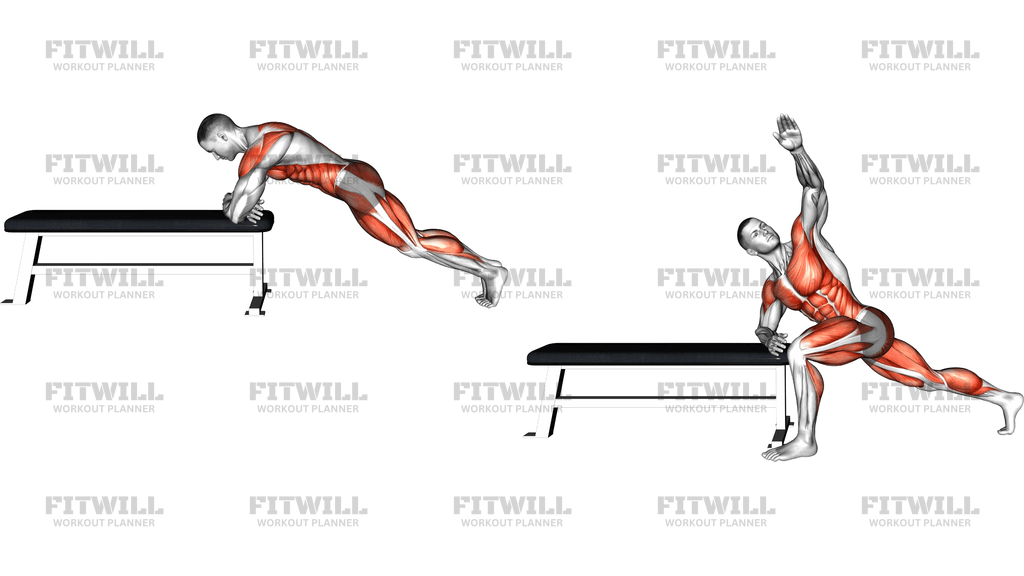
The Elevated Lunge T Spine Rotation is a hybrid mobility and strength drill that combines a supported lunge position with a rotational reach toward the ceiling. You set up with one hand or forearm planted on a flat bench, step the same-side foot forward into a lunge, and then rotate through the mid-back as the opposite arm opens and extends up overhead. The bench takes care of balance and lower-body load, which frees you to focus entirely on the quality of the turn happening in your thoracic spine.
This movement is useful for almost anyone who sits for long hours or trains hard without much rotational work. Desk workers, lifters with stiff mid-backs, and athletes in swinging or throwing sports all tend to lose thoracic rotation, and the body usually compensates by twisting through the lower back instead. By pinning the lower body into a lunge and giving one arm a stable point of contact on the bench, this drill encourages the rotation to come from the ribcage and mid-back rather than the lumbar spine.
The primary work happens in the obliques and the rotator muscles of the upper back, while the lunge position lengthens the hip flexors of the trailing leg and loads the front leg's glutes and quads isometrically. The reaching arm also challenges shoulder mobility and control, and the whole position demands core bracing to keep the torso from collapsing as you rotate.
Setup matters here because the bench height and your lunge depth determine where the rotation actually comes from. A standard flat bench works well: plant the hand directly under the shoulder, drop the back knee low, and keep the front shin roughly vertical. If you rush into the reach without settling the hips first, you will get most of your range from the low back, which defeats the purpose of the drill.
To execute it well, exhale as you rotate, follow the moving hand with your eyes, and think about turning the ribcage rather than just swinging the arm. Pause briefly at the top where the chest faces the wall beside you, then reverse the motion under control before repeating. The tempo should be smooth rather than explosive, with each rep reaching slightly toward the edge of comfortable range rather than forcing end-range speed.
Use this movement as a warm-up before lower-body lifting, as a filler between sets of squats or presses, or as a standalone mobility block on recovery days. Two to three sets of five to eight rotations per side is a practical dose. Stop and shorten the range if you feel pinching in the front of the trailing hip, strain in the low back, or any shoulder discomfort from the planted arm.
[ Workout Log & Planner ]
Put your next workout in Fitwill
Keep your plan and training log ready when you are.


Instructions
- Place a flat bench in front of you and kneel onto one knee facing it, then plant the same-side hand flat on the bench directly under your shoulder with the elbow slightly soft.
- Step your front foot forward so it sits beside the bench with the knee bent about 90 degrees, and let your back leg extend behind you with the knee hovering or the shin resting low behind you.
- Settle your hips down and forward until you feel a stretch across the front of the trailing hip, and keep your front foot flat with the shin close to vertical.
- Brace your core lightly and press the planted hand into the bench so your shoulder stays stacked and your torso does not sag toward the floor.
- Inhale, then exhale as you rotate your ribcage away from the bench, lifting the free arm up and back toward the ceiling until the arm points skyward and your chest faces sideways.
- Follow your reaching hand with your eyes and pause for one to two seconds at the top of the rotation, letting the turn come from the mid-back rather than the low back.
- Reverse the motion slowly, lowering the arm and rotating the torso back to face the bench while keeping the hand planted and hips low.
- Breathe out on every rotation up and in on the return, keeping the rhythm steady rather than holding your breath.
- Complete all reps on one side, then switch by planting the opposite hand on the bench and stepping the other foot forward into the lunge.
- To reset between sides, lift the planted hand off the bench, stand or kneel up fully, and rebuild the lunge position from a neutral stance.
Tips & Tricks
- If your low back arches and twists instead of your ribcage, tuck the trailing hip slightly under before you rotate so the pelvis stays quiet while the mid-back turns.
- Rotating fast and swinging the arm is the most common error here; the arm should follow the ribcage, not lead it, so drive the turn from your chest and upper back.
- Keep weight mostly through the front heel and the planted hand. If your hips shift backward as you rotate, shorten the lunge stance slightly so you can stay tall over the front foot.
- The planted shoulder tends to shrug up toward the ear; press deliberately through the bench and keep space between the shoulder and jaw throughout the set.
- If the trailing knee touching down bothers you, hover it a few centimeters off the floor or pad it with a folded mat while keeping the hip extended.
- A bench that is too high turns this into an upright twist with little hip stretch; if you barely feel the trailing hip, switch to a lower surface so the torso angles down more.
- Do not chase the ceiling with your eyes only. If your head turns but the chest stays forward, you are faking range, so keep your gaze tracking the hand as the ribcage genuinely rotates.
- Exhaling fully at the top of each rotation often adds a few degrees of comfortable range, so time your breath to the turn instead of holding air in.
- Stop short of any pinching sensation in the front of the trailing hip; ease back into the lunge a little and rebuild the rotation from a shallower position.
Frequently Asked Questions
What muscles does the Elevated Lunge T Spine Rotation work?
The rotation is driven mainly by the obliques and the mid-back muscles, while the lunge position stretches the hip flexors of the trailing leg and holds the glutes and quads of the front leg under tension. The reaching arm also works through shoulder range under light load.
Is the Elevated Lunge T Spine Rotation suitable for beginners?
Yes, provided the range is kept modest and the bench offers a stable hand position. Beginners should prioritize a slow tempo and a comfortable lunge depth over a big reach toward the ceiling.
Why is one hand placed on the bench during this rotation?
The planted hand creates a fixed anchor that removes the balance demand of an unsupported lunge and helps lock the lower body in place. That stability lets the rotation come from the thoracic spine instead of being stolen by the low back or hips.
Should the back knee touch the floor during the Elevated Lunge T Spine Rotation?
Touching down is fine if it is comfortable, and it can make the position easier to hold. Hovering the knee slightly increases the hip flexor stretch, so choose whichever lets you keep the hips square and the torso tall.
How many reps of the Elevated Lunge T Spine Rotation should I do?
Two to three sets of five to eight slow rotations per side works well as a warm-up or mobility block. Because quality of the turn matters more than volume, there is little benefit in piling on extra reps once range stalls.
What is the most common mistake in this movement?
Letting the low back do the rotating while the arm simply swings. Keep the pelvis still and think about turning the ribcage toward the ceiling so the mid-back produces the motion.
Can I do the Elevated Lunge T Spine Rotation without a bench?
Yes, a sturdy chair, box, or low wall can replace the bench as long as it keeps your planted hand roughly under your shoulder. A very low surface like the floor turns this into a different drill with a much deeper torso angle.
Is this drill better before or after a workout?
It works best before lower-body or pressing sessions as a warm-up, and it can also be used between sets as active recovery. Doing it after training is fine as well, when the muscles are warm and range often feels easiest.
Should I feel this in my lower back?
No, the target sensation is rotation through the mid-back and a stretch across the trailing hip. If you feel strain in the low back, reduce the rotation range, tuck the pelvis slightly, and make sure the lunge is not so deep that your torso is collapsing forward.
Can the Elevated Lunge T Spine Rotation help with a stiff mid-back from sitting?
It is a practical choice for that, since the bench-supported lunge pins the hips and gives the thoracic spine a clear job. Consistent, comfortable-range reps usually serve you better than forcing maximal rotation.