Resistance Band Bent Leg Side Kick (Kneeling)
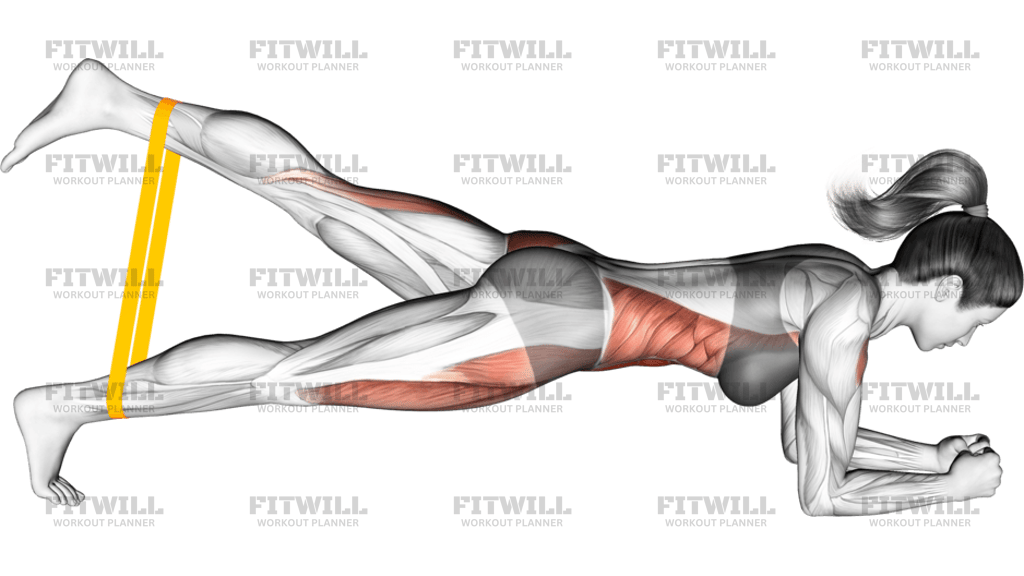
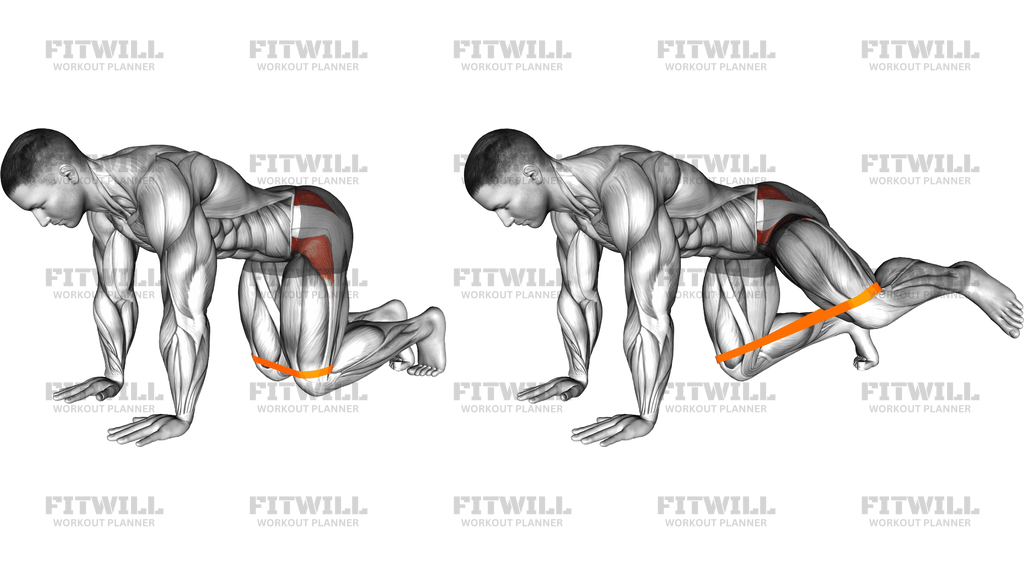
The Resistance Band Bent Leg Side Kick (Kneeling) is a quadruped hip abduction exercise performed on all fours with a loop band wrapped around both legs just above the knees. From that hands-and-knees position, you lift one leg out to the side with the knee bent at roughly ninety degrees, pressing outward against the band's tension before drawing it back under control. The movement looks simple, but the band changes everything compared to the bodyweight version: resistance is highest right where your glute is strongest at the top of the lift, and it keeps pulling the working knee toward the support knee throughout the rep.
This exercise primarily targets the gluteus medius and the outer hip muscles, with the gluteus maximus assisting as the leg drives back and out. Because you are supporting yourself on one hand and one knee, your core, especially the obliques and deep trunk stabilizers on the working side, has to work hard to stop your hips from rotating or sagging. That anti-rotation demand is a big part of the exercise's value; you are training hip strength and trunk control in the same rep.
People most often use this movement for glute development, hip stability, and knee health. Strong gluteus medius muscles control the position of the femur during walking, running, squatting, and lunging, so this is a common accessory exercise for runners, lifters who feel their knees cave in during squats, and anyone rebuilding hip strength after time away from training. It is also popular in warm-ups before lower body sessions, since it wakes up the lateral glutes without much load or fatigue.
The kneeling setup matters because it fixes the pelvis in place and removes momentum from the equation. With your torso horizontal and your weight supported on your hands and the opposite knee, the only way the leg can travel out to the side is by the hip muscles actually doing the work. A mat under your knees and hands makes the position comfortable enough to hold for a full set, and placing the band above the knees keeps the pull in line with the hip joint rather than yanking at the ankle.
To execute it well, keep your working knee bent and lift by rotating the leg away from your body at the hip, not by swinging the foot or arching the lower back. The end position is the leg out to the side, thigh roughly parallel to the floor or slightly below, shin relaxed. Pause briefly where the band tension peaks, then resist the band on the way back so the knee travels slowly inward rather than snapping back to the start. Expect to feel this on the side of the working hip within ten to fifteen reps; if you only feel it in your lower back or the front of your hip, the setup or range needs adjusting.
Keep the reps deliberate and the range honest. A smaller kick performed with a level pelvis beats a big sweep where the torso twists to fake extra height. If balance is an issue at first, widen your base slightly by moving your support hand directly under your shoulder and your support knee directly under your hip.
[ Workout Log & Planner ]
Put your next workout in Fitwill
Keep your plan and training log ready when you are.


Instructions
- Loop a resistance band around both legs and position it just above your knees, then kneel on an exercise mat and place your hands on the floor so you are on all fours.
- Position your hands directly under your shoulders and your knees directly under your hips, with your working knee bent at about ninety degrees and the top of your supporting foot flat on the mat.
- Set your spine in a neutral line from head to hips, look down at the floor, and brace your abs as if preparing for a light push to the ribs.
- Shift a small amount of weight into your supporting hand and knee so the working leg is free to move without tipping you.
- Exhale and drive your working knee up and out to the side against the band, keeping the knee bent and the foot relaxed, until your thigh is roughly level with your hip or as high as you can go without tilting your pelvis.
- Pause for a beat at the widest point, squeezing the side of your hip while keeping your shoulders and hips square to the floor.
- Inhale and slowly let the knee travel back down and inward, resisting the band's pull instead of collapsing into the start position.
- Lightly touch or hover the knee near the floor, reset your brace, and begin the next rep without losing band tension if possible.
- Complete all reps on one side, then reposition the band if needed and switch legs, keeping the set count equal on both sides.
Tips & Tricks
- If your torso rotates toward the ceiling as you kick, you are cheating the hip out of its job; imagine a cup of water balanced on your lower back and keep it level through every rep.
- A band placed over the knees that rolls up mid-set is usually too loose or too low; reposition it above the knee line and check the loop tension before each set.
- Height in this exercise comes from hip rotation, not from arching your lower back to lift the thigh higher. If your spine extends to gain range, shorten the kick instead.
- Supporting hand fatigue is common with longer sets; press the floor away slightly and spread your fingers so the shoulder and forearm share the load instead of dumping it into the wrist.
- Keep the working foot relaxed and the knee bent throughout. Straightening the leg mid-rep turns it into a different, longer-lever movement and usually costs you control at the top.
- If you feel a pinch at the front of the working hip, you are likely lifting the thigh too high with the pelvis tilted; reduce the range a few degrees and keep the hip stacked under the shoulder.
- Slow the lowering phase to about two seconds. The band pulls the knee inward fast on the way down, and that return is where much of the glute's work actually happens.
- For more resistance, use a thicker band or fold the loop to shorten it, but only after you can complete all reps without your hips rotating or dipping.
- Cushion the supporting knee with a mat or folded towel; discomfort there will make you shift your weight and tilt the pelvis without you noticing.
Frequently Asked Questions
Which muscles does the Resistance Band Bent Leg Side Kick (Kneeling) work?
The main movers are the gluteus medius and outer hip muscles, with the gluteus maximus assisting as the leg drives out. Your core, particularly the obliques on the working side, works isometrically to keep the pelvis level and prevent rotation.
Why should the knee stay bent during this side kick instead of extending the leg?
Bending the knee shortens the lever and lets the hip abductors rotate the leg through a full, controlled range without the hamstrings or lower back taking over. Keeping the knee bent also matches the band's pull to the hip joint, so the glutes stay the limiting factor.
Where exactly should the resistance band sit?
Just above both knees. That position keeps the band from slipping and directs tension across the thighs, which loads the hip abductors directly without straining the ankle or knee joint itself.
Is the Resistance Band Bent Leg Side Kick (Kneeling) suitable for beginners?
Yes, it is one of the more accessible hip abduction exercises because the quadruped position supports your weight and the band provides light, adjustable resistance. Beginners should start with a thin band and a short range, prioritizing a level pelvis over kick height.
How high should I lift my leg at the top of the movement?
Aim for the working thigh roughly level with your hip, or slightly lower if your pelvis starts to tilt. Once the hip stops rotating and the back starts arching to gain height, you have passed your useful range.
My lower back aches during this exercise. What am I doing wrong?
This usually means the spine is arching or the pelvis is rotating to lift the leg higher than the hip allows. Reduce the range, re-brace your abs before each rep, and think about kicking out to the side rather than up toward the ceiling.
Can I do this exercise without a band?
Yes, the bodyweight version is a classic fire hydrant, but you will lose resistance at the top of the lift where the glutes are strongest. If no band is available, you can pause longer at the top or add reps, though a band gives a more complete strength stimulus.
How many reps and sets should I do?
Two to four sets of ten to twenty controlled reps per side works well, whether as a warm-up before squats or deadlifts or as standalone glute training. Stop the set when your pelvis can no longer stay level, not when the leg simply gets heavy.
Is it safe for my knees?
The band sits above the knees and the working knee stays bent and unloaded, so the joint is not stressed directly. If kneeling on the supporting knee is uncomfortable, pad it well, and if a band ever causes pulling discomfort around the kneecap, move it slightly higher on the thigh.
How is the Resistance Band Bent Leg Side Kick (Kneeling) different from a standing side kick with a band?
The kneeling version removes balance demands and anchors the pelvis, making it easier to isolate the hip abductors and harder to use momentum. The standing version adds balance and single-leg stability work but often lets the torso lean to fake extra range.