Band Bent Over One Arm Neutral Grip Kickback
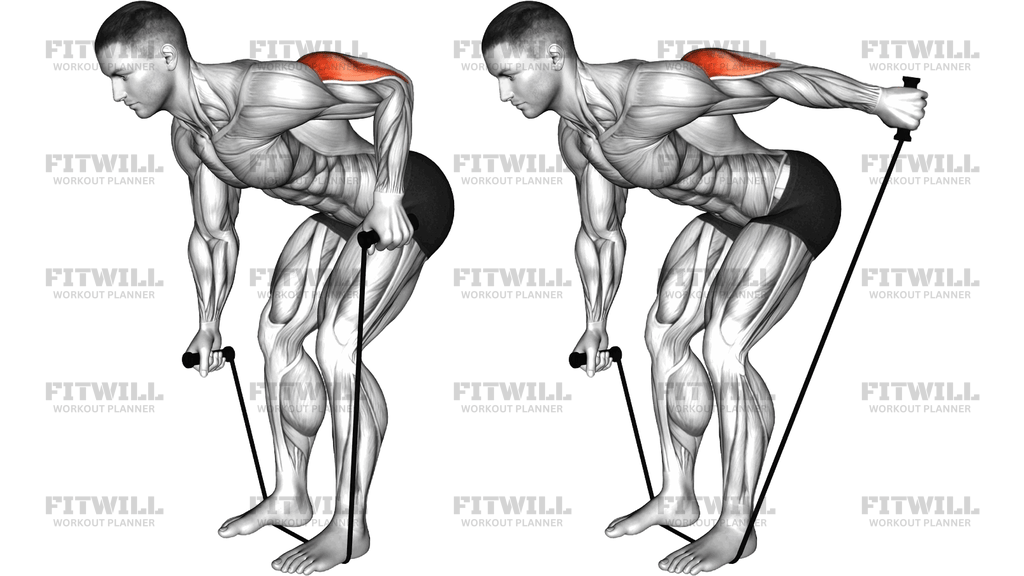
The Band Bent Over One Arm Neutral Grip Kickback is a single-arm rear shoulder exercise performed standing. You anchor a resistance band under your feet, hinge forward at the hips until your torso is nearly parallel to the floor, brace your free hand against your thigh, and sweep the working arm straight back and up behind you with the palm turned inward. Because the band is anchored at floor level under your own body, the tension climbs steadily as your arm travels toward the top of the movement, which is exactly where the rear delt does most of its work.
This movement fills a real gap in most training programs. Pushing, pressing, and bench work dominate many routines, and the back of the shoulder gets little direct attention. Training the rear deltoids one side at a time also lets you notice and correct left-to-right differences, which is hard to do with two-arm bent over raises. It suits lifters who want more balanced shoulder development, desk workers whose shoulders drift forward, and anyone who needs a joint-friendly way to load the upper back and rear shoulders without heavy weights or a cable station.
The setup does a lot of the work here. Your hinge angle decides whether the band pulls the arm straight back or drags it toward the floor, so committing to a genuine hip hinge with a flat back matters more than how heavy the band is. The neutral grip, with the palm facing your body, keeps the shoulder in a comfortable rotation throughout the arc and avoids the twisted positions that a pronated grip can force at the top. Bracing the free hand against your thigh turns your lower body into a stable platform so the effort stays in the shoulder instead of leaking into torso rotation.
Execution is simple but easy to rush. Start with the working arm hanging straight down under the shoulder and the band already under light tension, then push the arm back and up as one piece, keeping a soft bend in the elbow. The finish position has your hand roughly at hip-to-shoulder height behind you, with the upper arm in line with your torso, not up by your ear. Pause there for a beat, feel the back of the shoulder contract, then lower the arm under control so the band never snaps you back to the start.
In practice, this exercise works well as an accessory movement after pressing or pulling, or as a standalone shoulder-health block on lighter days. Bands make it easy to scale: a narrower stance or a thicker band increases resistance, while more slack in the band eases it off. Aim for controlled reps in the moderate-to-high range, and treat the top position, not the weight used, as the quality marker of the set.
[ Workout Log & Planner ]
Put your next workout in Fitwill
Keep your plan and training log ready when you are.


Instructions
- Stand with both feet about hip-width apart on the middle of a resistance band and hold one handle in your working hand with a neutral grip, palm facing inward toward your body.
- Hinge forward at the hips until your torso is close to parallel with the floor, knees softly bent, back flat, and take the slack band or other handle in your free hand, bracing it against your thigh.
- Let your working arm hang straight down beneath your shoulder with the elbow slightly bent, and step or adjust your stance until the band is under light tension before the first rep.
- Brace your abdominal muscles and keep your neck in line with your spine, eyes on the floor slightly ahead of your feet.
- Sweep the working arm straight back and up behind you, keeping the soft elbow bend, until your hand reaches roughly hip-to-shoulder height and your upper arm lines up with your torso.
- Pause for a moment at the top and squeeze the back of your shoulder without shrugging or letting your chest rise.
- Lower the arm slowly along the same arc until it hangs back under your shoulder and the band stays taut.
- Exhale as you raise the arm behind you, inhale as you lower it back down.
- Finish all reps on one side, switch hands, reset your hinge and stance, and repeat on the other side.
Tips & Tricks
- If your chest lifts toward the ceiling as the arm goes back, the band is too strong or fatigue has set in; take a lighter band or stop the set rather than turning the hinge into a standing position.
- Keep the elbow bend soft and constant. If you find yourself straightening and snapping the elbow at the top, you have drifted from a shoulder movement into a triceps-style press.
- Watch for the arm traveling up beside your ribs instead of behind you — that means the shoulder is doing a row. Think of pushing the handle back toward the wall behind you, not up toward your hip.
- Brace your free hand on your thigh, not directly on the knee joint, so the support is stable without pressing on the kneecap.
- Widen or narrow your stance to tune the resistance. More band under your feet means a heavier rep; slack in the band at the start means the first few inches of the rep are nearly free.
- Do not chase height past the point where your upper arm lines up with your torso. Forcing the hand higher usually comes from rotating the torso or shrugging the trap, not from the rear delt.
- Keep your weight balanced over the middle of your feet. Rocking onto the toes as the arm lifts is a sign the hinge has collapsed.
- Set your shoulders down and back before the first rep. Starting each rep with a deliberate re-set of the hinge and shoulder position keeps the movement crisp.
- If your lower back tires before your shoulder does, shorten the set, sit your hips back further, or place a hand on a bench for extra torso support.
Frequently Asked Questions
Which muscles does the Band Bent Over One Arm Neutral Grip Kickback target?
The rear deltoid on the working side is the primary mover, with the middle traps and rhomboids assisting as the arm travels back. The triceps and the muscles around the shoulder blade work to hold the arm stable through the arc.
Why use a neutral grip instead of an overhand grip in this exercise?
The neutral grip, palm facing your body, keeps the upper arm in a comfortable rotation as it sweeps behind you. Many people find it less likely to pinch or strain at the top of the movement than a twisted overhand position.
Should my elbow stay bent or straight during the Band Bent Over One Arm Neutral Grip Kickback?
Keep a soft, roughly fixed bend in the elbow and move the whole arm as one piece. Unlike a triceps kickback, the elbow does not extend from a bent position here — the shoulder drives the motion.
Is this exercise suitable for beginners?
Yes. Start with a light band, a shallower hinge, and slow reps so you can feel the back of the shoulder working. The one-arm setup actually makes it easier for beginners to learn the correct path than two-arm variations.
Why do I stand on the band instead of anchoring it somewhere else?
Standing on the band anchors it at floor level, so resistance increases as your arm rises behind you, matching where the rear delt is strongest. It also needs no door anchor or rack, making the setup quick and portable.
How do I adjust the difficulty of the Band Bent Over One Arm Neutral Grip Kickback?
Widen your stance or switch to a thicker band to increase resistance, or narrow your stance and leave more slack in the band to reduce it. Slower tempo and a pause at the top also raise the challenge without changing equipment.
What is the most common mistake with this movement?
Turning it into a row by pulling the handle up alongside the ribs. The arm should travel back and slightly up behind the body; if your elbow bends more and more as you lift, reset and think about pushing the handle toward the wall behind you.
My lower back fatigues before my shoulder — what should I change?
Check that you are hinging from the hips with a flat back rather than rounding, and brace your core before each rep. If fatigue persists, rest the free hand on a bench for support or shorten your sets.
Can I train both arms at the same time with this setup?
You can hold both handles and raise both arms, but the single-arm version lets you focus on one side, keep the free hand braced on your thigh, and correct side-to-side differences, which is why it is usually the better starting point.
Is the Band Bent Over One Arm Neutral Grip Kickback safe for the shoulders?
For most people it is a low-load, shoulder-friendly way to train the rear deltoids. Keep the range within what feels comfortable, avoid forcing the arm higher than shoulder level, and stop if you feel sharp pain rather than muscle effort.