Resistance Band Seated Hip Abduction (Version 2)
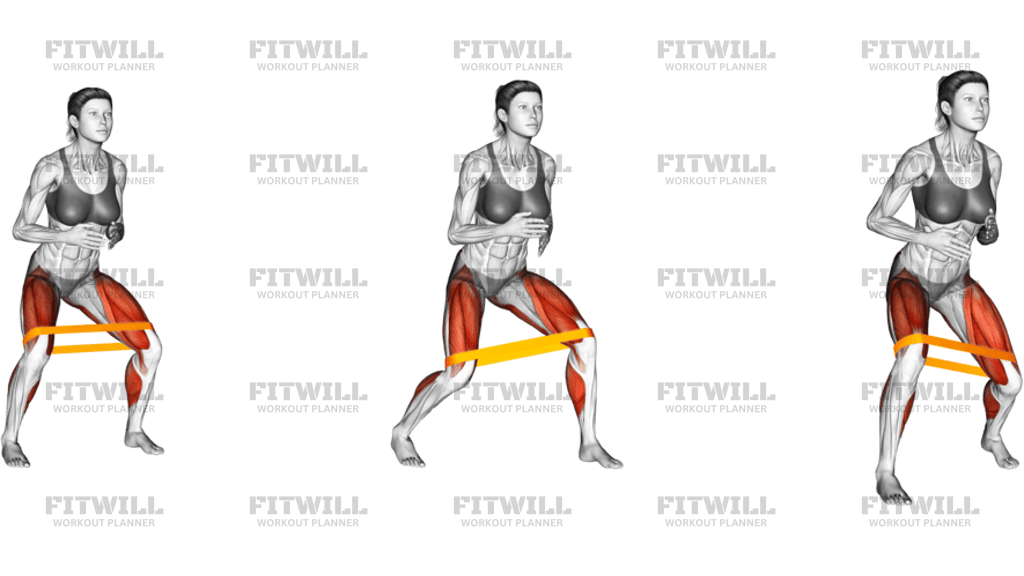
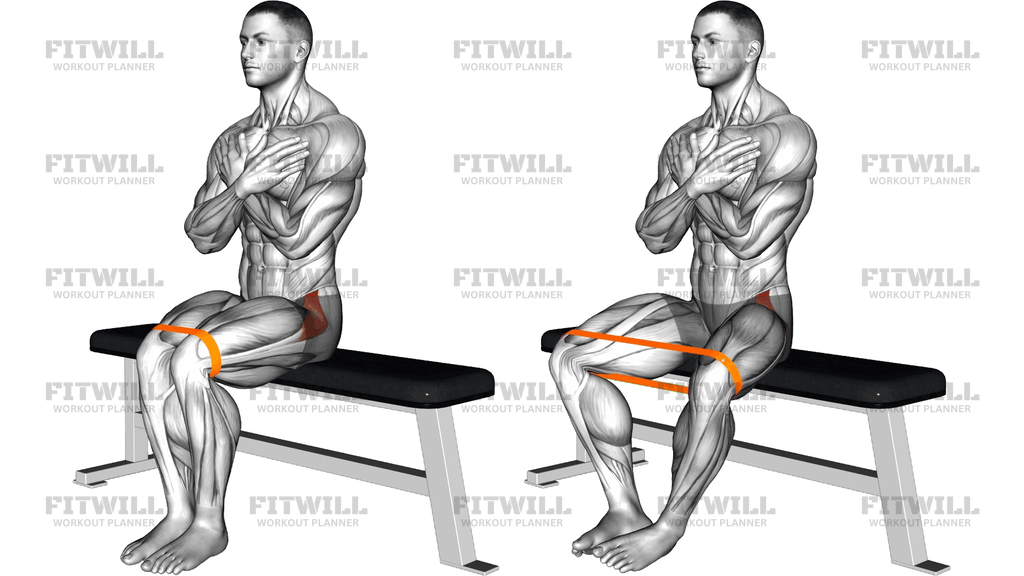
Resistance Band Seated Hip Abduction (Version 2) is a simple but highly targeted isolation exercise for the outer hip muscles. You sit upright on a flat bench with a looped resistance band wrapped around your legs just above the knees, feet together, and hands crossed over your chest. From there, you press your knees apart against the band's tension, squeeze briefly at the widest point, and control the legs back together. Because the band pulls the knees inward, the hip abductors have to work through the entire range, not just at the start.
The main muscle at work is the gluteus medius, the fan-shaped muscle on the side of your hip that lifts the thigh out to the side and keeps your pelvis level when you walk, run, or stand on one leg. The gluteus maximus and the tensor fasciae latae assist, and your deep core works to keep your torso still while your arms stay folded across your chest. Keeping the hands off the bench is a deliberate part of this version: it removes any temptation to lean or push with the arms and forces the hips to do all the work.
This movement suits a wide range of people. It is a common warm-up drill before squats, deadlifts, lunges, or running, since waking up the gluteus medius helps the knees track better under load. It is equally useful as a standalone strengthening exercise for people who sit a lot, for those building hip stability after time away from training, and for older lifters who want a low-load way to train lateral hip strength without getting on the floor.
Setup matters more than it looks. Sitting tall on the front half of the bench with feet flat and close together gives the knees a clear path to open outward. If the band is too low on the shins or the feet drift wide, the resistance angle changes and the hips stop doing the work. Choose a band that lets you press the knees apart at least shoulder-width while keeping your torso upright and both feet planted.
Execution should feel deliberate rather than rushed. Drive the knees out, pause for a beat to feel the contraction on the outside of each hip, then let the legs come back in slowly so the band is always under tension. Reps in the 12 to 20 range work well with bands, and two to three sets are usually enough given how small these muscles are. Expect a burning sensation along the outer hip rather than in the front of the thigh; if you feel it mostly in the quads, your feet are likely lifting or sliding instead of staying anchored.
As for safety, this is a joint-friendly exercise with very little loading on the spine or knees. The main caution is to avoid forcing the knees outward through pain, and to keep the movement in the hips rather than rolling the pelvis or twisting the lower back. If the band is so strong that your torso leans back or your heels lift, step down to a lighter loop and rebuild the range first.
[ Workout Log & Planner ]
Put your next workout in Fitwill
Keep your plan and training log ready when you are.


Instructions
- Sit on a flat bench with your feet flat on the floor, knees bent to roughly 90 degrees, and your weight on the front half of the bench.
- Loop a closed resistance band around both legs just above the knees, with your feet together so the band is already under light tension.
- Cross your arms over your chest with each hand resting on the opposite shoulder, and sit tall with your chest open.
- Brace your core lightly and keep your torso vertical so the work stays in your hips instead of your lower back.
- Press both knees outward against the band at the same time, keeping your feet planted and your heels down.
- Open the knees until they are about shoulder-width apart or the band tension stops you, and hold the widest point for one second.
- Slowly let the knees come back together under control, stopping just before the band goes slack.
- Exhale as you press the knees out, and inhale as you bring them back in.
- Complete your reps with steady tempo, then uncross your arms and slide the band off above the knees to reset.
Tips & Tricks
- If you feel the band biting into your skin, wear sweatpants or place the loop over a slightly wider section of thigh just above the knee.
- Do not let your feet roll inward or slide apart as the knees open; the feet are the anchor, and all the motion should come from the hip joints.
- Watch for the pelvis tipping forward as you press out. If your lower back arches, reduce the band tension and shorten the range slightly.
- The temptation in this version is to press down on your thighs with your hands; keeping the arms crossed over the chest prevents that and keeps tension honest.
- A slow return is where most of the benefit lives. Letting the band snap your knees back together cuts the time under tension roughly in half.
- Point the knees in line with the feet as they open. If a knee caves inward on the way out, you are moving too fast or the band is too strong.
- Squeeze your glutes lightly at the top of each rep to feel the outer hip contract, rather than just fighting the band passively.
- Start with a light loop band and progress by adding tension or reps, not by leaning or jerking the knees outward.
- Because the gluteus medius is an endurance-oriented muscle, higher reps with a short pause at the widest point work better than heavy, fast reps.
Frequently Asked Questions
Which muscles does Resistance Band Seated Hip Abduction (Version 2) work?
The primary muscle is the gluteus medius on the side of your hip, supported by the gluteus maximus and the tensor fasciae latae. Your core also works statically to keep the torso upright with the arms crossed.
Why is the band placed above the knees instead of around the ankles?
Above the knees keeps the resistance in the same plane as the hip joint and lets you stay seated with feet planted. Ankle placement would change the leverage and would pull the feet together, which is not the goal of this setup.
Is Resistance Band Seated Hip Abduction (Version 2) good for beginners?
Yes. It is seated, low-load, and easy to control, which makes it a good first exercise for learning to feel the outer hips. Beginners should start with a light band and 12 to 15 comfortable reps.
Should I hold onto the bench during the movement?
In this version, no. The hands stay crossed over the chest so you cannot push or lever yourself with the arms, which keeps the hip abductors doing the work. If you need support, rest your fingertips lightly on the bench edge without pushing.
Why do I feel this more in the front of my thighs than my glutes?
That usually means your feet are lifting or sliding as the knees press out, shifting work toward the quads. Keep both feet flat and anchored, and shorten the range until you feel the contraction on the outside of the hips.
Can I do Resistance Band Seated Hip Abduction (Version 2) before squats or running?
Yes, it works well as a warm-up drill. One or two sets of 12 to 15 reps about 10 minutes before lower-body training helps activate the gluteus medius before loaded or running movements.
How far apart should my knees go at the end of each rep?
Open to about shoulder-width or slightly wider, as long as your torso stays upright and your feet stay planted. Going further only helps if you can keep the pelvis level and avoid arching your lower back.
What can I use if I do not have a loop band?
A longer resistance band tied into a loop works the same way. If you have no band at all, a seated hip abduction machine trains a similar pattern, though you lose the ease of doing it anywhere.
Is it safe if I have sensitive knees?
The band sits above the knee joint and the movement happens at the hip, so most people tolerate it well. If pressing outward causes knee discomfort, lower the band slightly, use lighter tension, and stop if sharp pain occurs.