Standing Arms And Wrist Circle
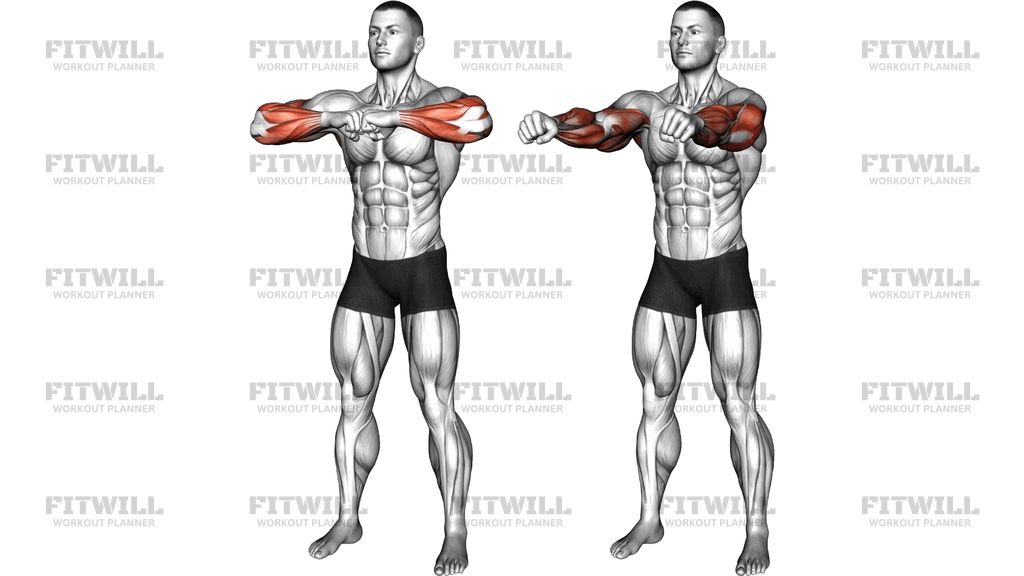
The Standing Arms And Wrist Circle is a simple body weight mobility drill performed with the arms extended straight forward at chest height. You keep both fists clenched and trace continuous circles with the whole arm while simultaneously rotating the wrists, so the forearms, wrists, and shoulders all move through a smooth, controlled loop. Because it needs no equipment and very little space, it works well as a warm-up before lifting, climbing, racket sports, or any activity that loads the grip and wrists.
The main area of work is the forearms. With the fists held tightly, the wrist extensors on the outside of the forearm and the wrist flexors on the inside work continuously to control the rotating motion, while the brachioradialis and other supporting forearm muscles help stabilize the elbow. The front of the shoulders holds the arms up and drives the circular path, and the traps and upper back stay engaged to keep the shoulder blades from creeping up toward the ears.
Setup matters more than it looks. Stand tall with feet about hip-width apart, brace the core lightly, and raise both arms straight ahead so they are parallel to the floor. If the arms drift down, the shoulders take over and the wrists stop moving through their full range; if the arms swing wildly, the exercise turns into momentum rather than control. Keeping the elbows extended but not locked is what keeps constant tension on the forearms through every inch of the circle.
To execute it well, think of drawing a medium-sized circle in the air with your fingertips, no larger than a dinner plate at first. Move the arms and the wrists together in one direction for a set number of reps, then reverse the direction for the same count. Keep the fists clenched firmly but without strangling the hands, breathe steadily, and keep the head neutral with the eyes forward rather than watching the hands.
This movement is most commonly used as a dynamic warm-up, but it also earns its place as a recovery drill between heavy pulling sessions and as a daily maintenance exercise for anyone whose work involves typing, gripping tools, or long hours on a keyboard. Beginners can start with ten circles in each direction and smaller loops, while more advanced lifters can increase the circle size, add tempo changes, or extend the duration to build endurance in the wrist stabilizers.
The main safety point is to stay in a pain-free range. Mild warmth or a gentle burn in the forearms is normal, but any sharp pinching at the wrist or front of the shoulder is a signal to shrink the circle, slow the tempo, or stop. Because the wrists take plenty of abuse in training, this drill should always feel like it is greasing the joints, not grinding them.
[ Workout Log & Planner ]
Put your next workout in Fitwill
Keep your plan and training log ready when you are.


Instructions
- Stand upright with your feet about hip-width apart, weight balanced evenly across both feet, and arms relaxed at your sides.
- Raise both arms straight forward to shoulder height so they are parallel to the floor, elbows extended but not locked.
- Clench both hands into firm fists and turn your wrists so the knuckles face forward.
- Brace your core lightly, pull your shoulder blades down slightly, and keep your head neutral with your eyes ahead.
- Begin tracing small-to-medium circles in the air with both fists at the same time, rotating the wrists as the arms move through the loop.
- Keep the circle smooth and even, roughly the size of a dinner plate, with both arms matching each other.
- Complete 10-15 circles in the forward direction, then reverse and perform the same number backward.
- Breathe steadily throughout, inhaling and exhaling in a relaxed rhythm rather than holding your breath.
- When finished, lower your arms slowly to your sides, shake out the wrists briefly, and reset your posture before the next set.
Tips & Tricks
- Start with a smaller circle than feels necessary. Most people make the loop too big too early, which forces the shoulders to shrug and steals the work from the wrists.
- Watch for the shoulders creeping toward the ears as the set gets harder. Reset the shoulder blades down before continuing, since shrugged shoulders turn this into a trap exercise.
- If your elbows bend during the circle, imagine the arms are steel rods rotating from the shoulder joint only. Bent elbows dramatically reduce the wrist rotation and forearm involvement.
- A death grip on the fists is a common mistake. Squeeze firmly enough that the wrists feel active, but loosen slightly if your hands start tingling or your fingers go white.
- Do the drill in both directions equally. Skipping the reverse circles leaves the wrists lopsided and reduces the warm-up benefit before pressing or pulling.
- For desk workers, perform this a few times a day with slow circles rather than one long session, since frequent light movement suits the wrists better than a single aggressive bout.
- If your wrists crack or feel tight at first, slow the tempo down to roughly two seconds per circle and let the range grow naturally over the first week or two.
- Pair this with a few arm swings or shoulder rolls beforehand if your shoulders feel stiff, since tight shoulders often limit the arm circle before the wrists ever get challenged.
Frequently Asked Questions
What muscles does the Standing Arms And Wrist Circle work?
It primarily targets the forearms, especially the wrist extensors and wrist flexors that control the rotating fists. The front shoulders hold the arms at chest height, and the upper back and traps work lightly to keep the shoulder blades stable.
Is the Standing Arms And Wrist Circle suitable for complete beginners?
Yes, it is one of the most accessible arm drills because it uses no equipment and only your body weight. Start with small circles, around ten in each direction, and build the size and duration gradually.
Should my elbows stay straight during the Standing Arms And Wrist Circle?
Yes, keep the elbows extended but not locked. Bending the elbows shortens the lever, reduces the wrist rotation, and shifts the work away from the forearms.
How big should the circles be?
Begin with a circle roughly the size of a dinner plate, then expand slightly as your wrists and shoulders warm up. The right size is the largest loop you can keep smooth and controlled without your shoulders shrugging.
Why do my wrists crack when I do this exercise?
Light, painless cracking during circular wrist movement is common and usually harmless, especially if the wrists have been static for a while. If it comes with discomfort, reduce the circle size and slow the tempo, and stop if there is any sharp pain.
When is the best time to perform the Standing Arms And Wrist Circle?
It works best as a dynamic warm-up before upper body training, climbing, or racket sports, and as a short mobility break during long typing sessions. Doing it before heavy gripping or pressing prepares the wrists for load.
Can I replace the Standing Arms And Wrist Circle with wrist stretches instead?
Static stretches are useful, but they do not replace the active control this drill builds because the arms and wrists move continuously under muscular effort. Ideally use both: circles to warm up dynamically before training, and stretches afterward.
How many reps and sets should I do?
A practical starting point is 2 sets of 10-15 circles in each direction, with a brief pause between directions. For warm-up purposes, one thorough set in both directions is usually enough.
Is it a problem if my arms drift downward during the circles?
Yes, it is the most common form breakdown. When the arms drop below shoulder height, the wrists stop rotating through their full range and the forearms lose tension, so pause, lift the arms back to parallel, and continue.