Alternating Leg V Up
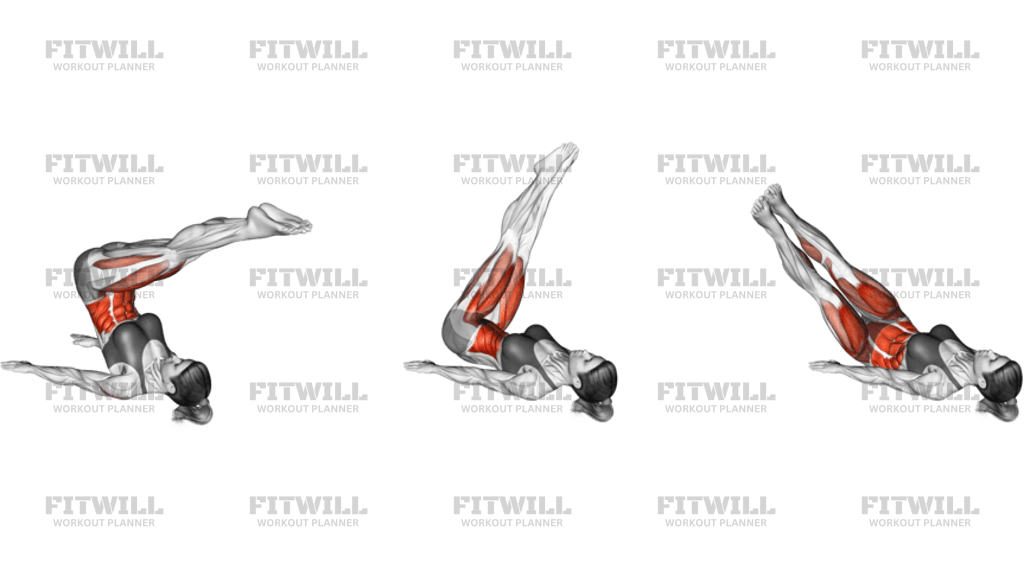
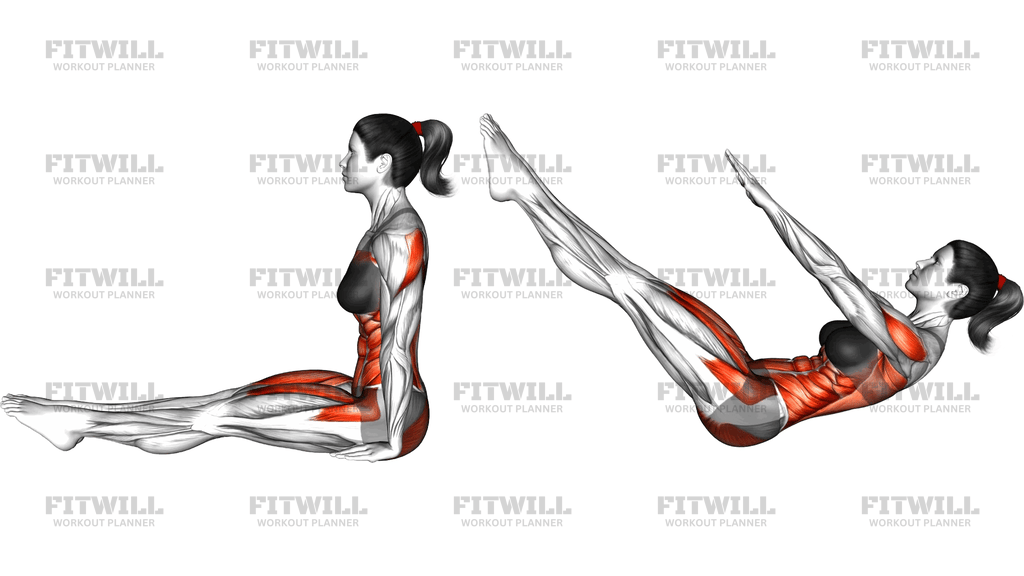
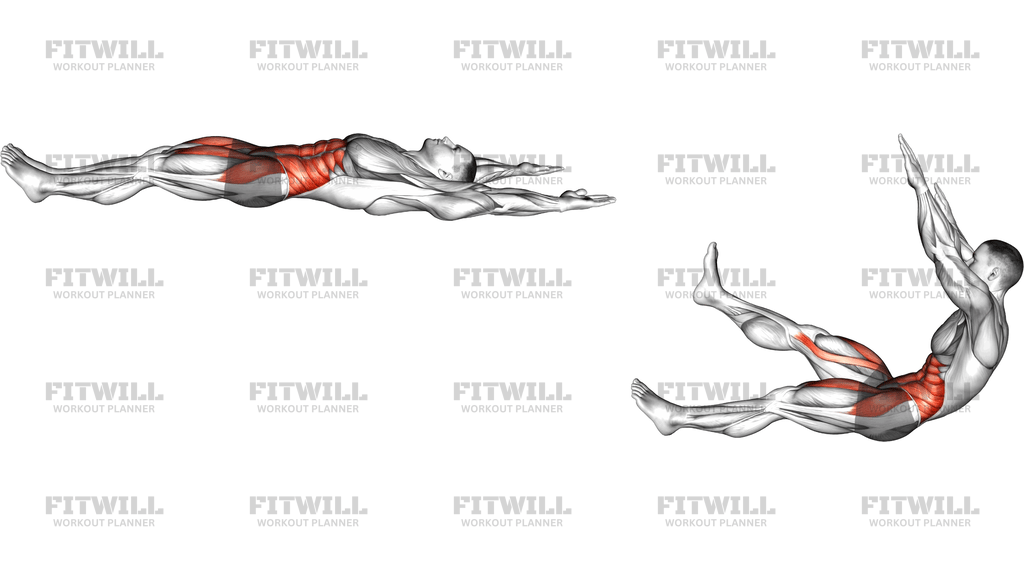
The Alternating Leg V Up is a bodyweight core exercise performed lying on your back, usually on an exercise mat. You start fully stretched out with arms extended overhead and legs straight on the floor, then lift your torso and one leg at the same time so your hands reach toward the raised foot, forming a V shape at the top. You lower back down and repeat on the opposite leg, alternating sides rep by rep.
This movement trains the abs through a much longer range than a standard crunch, because both the arms and legs travel through space from a fully lengthened position. The rectus abdominis flexes the spine as your shoulder blades leave the floor, while the hip flexors work hard to raise the straight leg. Because only one leg comes up at a time, the obliques and deep core also work to keep your trunk from rotating or wobbling as your body shifts slightly to one side.
The Alternating Leg V Up suits anyone who has already built basic crunch and lying leg raise strength and wants a harder floor exercise without equipment. It appears regularly in core circuits, martial arts and wrestling conditioning, and home workouts, since it needs nothing more than a bit of floor space. The alternating pattern also lets you accumulate more total reps than a full two-leg V Up, where both legs must clear the floor simultaneously.
Setup matters more than most people expect. Lying flat with your lower back in contact with the floor, arms overhead, and legs together gives you a stable starting line, and the mat protects your tailbone and spine from repeated contact on the way down. If your lower back arches off the floor before you even begin lifting, the starting position is too aggressive and the exercise loses much of its abdominal emphasis while straining the lumbar area.
To execute it well, think of folding rather than straining: exhale as you curl your upper body up and drive one straight leg toward the ceiling, reaching your fingers toward that foot with a deliberate squeeze at the top. Lower under control until your heel and shoulders are just above the floor, then immediately repeat with the other leg. Avoid jerking your arms or bouncing your leg off the floor, since momentum hides the difference between strong abs and a strong swing.
The main safety point is keeping the movement slow enough that your lower back stays supported. If you feel your lumbar spine lifting or straining, bend the working knee slightly, reduce the range, or spend a few weeks on single-leg toe touches and lying leg raises first. Controlled tempo beats rep count every time with this exercise.
[ Workout Log & Planner ]
Put your next workout in Fitwill
Keep your plan and training log ready when you are.


Instructions
- Lie flat on your back on an exercise mat with your legs straight and together and your arms extended overhead, resting on the floor behind you.
- Pull your ribs down gently so your lower back stays in contact with the mat, and let your head rest in line with your arms rather than jutting your chin forward.
- Brace your core as if preparing for a light punch to the stomach before you start moving.
- Exhale and simultaneously curl your upper body off the floor and raise your right leg, keeping the knee as straight as possible.
- Reach your hands toward your right foot at the top, forming a V with your torso and raised leg, and squeeze your abs for a moment.
- Lower your torso and right leg slowly until your heel and shoulders are just above the mat, keeping tension instead of dropping down.
- Repeat the same folding motion with your left leg, reaching toward your left foot.
- Keep breathing steadily throughout: exhale as you lift and reach, inhale as you lower.
- Continue alternating legs until you complete the planned number of reps, then settle flat on the mat and let your arms rest at your sides before standing up.
Tips & Tricks
- If your heels scrape the floor on every rep, your legs are not lifting high enough — drive each foot up toward the ceiling rather than toward your head.
- Do not yank your arms forward to start the rep; initiate the fold from your abs by pulling your ribs toward your hips, and let the arms simply reach to meet the foot.
- Watch for your lower back popping off the mat as the non-working leg returns down — brace harder or slightly bend the knees if you notice it arching.
- Because you lift one leg at a time, your trunk tends to twist toward the working side; keep both shoulders level and your chest facing the ceiling to hold the obliques honest.
- Keep the non-working leg from dangling loosely at the bottom — a light, controlled lower keeps tension on the abs between reps.
- Slow the lowering phase to two or three seconds if you are cheating with momentum; the descent is where most of the lengthening work for the abs happens.
- If reaching all the way to the foot is too hard, aim your fingers toward the shin or knee first and build range gradually.
- A common mistake is craning the neck to see the foot — keep your chin slightly tucked and look straight up or along your body line instead.
- Pause for one full breath count at the top of each rep to force a real contraction instead of bouncing through the middle position.
Frequently Asked Questions
Which muscles does the Alternating Leg V Up work the most?
The lower abs and rectus abdominis do the bulk of the work as you fold your trunk and lift a straight leg. The hip flexors assist strongly on the leg raise, and the obliques stabilize your torso against the side-to-side shift of the alternating pattern.
How is the Alternating Leg V Up different from a regular V Up?
In a regular V Up both legs rise together with the torso, while the Alternating Leg V Up lifts one straight leg at a time. This makes each rep slightly easier on the hips, lets you do more total reps, and adds a small anti-rotation demand for the obliques.
Is the Alternating Leg V Up suitable for beginners?
It is challenging for true beginners because the arms start overhead and the leg stays straight, which puts the abs at a long leverage disadvantage. Start with crunches, lying leg raises, or single-leg toe touches, and move to this once you can control those with a flat lower back.
Why does my lower back arch and hurt during the Alternating Leg V Up?
That usually means your hip flexors are pulling your spine into extension faster than your abs can control it. Slow the tempo, slightly bend the working knee, keep the leg you are not lifting closer to the floor but not fully slack, and shorten the range until your lower back stays on the mat.
Should my knees be straight or bent in the Alternating Leg V Up?
Straight knees match the classic form shown for this exercise and make the hip flexors and abs work harder, but a soft bend in the knee is fine if straight legs pull your back off the floor. Keep the knee angle the same on every rep so the load stays consistent.
Do I need to touch my foot at the top of each rep?
Touching the foot is a useful target but not required — what matters is folding far enough that your shoulder blades clear the floor and your abs contract fully. Reaching toward the shin or knee is a legitimate starting point and still trains the same movement.
How many reps and sets of the Alternating Leg V Up should I do?
Because it is a bodyweight movement, work in the range of 8 to 20 alternating reps per set, stopping when your form breaks rather than when your abs merely burn. Two to four sets placed at the end of a workout works well for most core routines.
What can I substitute if the Alternating Leg V Up is too difficult?
Single-leg toe touches, lying leg raises, and dead bugs all train similar patterns with less leverage demand. Once those feel controlled, the Alternating Leg V Up becomes a natural next step.
Do I need an exercise mat for the Alternating Leg V Up?
A mat is strongly recommended because your tailbone, spine, and shoulder blades repeatedly contact the floor on every rep. On a hard surface the repeated contact is uncomfortable and can make you rush the lowering phase.