Weighted Plate Seated Neutral Grip Wrist Curl
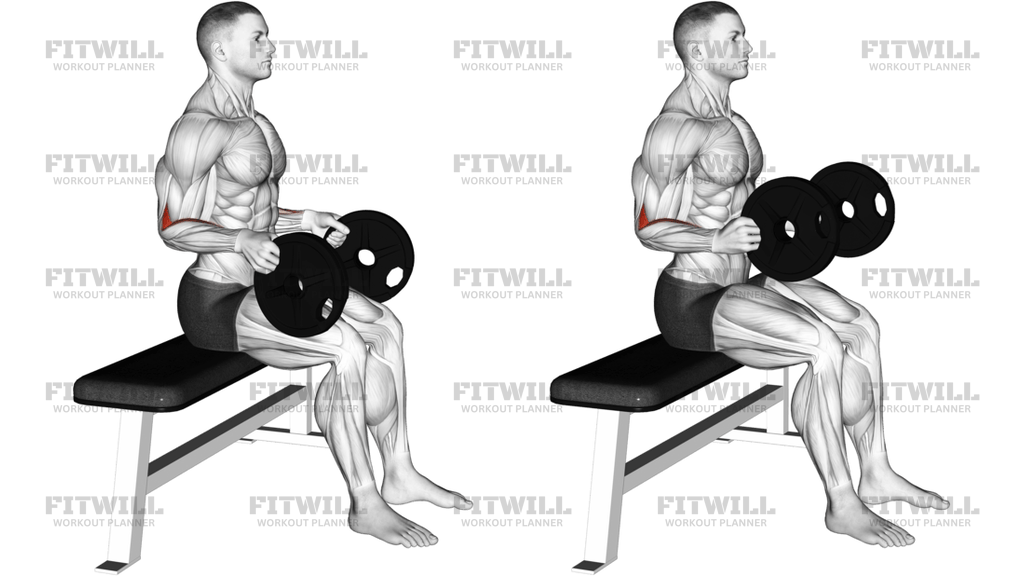
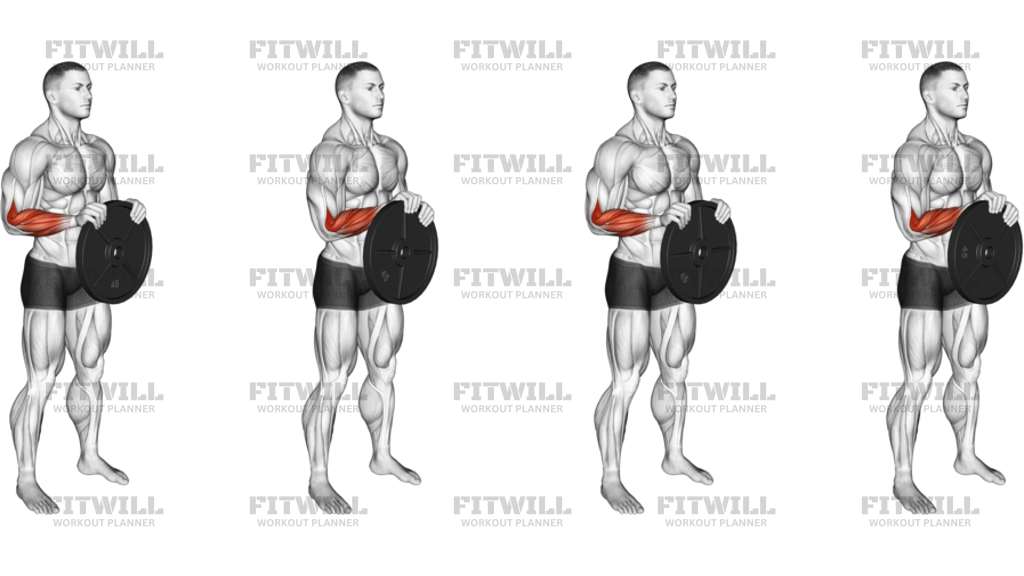
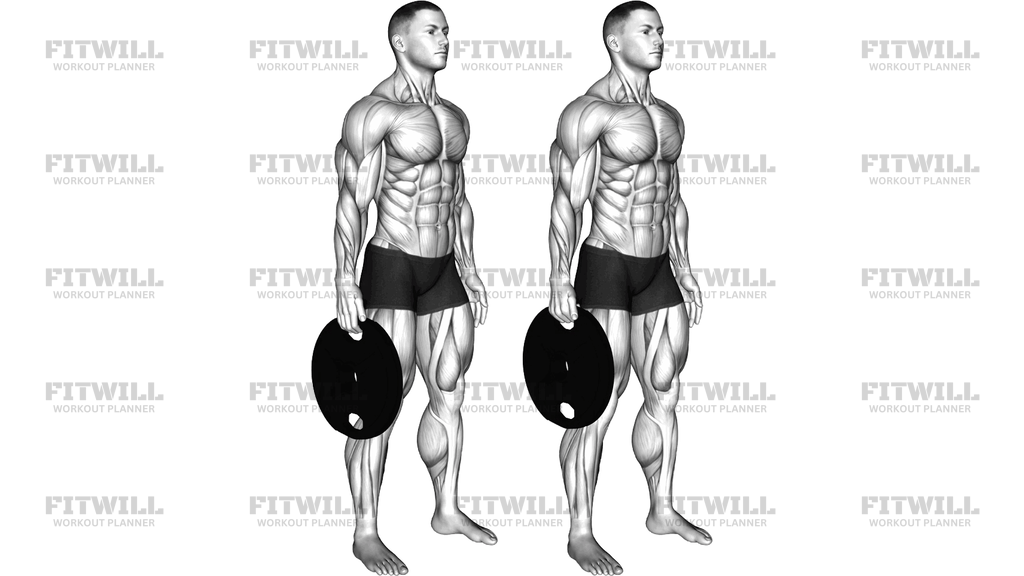
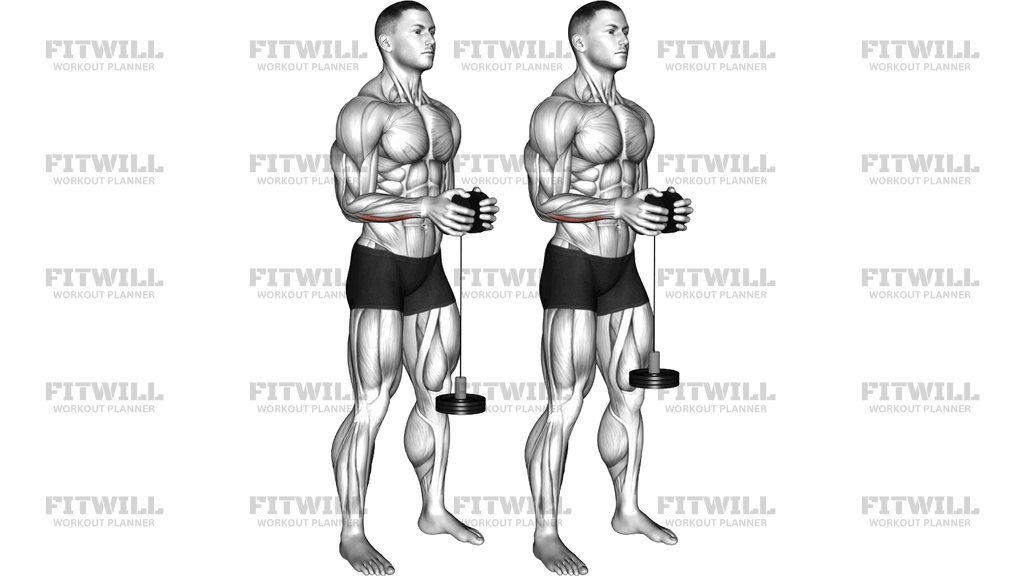
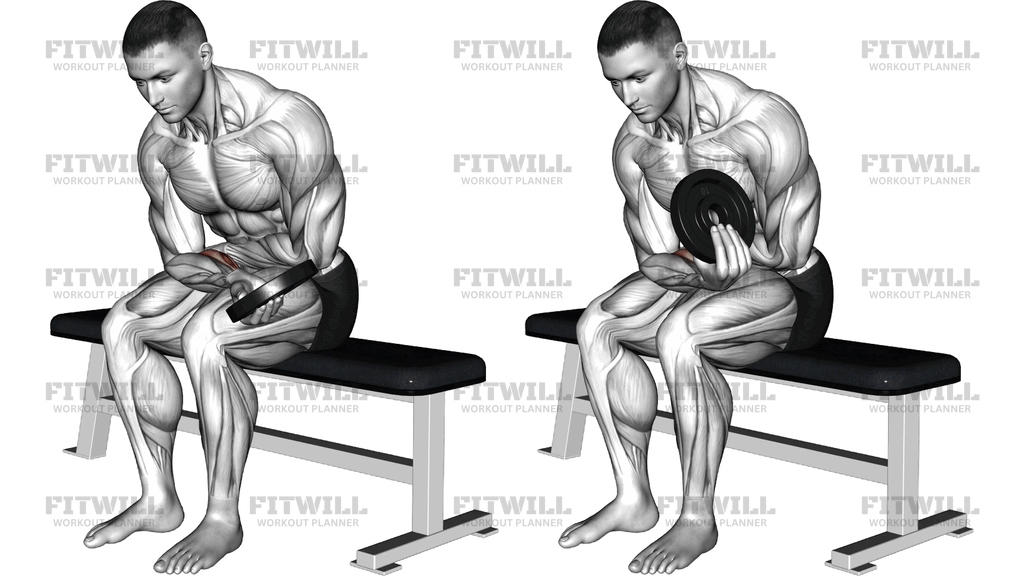
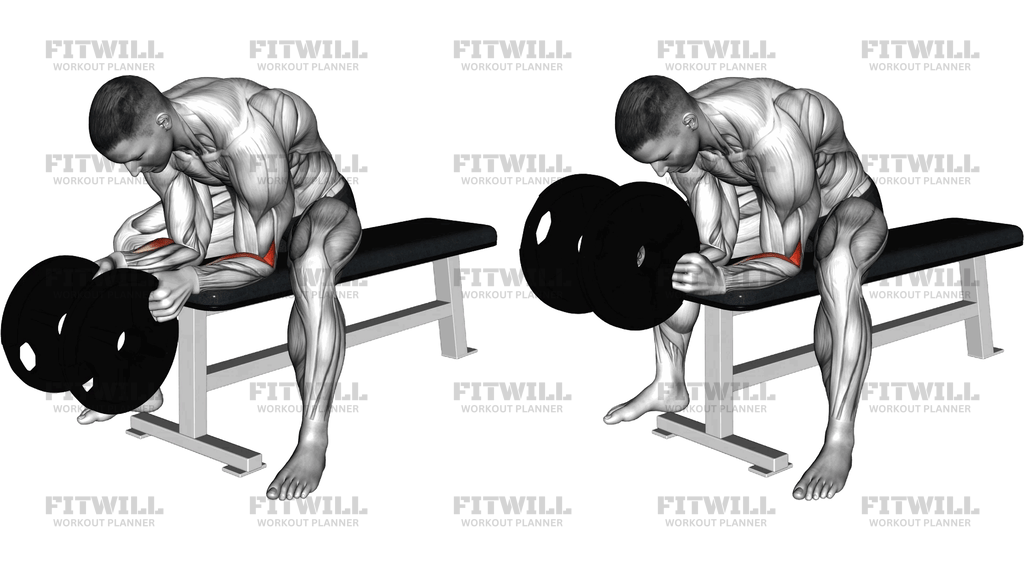
The Weighted Plate Seated Neutral Grip Wrist Curl is a forearm isolation movement performed at the end of a flat bench. You sit with your knees bent and feet planted, lean forward, and rest the back of your forearm along the bench pad so the wrist hangs just past the edge. Instead of a barbell or dumbbell, you hold a weight plate in a neutral, hammer-style grip, with the palm facing sideways and the fingers wrapped through the center hole or pinching the rim. From there you curl the wrist upward and lower it back down with control.
The neutral grip is what sets this exercise apart from a standard palms-up wrist curl. Rotating the hand so the thumb faces up shifts emphasis along the forearm flexors and loads the wrist in a slightly different plane, which is useful for building balanced forearm development and supporting grip strength. Because you are holding a flat plate rather than a handled implement, your fingers and thumb also work hard just to keep the weight secure, so the forearms and grip get a double duty stimulus.
This is a good choice for lifters whose grip gives out during deadlifts, rows, or carries, and for anyone who wants thicker forearms without adding a lot of equipment. A single plate and a bench are enough, which makes it easy to slot in at the end of an upper body session. Climbers, fighters, and racket sport players often appreciate the neutral position because it mirrors how the wrist is loaded in many real-world pulling and holding tasks.
Setup matters more than load here. Your forearm needs full contact with the bench so the elbow stays fixed and the wrist is the only joint doing the work. If the elbow drifts or the shoulder hikes up, the plate starts moving from momentum instead of wrist flexion, and the target muscles stop doing their job. Choose a plate you can control through a full, smooth arc rather than one you have to heave up.
To execute it well, curl the wrist up as high as the range comfortably allows, squeeze the flexors at the top for a beat, then lower the plate slowly until the wrist bends fully in the other direction. Keep the reps slow and deliberate, since the wrist joint does not respond well to bouncing or jerky movement. Start light, learn the path, and progress the weight only when the motion stays clean from top to bottom.
As with any direct wrist work, treat this as a finishing movement. A couple of sets of moderate to high reps after your main lifts is usually plenty. If you feel any sharp discomfort in the wrist joint itself rather than muscular fatigue in the forearm, stop, reduce the load, or switch to a lighter plate until the movement feels comfortable.
[ Workout Log & Planner ]
Put your next workout in Fitwill
Keep your plan and training log ready when you are.


Instructions
- Sit sideways at the end of a flat bench with your feet flat on the floor and your knees bent to roughly 90 degrees.
- Pick up a weight plate and hold it in one hand in a neutral grip, palm facing sideways toward your midline, fingers wrapped through the center hole or pinching the rim.
- Lean forward and lay the back of your forearm along the bench pad so the wrist extends just past the edge and the hand hangs free.
- Let the wrist bend downward so the plate drops slightly below bench height, and settle your upper body into a stable, forward-leaning position.
- Brace your core and keep your elbow planted in one spot on the bench for the entire set.
- Curl the wrist upward by pulling your knuckles and the plate toward the top of your forearm, moving only at the wrist joint.
- Pause briefly at the top of the curl and squeeze the forearm flexors.
- Lower the plate slowly until the wrist has bent fully in the opposite direction, resisting the weight on the way down.
- Exhale as you curl the plate up and inhale as you lower it back down.
- Complete all reps on one side, switch the plate to the other hand, and repeat with the opposite forearm on the bench.
Tips & Tricks
- The most common mistake with this setup is rolling the whole forearm off the bench to help lift the plate. If the elbow slides or the arm lifts, drop to a lighter plate until the wrist alone can move the weight.
- Because a plate has no handle, finger fatigue often fails before the wrist does. If your grip slips mid-set, reposition your fingers fully through the center hole rather than half-hooking the rim.
- Keep your palm facing sideways throughout. If your hand rotates so the palm turns up or down, you have drifted into a standard wrist curl and changed which forearm fibers are working.
- Lower the plate under control on every rep. Letting it free-fall into the bottom position is hard on the wrist joint and wastes half the movement.
- If the bench edge digs into your forearm, shift the arm slightly so the bony part of the wrist rests past the pad and the fleshy part of the forearm sits on the cushion.
- Stay leaned forward with your chest over your thighs. Sitting upright changes the wrist angle relative to the bench and shortens the working range.
- A thumb-up plate grip loads the wrist slightly differently than a barbell, so expect your working weight to be lower than on a bar wrist curl. That is normal.
- Do both sides even if your non-dominant hand feels weaker, and match the reps to your weaker side rather than your stronger one.
- Warm the wrists up with a few bodyweight curls before adding the plate, especially on cold days or before heavy sets.
Frequently Asked Questions
What muscles does the Weighted Plate Seated Neutral Grip Wrist Curl work?
The main muscles are the forearm flexors on the palm side of the forearm, working in a neutral hand position. Your grip muscles, especially the fingers and thumb, also work hard to hold onto the plate.
Why use a weight plate instead of a barbell or dumbbell for this wrist curl?
A plate forces your fingers and thumb to actively secure the weight, adding a grip challenge on top of the wrist flexion. The neutral, thumb-up grip also loads the wrist from a slightly different angle than a palms-up bar curl.
How should I hold the plate in the neutral grip?
Slip your fingers through the center hole or pinch the rim so the plate hangs vertically, with your palm facing sideways toward your body. Make sure the whole hand is engaged before you start the set.
Is this exercise suitable for beginners?
Yes, as long as you start with a light plate and keep the movement slow. Wrist curls are simple in concept, but beginners should prioritize a smooth range over heavy weight to protect the wrist joint.
Why do I need to keep my forearm flat on the bench?
The bench acts as a fixed support so the elbow cannot move and the wrist is the only joint doing the work. If the forearm lifts or slides, momentum takes over and the forearm flexors stop being properly isolated.
How many reps and sets should I do?
Two to three sets of 10 to 20 reps per side works well as a forearm finisher. Because the movement is short-range and joint-loaded, moderate weight and higher reps are usually more productive than max loads.
What is the most common mistake with this movement?
Using too heavy a plate and turning the exercise into a whole-arm heave, with the elbow rolling off the bench. If you cannot curl and lower the plate using wrist motion alone, reduce the weight.
What can I use if I do not have a flat bench?
Any sturdy padded surface at thigh height, such as a bench or box, works as long as your forearm can rest flat with the wrist hanging past the edge. You can also perform the same neutral-grip wrist motion with a dumbbell if no plate is available.
Is the Weighted Plate Seated Neutral Grip Wrist Curl safe for the wrists?
For most people it is safe when done with controlled reps and sensible weight. Avoid bouncing at the bottom, keep the range pain-free, and stop if you feel sharp or pinching sensations inside the wrist joint rather than simple muscle fatigue.
Will this exercise improve my grip for pulling lifts?
It can contribute, since the forearm flexors and fingers get direct work holding and curling the plate. For the best carryover to deadlifts and rows, pair it with heavier gripping work like holds or carries.