Seated Back Stretch On A Chair
The Seated Back Stretch On A Chair is a simple, equipment-light stretch that targets the muscles running along your spine and across your upper back. You sit sideways-free on a sturdy chair with your feet planted, hinge forward from the hips, and let your torso sink between your knees while your arms reach out in front of you. The rounded, folded position lengthens the lats, the erector spinae of the lower back, and the muscles between the shoulder blades all at once, which is hard to achieve standing up.
This stretch is especially useful for people who spend long hours sitting at a desk or behind a wheel. Prolonged sitting keeps the mid back in a slightly rounded posture and the lats in a shortened state, which often shows up as stiffness when you try to reach overhead or stand up straight. Because the chair supports your weight, you can relax fully into the stretch instead of fighting for balance, making it a good fit for beginners, older adults, and anyone in post-workout recovery after back or pulling days.
The setup matters more than it looks. Your feet should stay flat on the floor and your hips should remain on the chair as you fold; if your pelvis rolls backward off the seat, the stretch shifts away from the back and into the hamstrings and hips. Sitting toward the front edge of the chair gives your thighs room to make contact with your torso, while a braced, tall starting spine ensures you hinge rather than collapse.
To perform it well, start tall with a neutral back, take a breath in, and as you exhale walk your hands forward along your thighs and beyond your knees, letting your chest travel toward the floor. Your arms can rest on your legs, reach toward the ground, or extend overhead depending on how deep you want the lat stretch. Hold the end position while breathing steadily, letting each exhale settle you a little deeper, then roll back up slowly through the spine.
A few practical points keep this safe and effective. Move into the fold gradually rather than pulling yourself down, and never bounce at the bottom. If you feel sharp or pinching sensations anywhere in the spine, back off to a shallower angle. Most people get the best results holding the position for 20 to 40 seconds and repeating it two to three times, either as part of a warm-up, a desk-break routine, or a cool-down after training.
[ Workout Log & Planner ]
Put your next workout in Fitwill
Keep your plan and training log ready when you are.


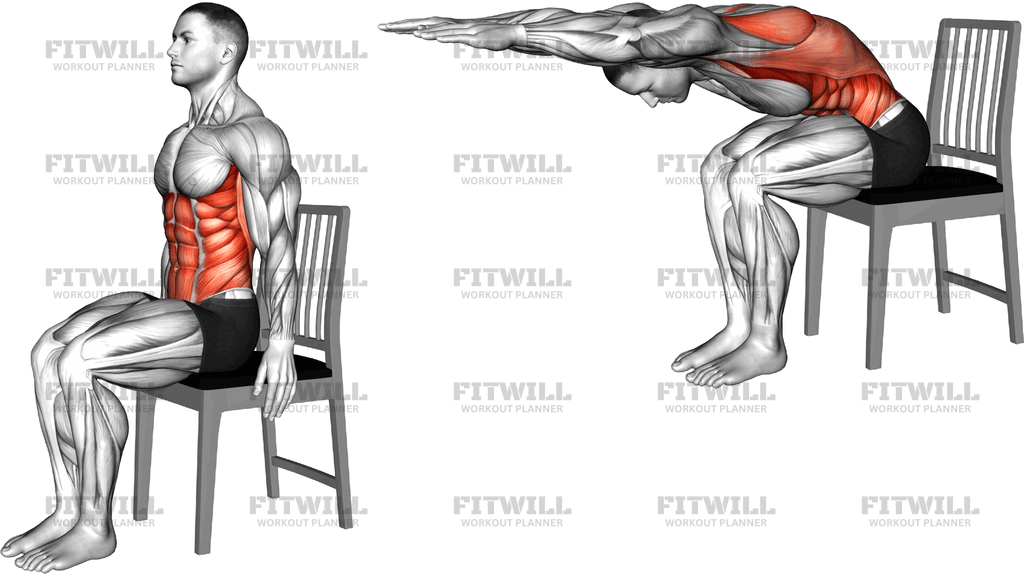
Instructions
- Sit sideways-free on the front half of a sturdy, armless chair with your feet flat on the floor about hip-width apart.
- Sit up tall at the start, letting your spine reach its full neutral length with your shoulders relaxed and your hands resting on your thighs.
- Take a slow breath in through your nose to fill your torso and set your posture.
- As you exhale, hinge forward from the hips and slide your hands forward along your thighs toward your knees.
- Continue folding until your chest moves down toward your thighs and your belly settles between them, letting your back gently round.
- Extend your arms forward in front of you, or let them reach toward the floor or overhead, to deepen the stretch through the lats and mid back.
- Hold the folded position for 20 to 40 seconds, breathing steadily and letting each exhale release you slightly deeper into the stretch.
- To come out, place your hands on your thighs or knees and slowly roll your spine back up one section at a time until you return to the tall seated position.
- Rest for a few breaths, then repeat the fold two to three times if desired.
Tips & Tricks
- Sit toward the front edge of the chair rather than against the backrest, or your thighs will have no room to fold and the stretch will feel blocked.
- Keep your feet firmly planted throughout; if your heels lift as you fold, you are rounding from the hips too early and losing the back stretch.
- A common mistake is pulling yourself down with your hands gripping your ankles. Let gravity do the work so the back muscles can actually release.
- If your head hangs heavy and strains your neck, lightly support it by resting your forearms on your thighs instead of letting your arms dangle.
- Avoid locking your knees straight against the chair edge; a small bend keeps blood flow comfortable and prevents the hamstrings from stealing the stretch.
- If the lower back feels compressed rather than lengthened, imagine your chest moving forward and down in a long arc instead of straight toward the floor.
- Do this stretch after training or after a long sitting period rather than as a cold first movement, when the back muscles respond more willingly.
- Come up slowly and avoid popping straight back upright, since rising quickly from a deep fold can leave you lightheaded.
Frequently Asked Questions
Which muscles does the Seated Back Stretch On A Chair target?
It primarily lengthens the lats along the sides of the back and the erector spinae of the lower back. The rhomboids and mid-trapezius between the shoulder blades also get a gentle stretch as the upper back rounds.
Is the Seated Back Stretch On A Chair good for beginners?
Yes, it is one of the most beginner-friendly back stretches because the chair supports your full weight and you control the depth completely. Beginners can rest their arms on their thighs for a shallower, very comfortable version.
Why should I sit on the front edge of the chair for this stretch?
Sitting on the front edge gives your thighs space to fold toward your torso so your chest can travel down between them. Against the backrest, your pelvis runs out of room and the fold becomes shallow and awkward.
How long should I hold the Seated Back Stretch On A Chair?
Hold the folded position for 20 to 40 seconds and repeat two to three times. Longer holds of up to a minute work well after workouts when the goal is releasing tight back muscles.
My lower back feels pinched when I fold forward. What should I change?
Back off to a shallower angle and focus on hinging from the hips with a long spine instead of collapsing straight down. Sharp or pinching sensations are a signal to reduce the range, not push through.
Can I do the Seated Back Stretch On A Chair if I cannot reach the floor with my hands?
Absolutely. Simply rest your forearms on your thighs or slide your hands as far along your legs as feels comfortable. The stretch comes from the fold of the torso, not from touching the floor.
What can I use if I don't have a suitable chair?
Any stable, armless seat works, such as a bench or the edge of a bed or ottoman. Avoid chairs with wheels or armrests, which make the fold unstable or impossible.
Is it normal to feel this stretch in my hamstrings too?
Some hamstring involvement is normal in a seated forward fold, especially if your legs are fairly straight. Bend your knees slightly and keep your hips on the seat to shift the emphasis back toward the lats and lower back.
When is the best time to use the Seated Back Stretch On A Chair?
It works well as a cool-down after back or pulling workouts, and also as a desk-break stretch to counteract long periods of sitting. Use it when the muscles are warm for the most comfortable range.