Single Leg Hip Extension With Chair Supported
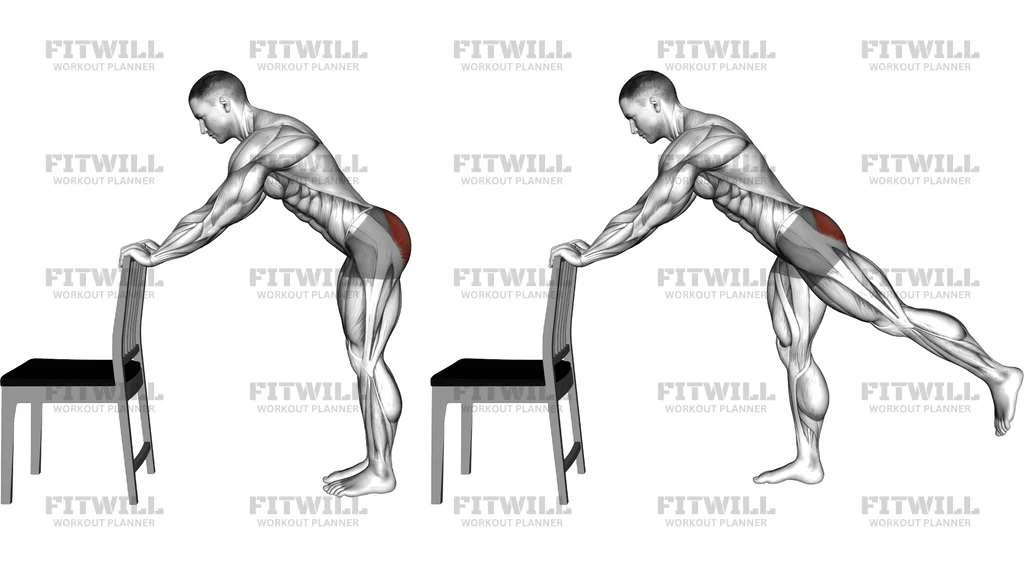
Single Leg Hip Extension With Chair Supported is a body weight glute exercise performed standing behind a sturdy chair. You hinge forward from the hips, place both hands on the chair back for balance, and extend one leg straight behind you by squeezing the glute of that leg. The chair takes care of stability so you can focus entirely on driving the movement from the hip instead of worrying about falling over.
The main muscle at work is the glute of the moving leg, with the hamstrings assisting as the leg travels back. Your standing leg, along with the muscles of the lower back and core, works isometrically to hold a stable hinged position while the other leg moves. Because you are hinged forward rather than upright, the hip extension angle targets the glutes more directly than a standing leg swing would.
This setup is especially useful for beginners learning what a glute contraction actually feels like, for people rebuilding hip strength after time away from training, and for anyone who wants to train one side at a time without equipment beyond a chair. It is also a practical warm-up drill before squats, deadlifts, or lunges, since it wakes up the glutes and exposes left-to-right differences in hip strength and control.
The chair matters more than it looks. Placing your hands on the backrest creates a stable anchor that lets you keep a flat back and a neutral neck while you hinge. Without support, most people arch their lower back or swing the leg to generate momentum, which shifts work away from the glute and toward the lumbar spine. The chair removes that compensation route.
To execute it well, hinge at the hips until your torso is angled toward the floor with a straight spine, and keep the working leg in a straight line from hip to heel as it lifts. The leg should rise because the glute shortens, not because the torso drops or the back rounds. A controlled tempo, a clear squeeze at the top, and a slow lower are worth more than height.
Keep the range honest. The leg does not need to reach horizontal; lifting only to hip height or slightly below with a strong glute contraction beats cranking the leg upward by arching. If your lower back grips or you feel the work in the front of the hip, reduce the height and slow the tempo.
[ Workout Log & Planner ]
Put your next workout in Fitwill
Keep your plan and training log ready when you are.


Instructions
- Place a sturdy chair on a non-slip floor and stand behind it, facing the backrest, with your feet roughly hip-width apart.
- Hinge forward from the hips and grip the top of the chair back with both hands, letting your arms extend so your torso angles down toward the seat.
- Shift your weight slightly onto one leg and brace your core to lock your torso in the hinged position.
- Keeping the working leg straight, squeeze its glute and lift the leg back and up behind you, pointing the foot in line with the leg.
- Stop at the highest point you can reach without your lower back arching, hold for a beat, and feel the glute fully contracted.
- Lower the leg back down under control until the toes are close to the floor, keeping tension in the glute rather than resting between reps.
- Exhale as you lift the leg back, inhale as you lower it, and keep your breathing steady throughout the set.
- Complete all reps on one side, then switch legs, rechecking your hinge and grip before starting the second side.
Tips & Tricks
- The most common fault is arching the lower back to lift the leg higher; if your back hollows, the leg is above your true glute range, so lower the target height.
- If your standing knee locks back hard, keep a soft bend in it so the standing leg stays a stable support rather than hanging on the joint.
- Point the toes of the working leg slightly down and back; a flexed foot often makes people lift with the front of the hip instead of the glute.
- Keep your shoulders down away from your ears and your arms relaxed on the chair, since leaning your weight onto the hands steals tension from the hips.
- Move the leg straight back in line with your hip; letting it drift out to the side turns this into a different hip exercise.
- If you cannot feel the glute working, tap it with your free focus or mentally push the heel toward the ceiling instead of lifting the foot.
- Set the chair against a wall if it slides on smooth floors; a shifting anchor will pull your posture apart mid-rep.
- Pause for one full second at the top of each rep; this exercise is easy to rush, and the pause is where the glute actually gets challenged.
- If your hamstrings cramp, shorten the range slightly and squeeze more deliberately at the top rather than reaching for height.
Frequently Asked Questions
What muscles does the Single Leg Hip Extension With Chair Supported work?
The glute of the moving leg is the primary muscle, with the hamstrings assisting the backward lift. The standing leg, lower back, and core work to hold the hinged position steady.
Why does this exercise use a chair instead of being done free-standing?
The chair back gives your hands a fixed anchor so you can hold a forward hinge without losing balance. That lets you concentrate on a clean glute contraction instead of stability, which makes it ideal for learning the movement.
How high should I lift my leg in the Single Leg Hip Extension With Chair Supported?
Lift only as high as you can while keeping your lower back neutral, which for most people is around hip height. Going higher usually comes from arching the back, not from more glute work.
Is this exercise suitable for beginners?
Yes, it is one of the more beginner-friendly glute exercises because the chair removes balance demands and the only load is your own leg. Start with one or two sets of eight to twelve slow reps per side.
My lower back feels this instead of my glutes. What am I doing wrong?
You are most likely arching your lower back to lift the leg higher or letting your torso drop as the leg rises. Hinge slightly less, lift to a lower target, and think about driving the heel back rather than up.
Should the working leg stay straight or can I bend the knee?
Keep it straight so the hamstrings and glutes work together through the intended path. Bending the knee shifts emphasis toward the hamstrings and turns it into more of a leg curl-style movement.
Can I use something other than a chair for support?
Yes, any stable surface at roughly waist height works, such as a countertop, the back of a sofa, or a squat rack upright. Just make sure it cannot slide or tip while your weight is on it.
How is this different from a glute kickback with a cable?
The movement path is the same hip extension, but here the resistance is only the weight of your leg and the chair handles balance. Cable versions add load, so this one works better as a learning drill, warm-up, or high-rep finisher.
Is it safe to do Single Leg Hip Extension With Chair Supported every day?
Because the load is light and the movement is low stress, daily practice is generally fine and is often used to reinforce glute activation. Stop if you feel joint discomfort rather than muscle fatigue.
How do I make this exercise harder without adding equipment?
Slow the lowering phase to three or four seconds, add a two-second pause at the top, or increase reps substantially. Adding a light ankle weight once the body weight version feels easy is also an option.