Seated Dynamic Jabs On Chair
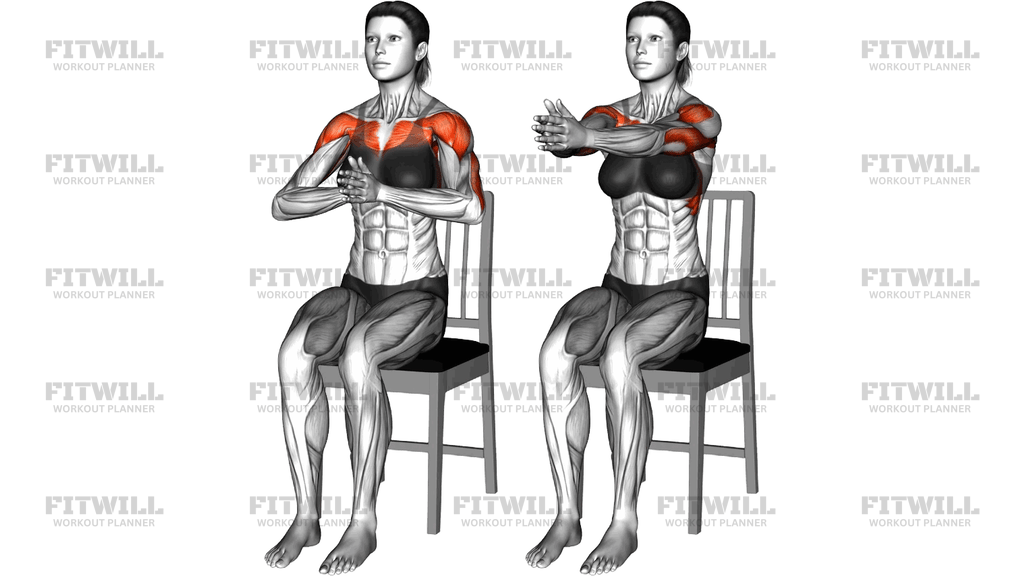
Seated Dynamic Jabs On Chair is a bodyweight striking drill performed from a simple upright chair. You sit tall with your feet planted, bring your fists up to a boxing guard at chin level, and fire straight punches forward one arm at a time. Because the chair removes your legs from the equation, every ounce of power has to come from your chest, shoulders, arms, and the rotational control of your trunk.
This movement is a great fit for people who want the upper-body and trunk benefits of punching work without standing drills. It suits beginners learning the jab pattern, older adults who need a stable base, office workers squeezing in movement breaks, and anyone rehabbing lower-body limitations who still wants to train the upper body dynamically. Boxers and kickboxers also use seated variations to isolate hand speed and shoulder endurance without footwork masking technique flaws.
The main muscles doing the work are the chest and front shoulders, which drive the arm forward, with the triceps finishing the extension. Your core, especially the obliques, braces and controls the small trunk rotation each punch creates, and the muscles between your shoulder blades work to retract the arm back to guard. Because you are seated with no lower-body drive, the shoulders tend to fatigue faster than they would during standing shadowboxing, so expect a burning feel across the front of the shoulders as sets get longer.
The setup matters more than it looks. Sitting away from the backrest forces your trunk to hold itself upright, which turns every punch into a small anti-rotation exercise for your core. Feet flat and knees bent roughly ninety degrees give you a stable base so the punching force does not rock you side to side. A sturdy, non-rolling chair is essential, since any wobble shows up immediately as sloppy punches.
To execute well, keep your fists loose until the moment of extension, punch straight out at chest height rather than arcing around your body, and rotate the fist so the palm turns downward as the arm reaches full extension. Snap the hand back to your chin just as quickly as it went out. Exhale sharply on each punch and reset your breath as the hands return. Alternate arms at a rhythm you can hold for the entire set, whether that is a controlled pace for technique work or a faster tempo for conditioning.
A practical safety note: stop the set when your punches start drifting downward or your lower back starts rounding, as those are the first signs of fatigue in this position. Keep the elbows from snapping into full lockout at high speed, and stay tall through the spine rather than leaning into each punch.
[ Workout Log & Planner ]
Put your next workout in Fitwill
Keep your plan and training log ready when you are.


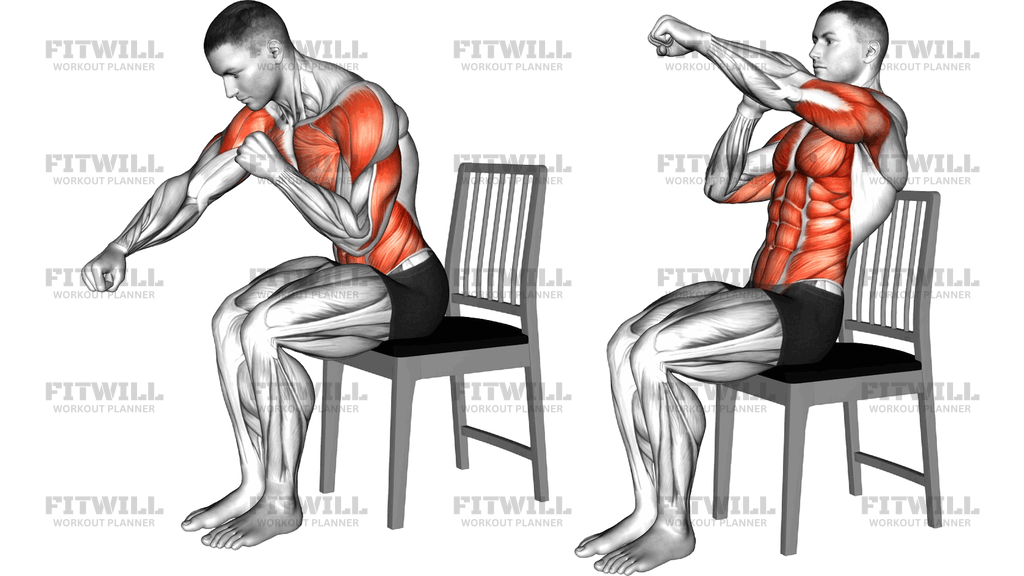
Instructions
- Sit on a sturdy, armless chair with your feet flat on the floor, hip-width apart, and knees bent about ninety degrees.
- Slide forward or back so your torso sits tall and upright without touching the backrest, and place your weight evenly across both seat bones.
- Make loose fists and bring both hands up to chin level in a guard position, elbows tucked close to your ribs.
- Brace your core and pull your shoulders down and back so they are not hiked up toward your ears.
- Exhale and extend one arm straight forward at chest height, rotating the fist so the palm faces down at full extension.
- Keep the opposite hand pressed lightly against your chin in guard and allow only a small rotation through the ribs as you punch.
- Snap the punching hand straight back to your chin while the other arm begins its punch, keeping the alternation smooth.
- Breathe out sharply on every punch and inhale as the hands recycle back to guard.
- Continue alternating jabs for your chosen number of reps or time interval, keeping the pace consistent.
- When finished, rest both hands on your thighs, sit back against the chair, and catch your breath before the next set.
Tips & Tricks
- Loose fists are faster fists. Squeezing your hands tight from the start fatigues the forearms early and slows the snap of each jab.
- If your torso starts rocking side to side, narrow the rotation to just the ribs and shoulders. Excessive lean means your core is not bracing hard enough.
- Do not punch downward. Fatigue usually pulls the fist path toward the lap, so check that each punch finishes at chest height.
- Keep the extended elbow soft rather than snapping into a hard lockout, especially at fast tempos, to protect the joint.
- If your shoulders creep up toward your ears, pause, drop them back down, and continue at a slower pace.
- A chair with wheels or a folding seat is a poor partner here. Test that it is stable and will not slide before the first punch.
- For conditioning, count punches rather than reps, aiming for steady rounds of thirty to sixty seconds with short rests between.
- Your feet should stay glued to the floor. If they lift as you punch, you are generating the movement from your trunk instead of your arm.
- Reset your posture between sets rather than sliding into a slouch, so every set starts from the same tall seated position.
Frequently Asked Questions
What muscles do Seated Dynamic Jabs On Chair work?
The chest and front shoulders drive each punch forward, the triceps finish the arm extension, and the obliques and deep core control the small trunk rotation. The upper back also works as the hand retracts to guard.
Why is this done seated on a chair instead of standing?
Sitting removes the legs and hips from the movement, so your chest, shoulders, and core have to produce and control all the force. It also gives a stable base for people who cannot safely perform standing punching drills.
Is Seated Dynamic Jabs On Chair suitable for complete beginners?
Yes. The chair makes it one of the safest ways to learn the jab pattern because balance is not a limiting factor. Start with slow, controlled punches before increasing the tempo.
How many punches should I do per set?
For technique, work in rounds of twenty to thirty seconds at a deliberate pace. For conditioning, aim for thirty to sixty second rounds and stop when your punches start drifting below chest height.
Can I add light weights to Seated Dynamic Jabs On Chair?
Small weights are generally not recommended for fast punching motions because they stress the shoulder joint at the end range. If you want more resistance, slow the tempo down instead and stay unloaded.
What is the most common mistake in this exercise?
Leaning the whole torso into each punch instead of keeping a tall spine with a small rib rotation. This turns a shoulder and core drill into a lower back strain and shortens the punch path.
Does this count as cardio or strength work?
It depends on how you program it. Slow, controlled sets build local muscular endurance in the shoulders and arms, while fast continuous rounds raise the heart rate and work as low-impact conditioning.
What can I use if I do not have a suitable chair?
Any stable seat without wheels works, such as a bench or the edge of a sturdy stool. Avoid soft couches and swivel chairs, since they let your hips shift and ruin the punching path.
My lower back gets tight during Seated Dynamic Jabs On Chair. What should I change?
Check that you are sitting tall on both seat bones rather than slumping, and reduce how far you rotate with each punch. Bracing your core before the first punch usually resolves the discomfort.