Seated Straight Leg Crunch On Chair
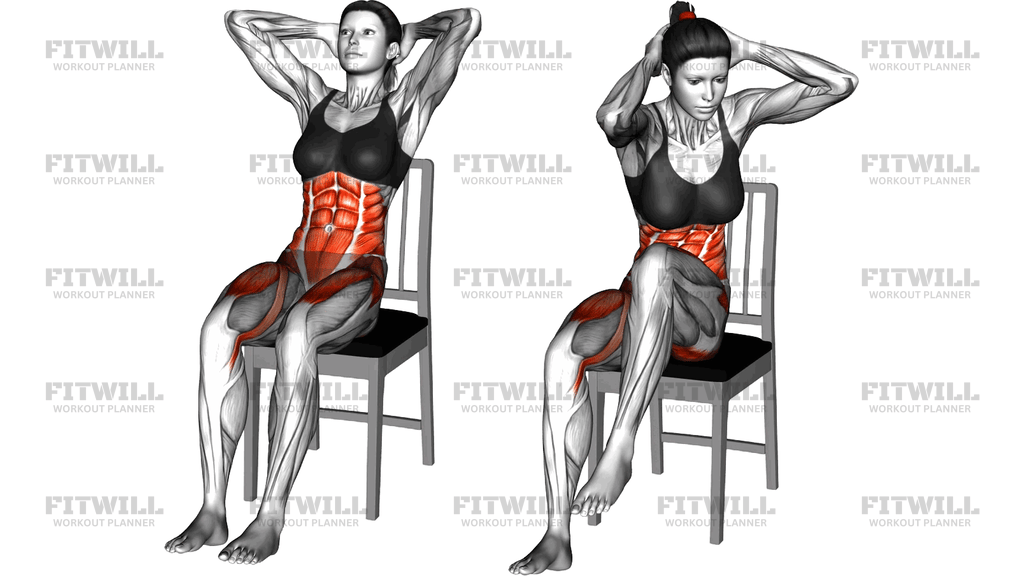
The Seated Straight Leg Crunch On Chair is a body weight abdominal exercise performed from an ordinary chair. You sit sideways on or near the front edge of the seat, extend both legs straight out in front of you with your heels resting on the floor, place your hands lightly behind your head, and then lean your torso back and curl it forward again in a controlled crunch. Because the legs stay fixed and straight, the abs have to work hard to flex the spine without any help from bending the knees.
This movement is a great fit for people who train at home, in an office, or while traveling, since the only equipment needed is a sturdy chair. It also suits anyone who finds floor crunches uncomfortable to get down into or up from, such as older trainees or those with stiff hips or knees. Gym goers can use it as a finishing movement at the end of a core session when the abs are already pre-fatigued.
The primary muscle worked is the rectus abdominis, the front wall of the abs that creates the flexion of the trunk. The obliques assist by stabilizing the ribcage and keeping the torso square, while the hip flexors work isometrically to hold the straight-leg position against the floor. The neck and upper back muscles also contribute lightly to control the head position as the torso rocks back and forward.
The setup matters more than it might seem. Sitting with the legs fully extended and the hips anchored on the seat removes momentum from the lower body, so every degree of trunk movement must come from the abdominals themselves. Sliding too far forward off the chair or letting the hips lift turns the exercise into a rocking motion and bleeds tension away from the abs, so keep your seat position consistent from rep to rep.
To execute it well, think of curling your ribs toward your pelvis rather than simply leaning forward at the hips. Exhale as you crunch down, squeeze the abs briefly at the bottom, and lean back only as far as you can control without your lower back collapsing. Ten to twenty controlled reps per set works well for most people, and the difficulty can be increased by leaning further back or slowing the tempo.
As for safety, this is a gentle exercise as long as you keep the movement in your trunk and avoid yanking on your head with your hands. If you feel the work shifting into your lower back or hip creases instead of your midsection, shorten the range and re-focus on the rib-to-pelvis curl before adding more reps.
[ Workout Log & Planner ]
Put your next workout in Fitwill
Keep your plan and training log ready when you are.


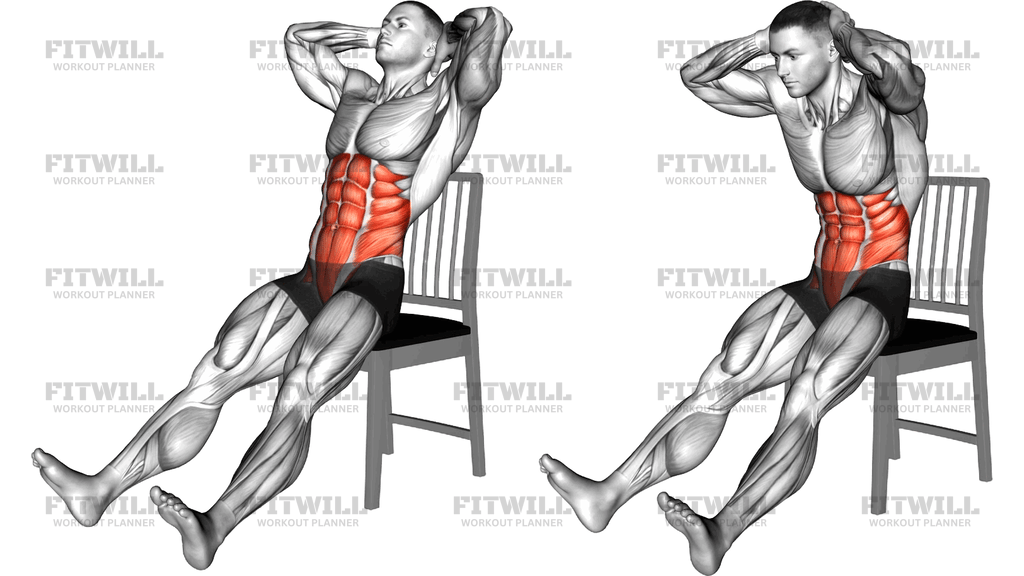
Instructions
- Sit on a sturdy chair and shift toward the front edge of the seat so your hips are fully supported but your back is free of the backrest.
- Extend both legs straight out in front of you with your heels on the floor and your toes pointing up, keeping your knees unlocked.
- Place your hands lightly behind your head with your elbows flared out to the sides, and interlace your fingers only for support, not for pulling.
- Brace your abdominal wall and lift your chest so your spine is tall before the first repetition.
- Inhale and lean your torso backward, hinging slightly at the hips while keeping your ribs lifted and your heels planted.
- Exhale and curl your torso forward and down, rounding your upper back and pulling your ribs toward your pelvis until you feel a strong squeeze in your abs.
- Pause for a beat at the bottom of the crunch with your abs fully contracted and your elbows pointing toward your thighs.
- Slowly extend back up to the leaned-back starting position under control, resisting gravity rather than letting your torso fall back.
- Keep breathing steadily throughout the set, exhaling on every crunch and inhaling as you return.
- Complete your reps, then sit upright, release your hands from your head, and rest before the next set.
Tips & Tricks
- Do not pull on the back of your head with your fingers; if your elbows drift forward and your chin juts, the neck is taking over the work.
- Keep your hips glued to the seat. If your buttocks slide forward or lift during the crunch, you are using momentum instead of spinal flexion.
- Keep both heels in contact with the floor for the whole set. Lifting the feet means the hip flexors are dominating the movement.
- Curl the spine segment by segment rather than flopping forward from the waist; the crunch should feel like peeling your ribcage down toward your belt line.
- Limit how far you lean back. Going past the point where your abs can hold you makes the lower back and hip flexors absorb the load.
- If the crunch feels too easy, slow the lowering phase to a three-second count or pause two seconds at the bottom of each rep.
- Keep your elbows wide and your chest open. Collapsing the elbows toward your knees shortens the range and reduces abdominal involvement.
- Choose a chair without wheels and, ideally, one with some weight to it, so it does not tip or roll as you lean back.
- If your hamstrings feel tight and pull your posture back when the legs are straight, soften the knees slightly rather than forcing a full lockout.
Frequently Asked Questions
What muscles does the Seated Straight Leg Crunch On Chair work?
The rectus abdominis across the front of your stomach is the prime mover. The obliques stabilize the trunk and the hip flexors hold the straight-leg position, but the crunching action itself should come from the abs.
Why are the legs kept straight during this crunch?
Straight legs anchor the lower body to the floor so the hips cannot assist with the movement. This forces the abdominals to produce all of the spinal flexion, making the abs work harder than in a standard seated crunch.
Is the Seated Straight Leg Crunch On Chair good for beginners?
Yes, it is very beginner friendly because the range of motion is naturally limited by the chair and no extra weight is involved. Start with a smaller lean-back angle and build up the range as your abs get stronger.
Can I do this exercise in an office chair?
You can, as long as the chair is stable, does not roll, and has no armrests blocking your elbows. A fixed four-legged chair is the safer choice because it will not slide out from under you as you lean back.
How far back should I lean during the Seated Straight Leg Crunch On Chair?
Lean back only as far as you can keep your abs braced and your heels down, which is usually a slight recline behind vertical. If your lower back starts to arch and take over the load, you have gone too far.
My neck hurts when I do this crunch. What am I doing wrong?
You are most likely pulling your head forward with your hands. Keep the fingertips resting lightly behind your head, keep your elbows wide, and imagine an apple under your chin so the crunch comes from your ribcage, not your neck.
How does this compare to a regular floor crunch?
The seated position keeps your hips fixed and your legs extended, so there is less hip flexor contribution and less momentum than a floor crunch where the feet are often anchored. It also spares you from getting down on the floor.
How many reps and sets should I do?
Two to four sets of ten to twenty slow, controlled reps is a solid starting point. Because the load is only your body weight, prioritize feeling each crunch over chasing a high rep number.
What can I use if I do not have a suitable chair?
Any stable seated surface works, such as a bench, a sturdy ottoman, or the edge of a bed with a firm mattress. The key requirements are that your hips are supported, your feet can reach the floor with straight legs, and the surface cannot tip or roll.
Is it safe for my lower back?
For most people it is a low-risk movement because the chair supports the hips and the range is self-limited. Keep the lean-back modest, avoid bouncing, and stop if you feel pressure in your lower back rather than your abs.