Air Bike On A Chair
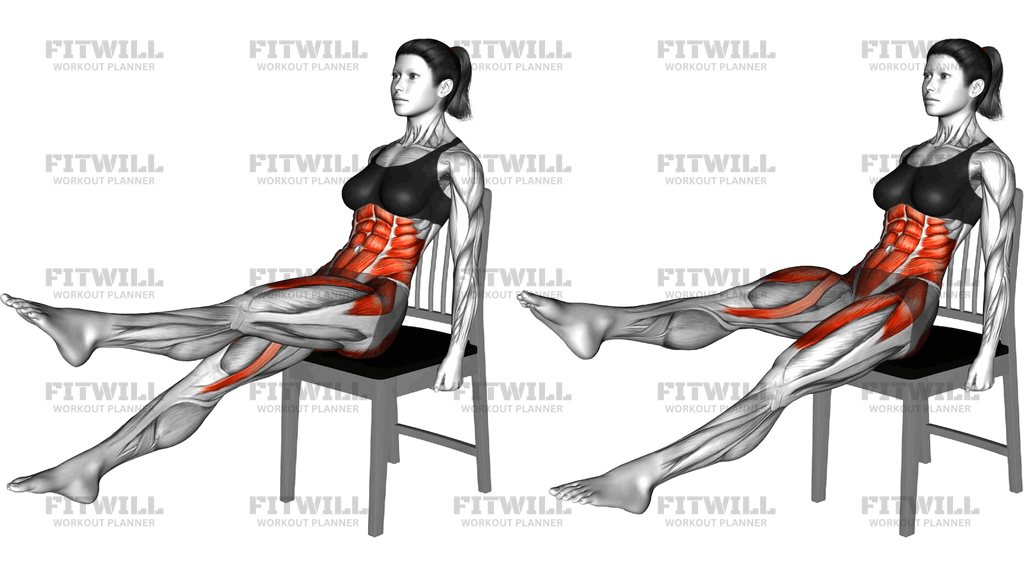
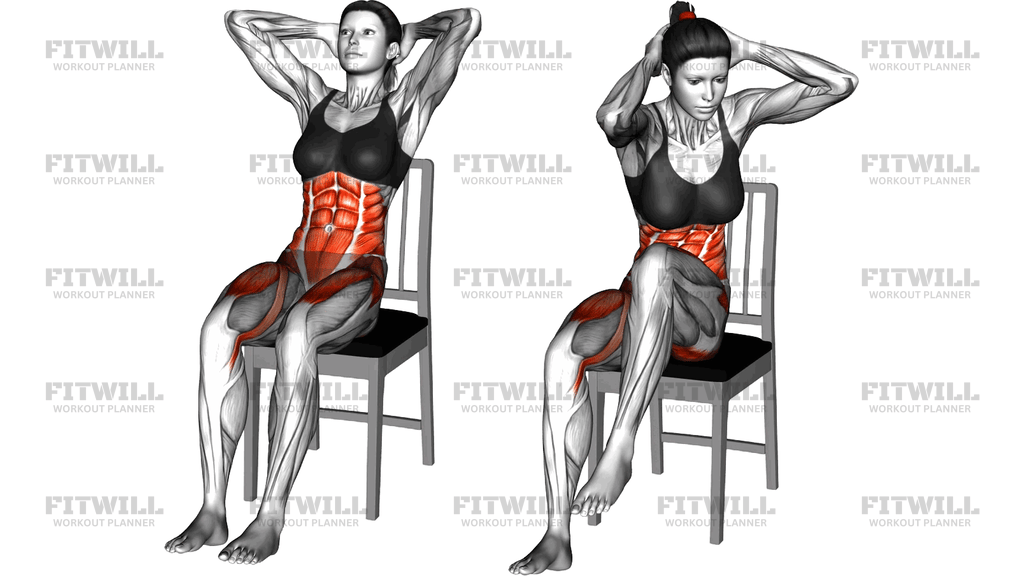
Air Bike On A Chair is a seated version of the classic bicycle crunch. Instead of lying on the floor, you sit upright on a sturdy chair with your hands lightly placed behind your head, then alternate bringing each elbow toward the opposite knee while that knee lifts toward your chest. The highlighted working area is the entire midsection: the rectus abdominis drives the crunch, the obliques handle the twisting, and the hip flexors raise each thigh against the resistance of your own body.
This setup is especially useful for people who find floor work uncomfortable. If getting down onto and up from the floor is a challenge, if you have knee or wrist sensitivity, or if you simply want a discreet core exercise you can do at your desk or at home between other tasks, the chair version gives you the same alternating crunch-and-twist pattern in a much more accessible position. It is also a natural progression step: the seated angle shortens the leverage the legs have, so beginners can learn the coordination of the movement before taking it to the mat.
Because you are upright, your core has to work differently than in a floor bicycle crunch. The abs must flex the trunk forward while the obliques rotate the ribcage toward the lifting knee, all while your torso stays balanced on the seat. That balance requirement quietly trains the deep stabilizers as well, which is why the exercise feels harder than it looks once you slow it down.
Execution quality comes down to three things: curling rather than just pulling the knee up, rotating from the ribcage rather than swinging the arms, and keeping the lower back from collapsing into a slouch between repetitions. Your elbows stay wide and open; they never yank the neck. Each rep should feel like a diagonal fold of the trunk, with the shoulder and knee meeting as close as your mobility allows.
A stable, non-swiveling chair is essential. Sit toward the front half of the seat so your hips can move freely, and keep one foot grounded while the other knee drives up. If the chair slides or rocks, reposition it against a wall before you begin. Move with control rather than speed — fast, sloppy reps mostly train momentum, while deliberate reps actually load the abdominal wall.
Common uses include home workouts without equipment, office-friendly core breaks, senior fitness programming, and warm-up or finisher sets in a larger routine. Breathe out as the elbow and knee come together, breathe in as you switch sides, and stop the set when your form starts to lean on arm pulling or lower-back slouching rather than abdominal effort.
[ Workout Log & Planner ]
Put your next workout in Fitwill
Keep your plan and training log ready when you are.


Instructions
- Sit sideways-free on a stable, armless chair with your hips toward the front edge of the seat and both feet flat on the floor.
- Place your hands lightly behind your head with elbows flared wide, and sit tall so your chest is open and your lower back is in a neutral, upright curve.
- Brace your abdominal wall as if preparing for a light push to the stomach, and keep the brace on for the whole set.
- Lift your right knee toward your chest while simultaneously curling and rotating your upper body so your left elbow travels toward that knee.
- Squeeze briefly at the point where elbow and knee are closest, keeping the crunch coming from your ribcage and abs, not your arms.
- Lower the right foot back to the floor and return your torso upright, then immediately repeat on the other side with the left knee and right elbow.
- Continue alternating sides in a smooth, controlled rhythm, exhaling as the elbow and knee come together and inhaling on the switch.
- Keep one foot grounded whenever the opposite knee is lifted so you stay balanced on the seat.
- Complete your target reps, then release your hands from behind your head, sit upright, and rest before the next set.
- If you start pulling on your neck or slouching your lower back, end the set rather than forcing more repetitions.
Tips & Tricks
- The most common fault on a chair is letting the torso stay vertical and just pumping the knees up and down — the abs barely work that way. Curl your ribcage down and across on every rep.
- Do not lace your fingers behind your head and pull. Rest your hands like a cradle; if your neck feels strain, one hand on your chest or a light touch to your ears works too.
- A swivel office chair is a hazard for this movement. Use a fixed four-legged chair, or push the back of the chair against a wall so it cannot roll.
- Sit toward the front of the seat. Sitting too far back pins your hip flexors against the edge of the cushion and makes knee lift choppy.
- The lower back tends to round into a slouch as fatigue sets in, which offloads the abs and loads the spine. Reset tall between reps if you feel yourself sinking.
- Slow the tempo down instead of chasing reps. A two-second lift with a one-second hold recruits the obliques far better than a fast bicycle flail.
- If your hip flexors cramp, that is a sign they are compensating for tired abs. Shorten the knee lift height and focus harder on the trunk curl.
- Keep your elbows wide throughout. Elbows collapsing forward toward the knee turns the rep into a plain crunch and removes the rotation your obliques need.
- Place a folded towel on a hard wooden seat if the surface is slippery — your sit bones shifting mid-set throws off the diagonal path.
Frequently Asked Questions
What muscles does Air Bike On A Chair work?
The rectus abdominis does the crunching, the internal and external obliques handle the twist, and the hip flexors such as the iliopsoas lift each thigh. Your deep core also works to keep you balanced on the seat.
Is Air Bike On A Chair effective if I am a beginner?
Yes, it is one of the friendliest ways to learn the bicycle crunch pattern. The seated position removes the floor transition and reduces leverage, so you can focus on the curl-and-twist coordination before progressing to mat versions.
What kind of chair should I use for Air Bike On A Chair?
A stable, armless chair that will not slide, swivel, or tip. A simple dining-style chair pushed against a wall is ideal; avoid rolling office chairs and anything with armrests that block the knee path.
Why do my hip flexors burn more than my abs during Air Bike On A Chair?
The hip flexors raise the thigh, and if the trunk is not actively curling, they take over the whole rep. Exaggerate the ribcage rotation toward the knee and slightly reduce the knee lift height to shift work back to the abs.
Can I do Air Bike On A Chair at my desk during the workday?
Yes, that is one of its best use cases. Just make sure your chair is fixed rather than on castors, and keep the reps slow so the movement stays deliberate rather than bouncing in your seat.
How does the seated version compare to a floor bicycle crunch?
The floor version trains the abs through a larger range and adds a leg-extension component, while the chair version emphasizes the crunch and rotation with easier balance demands. Many people use the chair version as a stepping stone or a low-variation alternative.
Should my elbows actually touch the opposite knee in Air Bike On A Chair?
Contact is nice but not required. What matters is that your shoulder and ribcage rotate and fold toward the knee as far as you can control; forcing the touch usually means yanking the neck or rounding the back.
How many reps and sets should I do of Air Bike On A Chair?
A reasonable start is 2 to 3 sets of 10 to 20 alternating reps, counting each elbow-to-knee pairing as one rep. Add reps or slow the tempo before adding any external resistance.
Is Air Bike On A Chair safe for lower back issues?
It is generally gentler than floor crunches because your back is supported by an upright posture rather than pressed into the ground, but anyone with back pain should move within a pain-free range and consult a professional if unsure. Avoid slouching mid-set, as that is the position most likely to aggravate the spine.