Seated Leaning Back Hundreds On Chair
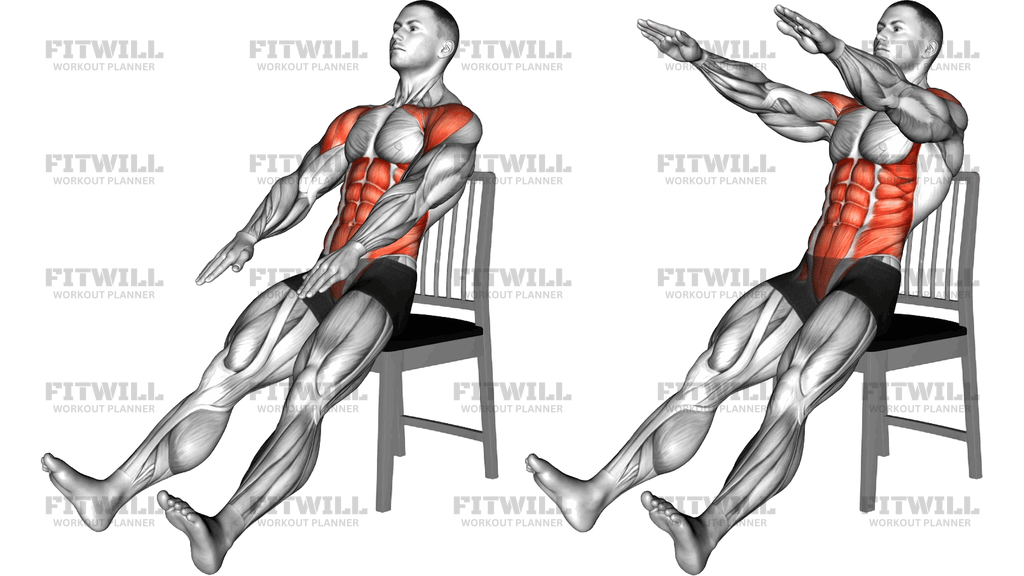
Seated Leaning Back Hundreds On Chair takes the classic Pilates hundred and adapts it to a chair, so you hold a leaned-back V-position with your legs extended and heels grounded while your arms sweep up and down in front of you. Instead of lying on a mat, you brace your torso at roughly a 45-degree angle from the seat, which forces the abdominal wall to work continuously against gravity for the entire set.
This variation suits people who find a full mat hundred too demanding on the neck or lower back, as well as anyone training in a home or office setting where a chair is the only equipment available. Because the heels stay planted, you also get support from the legs, making it a practical stepping stone toward the floor version while still building serious core endurance.
The primary work comes from the abs, especially the rectus abdominis and deep transverse abdominis, which hold your torso stable in the lean. The hip flexors work hard to keep your legs lifted and extended, the shoulders and arms drive the reaching motion, and the obliques contribute to keeping your ribcage from twisting as the arms move.
Setup matters more than speed here. Sit well forward on a stable chair, grip or brace near the front edge, and only lean back as far as you can hold without your lower back rounding or your ribs flaring. If your torso collapses or your shoulders creep toward your ears, the abdominal focus is lost and the move becomes a strain rather than a training stimulus.
Execution is about controlled rhythm. From the leaned-back position, sweep your arms from your hips up in front of you to shoulder height or slightly above, palms facing down, then lower them back along the same path. Keep the torso, legs, and head completely still while the arms move, and breathe in a steady pattern rather than holding your breath.
Use this exercise as a core finisher, a warm-up activation drill, or a low-impact daily practice. Aim for timed holds of 20 to 45 seconds with continuous arm sweeps, or count breaths Pilates-style with five short inhales and five short exhales. Stop the set as soon as your lower back takes over or your form breaks down.
[ Workout Log & Planner ]
Put your next workout in Fitwill
Keep your plan and training log ready when you are.


Instructions
- Sit on the front half of a sturdy chair and place your hands on the seat edge beside your hips.
- Lean your torso back to about 45 degrees, keeping your spine long and your chest open rather than slumped.
- Extend both legs forward in front of you with heels resting on the floor and knees soft or nearly straight.
- Press your shoulders down away from your ears and brace your abs as if preparing for a light push to the stomach.
- Starting with your arms down by your hips, sweep them forward and up in front of your body to about shoulder height or slightly higher, palms facing down.
- Lower your arms back down toward your hips along the same path, resisting gravity rather than letting them drop.
- Keep your torso, legs, and head completely still; only the arms travel through the arc.
- Breathe steadily throughout, inhaling on the reach up and exhaling on the way down, or use the classic five-in, five-out Pilates count.
- After your final rep, bring your arms down, walk your feet in, and sit upright to release the lean before resting.
Tips & Tricks
- If you feel the work shifting into your lower back, reduce how far you lean back; a steeper, well-held torso angle beats a deep lean that collapses.
- Check your heels often. Lifting them means your hip flexors and balance are being taxed beyond your core's capacity, so shorten the hold instead.
- Avoid shrugging as your arms rise. Keep the space between your shoulders and ears long, and let the movement come from the shoulder joint, not a lifted shoulder girdle.
- Do not let your chin jut forward as the arms reach up. Keep your gaze level and your head stacked over your ribcage.
- If gripping the chair edge makes your shoulders tense, rest your fingertips lightly on the seat or release your hands to the sides once you are stable in the lean.
- Test the chair before starting. A chair that slides or tips under a leaned-back load is the biggest safety risk in this setup, so brace it against a wall if needed.
- Bend your knees slightly if fully extended legs pull your lower back into an arch. The core challenge stays largely intact while the spine stays protected.
- Keep the arm sweeps smooth and equal on both sides. Jerky or uneven reaches usually mean one side of the torso is doing more bracing than the other.
- Stop the set when your breathing gets ragged or your ribs flare upward; those are signs your abs have handed the job off to accessory muscles.
Frequently Asked Questions
What muscles does Seated Leaning Back Hundreds On Chair work?
The abs, particularly the rectus abdominis and transverse abdominis, do most of the work holding the leaned-back position. The hip flexors keep the legs extended, while the shoulders and arms drive the up-and-down arm sweep.
Is Seated Leaning Back Hundreds On Chair good for beginners?
Yes, it is often more approachable than the floor version because the heels stay grounded and the neck is unloaded. Beginners should start with a smaller backward lean and shorter holds of 15 to 20 seconds.
Why does the Seated Leaning Back Hundreds On Chair use a chair instead of a mat?
The chair raises the torso and gives you a handhold for stability, which reduces neck and lower back strain while keeping the abdominal challenge. It also makes the exercise possible anywhere a stable seat is available.
How far back should I lean during Seated Leaning Back Hundreds On Chair?
Lean back only as far as you can hold with a long spine and ribs drawn down, usually around 30 to 45 degrees from upright. If your lower back rounds or arches, you have gone too far.
Should my feet be on the floor during Seated Leaning Back Hundreds On Chair?
Yes, the heels stay planted on the floor with legs extended forward, which is what separates this version from the mat hundred where the legs are lifted. Pressing the heels down adds stability and control.
How do I breathe during the hundreds arm pattern?
Breathe continuously rather than holding your breath. A traditional approach is five short inhales and five short exhales while the arms pump, but a simple inhale on the reach up and exhale on the way down works just as well.
What is the most common mistake in Seated Leaning Back Hundreds On Chair?
Collapsing the torso or letting the shoulders ride up toward the ears as the arms rise. Both shift tension away from the abs and into the neck and lower back, so reset the lean and shoulder position before continuing.
What can I use instead of a chair for Seated Leaning Back Hundreds On Chair?
A sturdy bench, ottoman, or the edge of a stable couch works if it will not slide. Once you are comfortable, the classic mat hundred with legs extended or bent at a tabletop position is the natural progression.
How long should I hold Seated Leaning Back Hundreds On Chair?
Start with 20 to 30 seconds of continuous arm sweeps and build toward 45 to 60 seconds as your core endurance improves. Quality of the lean and arm path matters more than total time.
Is it safe to do Seated Leaning Back Hundreds On Chair with lower back issues?
A smaller lean and slightly bent knees usually keep the spine neutral and comfortable, but stop if you feel any back strain. Anyone with a current or recurring back problem should check with a qualified professional before adding this movement.