Cable Reverse Narrow Grip Lat Pulldown
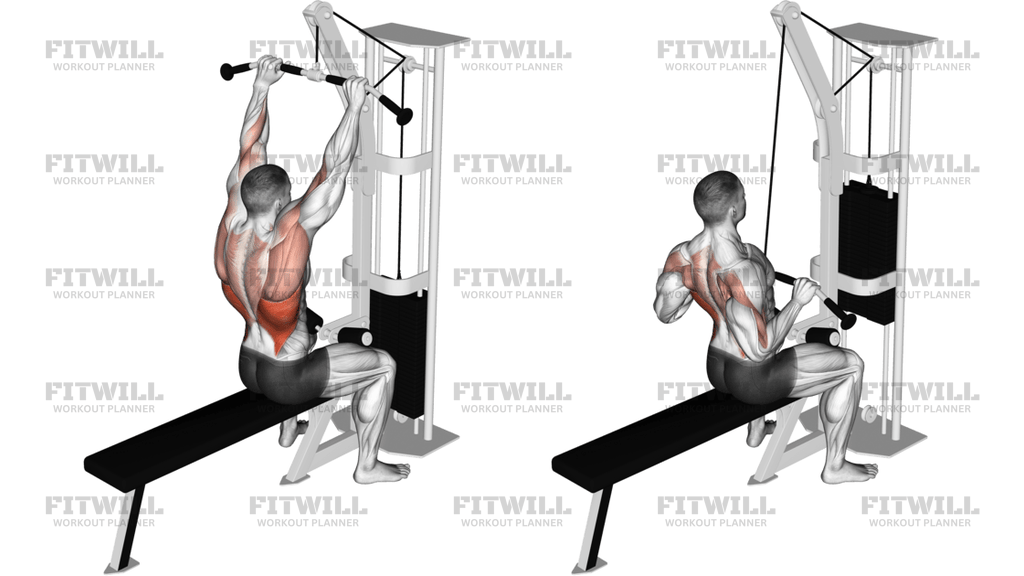
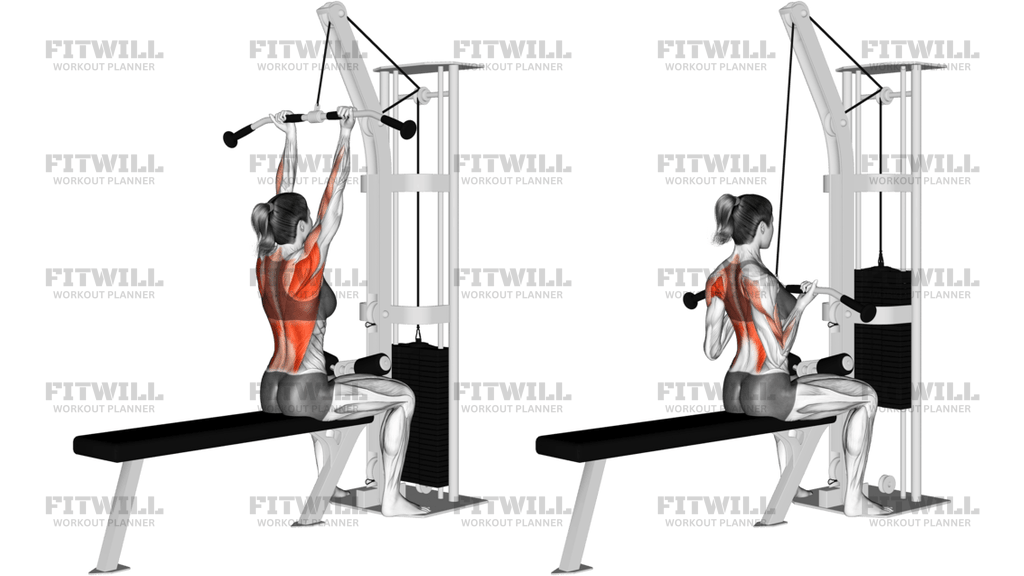
The Cable Reverse Narrow Grip Lat Pulldown is a seated cable exercise where you pull a bar down from overhead using an underhand grip set roughly shoulder-width apart or slightly narrower. Because your palms face you, the biceps sit in a stronger line of pull, which lets many lifters feel their lats working more directly than they do with a wide overhand grip. It is performed on a high pulley with a short straight bar while you sit facing the machine.
The main target is the latissimus dorsi, the large muscle that gives the back its width, with strong assistance from the biceps, the rhomboids and mid-traps that pull the shoulder blades down and together, and the teres major. The supinated narrow grip shifts a bit more emphasis toward the lower portion of the lats and the elbow flexors compared with a wide pronated pulldown, making it a good choice if wide-grip pulldowns tend to leave your arms tired before your back feels anything.
This movement suits beginners learning what lat contraction feels like, intermediate lifters adding back volume, and anyone whose shoulder comfort is better with a neutral-width underhand path than a very wide overhand one. It also carries over well to pull-ups: if you are working toward your first bodyweight pull-up, this exercise trains the same downward pulling pattern with adjustable resistance.
Setup matters more than most people assume. Sit far enough from the machine that the cable runs nearly vertical when the bar is overhead, and plant your feet flat so your body has a stable base. Because you are on a plain bench rather than a padded pulldown station, you cannot shove your thighs into a pad to cheat, so your torso angle has to stay honest throughout the set. Keep your chest tall and lean back only slightly from the vertical position as you pull.
Execution comes down to driving the elbows down toward your hips rather than yanking the bar with your arms. Think about pulling your shoulder blades down first, then drawing the bar to your upper chest while the elbows stay close to your sides. Squeeze at the bottom, then let the bar rise under control until your arms are fully extended and you feel a stretch across the back. That controlled return is where a lot of the growth stimulus lives, so resist the urge to let the stack yank your arms back up.
In practice, this works well as a primary back builder early in a session for moderate reps, or as a finishing pump movement with lighter weight and higher reps. Common form faults are leaning back too far and turning it into a row, pulling with the wrists bent back, and cutting the range short at the top. Fix those three and the exercise does exactly what its name promises.
[ Workout Log & Planner ]
Put your next workout in Fitwill
Keep your plan and training log ready when you are.


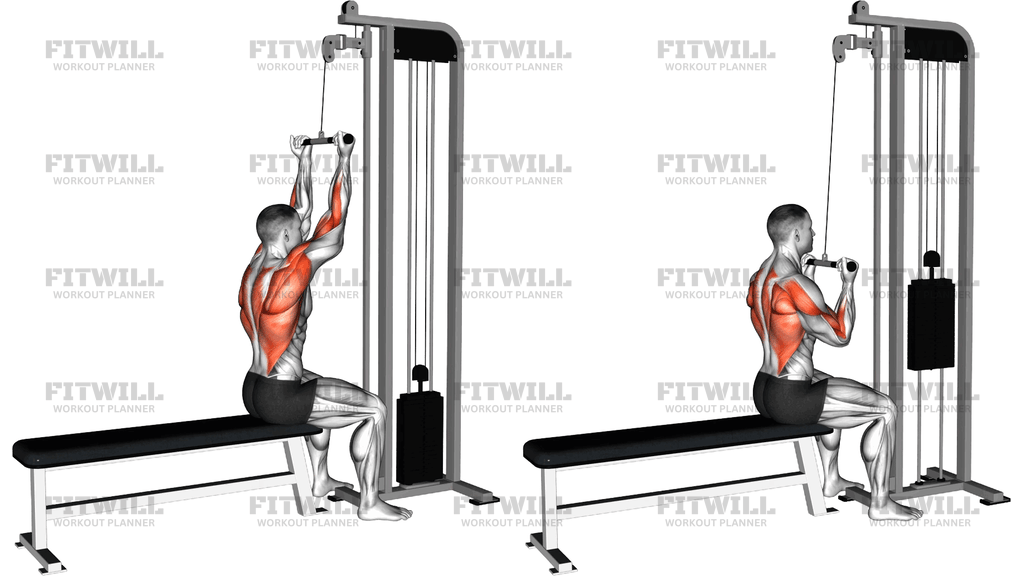
Instructions
- Attach a short straight bar to the high pulley of a cable machine and position a flat bench facing the machine, about an arm's length away from the tower.
- Sit down facing the machine, plant your feet flat on the floor with knees bent, and take an underhand grip on the bar with your hands roughly shoulder-width apart or slightly narrower.
- With arms fully extended overhead, slide back or forward until the cable runs almost straight down to the pulley, then sit tall with a slight natural arch in your lower back.
- Brace your core and pull your shoulder blades down and together before your arms start bending.
- Pull the bar down toward your upper chest, keeping your elbows tracking close to your sides and pointing down, not flaring outward.
- Pause briefly at the bottom with the bar at chest height and squeeze your lats.
- Return the bar upward in a slow, controlled motion until your arms are completely straight and you feel a stretch through your lats.
- Exhale as you pull down and inhale as you let the bar rise back up.
- Complete your reps without leaning back further as the set gets hard, and stand up carefully to release the bar between sets.
Tips & Tricks
- If the cable is angled sharply toward you at the start, you are sitting too close to the machine; move the bench back until the line of pull is close to vertical.
- A common mistake with the reverse grip is letting the wrists curl backward so the bar hangs on the fingers; keep your wrists straight and grip the bar in the palm.
- Do not turn this into a seated row by reclining dramatically as you pull; a small backward lean of a few degrees is fine, but your torso angle should barely change from rep to rep.
- If your biceps fatigue before your back feels worked, lower the weight and focus on initiating each rep by depressing your shoulder blades first.
- Use a full stretch at the top of every rep; stopping halfway up shortchanges the lats and makes the set feel much harder on the forearms.
- Because there is no thigh pad on a plain bench, keep your body weight balanced over your feet and avoid using momentum from your torso to start the pull.
- Narrower than shoulder-width is unnecessary; gripping too close makes the wrists and elbows uncomfortable without adding lat benefit.
- Chalk or a firm grip helps on heavy sets, but if your grip keeps failing, use lifting straps rather than shortening the range of motion.
- Keep the reps smooth and rhythmic; if the weight stack slams down on the return, the load is too heavy for controlled form.
Frequently Asked Questions
Which muscles does the Cable Reverse Narrow Grip Lat Pulldown work?
The lats are the primary mover, with the biceps, rhomboids, mid-traps, and teres major assisting. The underhand narrow grip gives the biceps a favorable pulling angle, so expect noticeable forearm and arm involvement along with your back.
Why use an underhand narrow grip instead of a wide overhand grip?
The supinated grip lets many lifters generate more force and feel their lats better because the biceps are in a stronger position. The narrower hand spacing also allows the elbows to travel closer to the body, which suits the lat's downward pulling function.
Is this exercise suitable for beginners?
Yes, it is one of the more approachable back exercises because the cable guides the path and the resistance is fully adjustable. Beginners should start light and prioritize feeling the shoulder blades pull down before the arms bend.
How far back should I lean while pulling the bar down?
Only a few degrees at most. If your torso swings back toward the bench as you pull, you are using momentum and turning the pulldown into a row, which takes work away from the lats.
Where exactly should the bar finish at the bottom of the rep?
Bring it to your upper chest, around collarbone height, with your elbows pulled down close to your sides. Pulling to the stomach or mid-torso means you have leaned back too far.
Can I do this exercise without a bench?
You can perform it kneeling or standing if the cable station allows, but the seated position on a bench gives you a stable base and removes leg drive, which makes it easier to keep the work on the back.
My forearms and grip give out first. What should I change?
Slow the tempo, use a lighter weight, and make sure your wrists are straight rather than bent back. If grip is still the limiting factor on heavier sets, lifting straps let you keep training your back without being capped by your hands.
How does this compare to pull-ups?
It trains the same vertical pulling pattern but with adjustable load, which makes it useful for building toward pull-ups or adding volume once pull-ups become easy. The supinated grip also closely matches chin-up mechanics.
Is the reverse grip hard on the elbows or wrists?
Most people find the narrow supinated grip comfortable because the arms rotate naturally during the pull. Keep your hands no narrower than about shoulder-width and your wrists neutral, and ease back if you feel any joint discomfort.