Walk Burpee
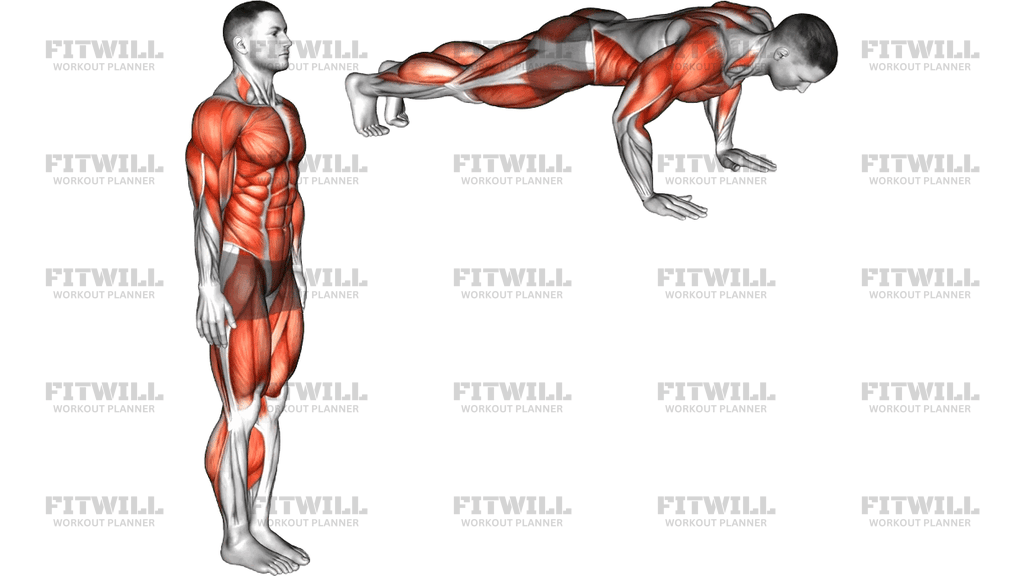
The Walk Burpee is a low-impact variation of the classic burpee. Instead of kicking your feet back into a plank or jumping at the top, you step one foot back at a time to reach the high plank position, then walk the feet forward one at a time to stand back up. The image shows the two key positions: a tall standing posture at the start, and the intermediate position where the hands are planted on the floor while one leg has already stepped back and the other is about to follow.
This version keeps everything a burpee is good at — a full-body effort that raises your heart rate quickly and works your legs, hips, core, shoulders, and arms — while removing the repetitive impact that comes from jumping back and landing. That makes it a smart choice for beginners learning the burpee pattern, taller or heavier trainees, anyone with sensitive knees, ankles, or lower back, and people working out on hard floors or in apartments where jumping is not practical.
The movement trains the hip hinge and squat mechanics needed to get your hands to the floor cleanly, challenges your trunk to hold a straight line while you step back into the plank, and builds conditioning through repeated transitions rather than explosive power. Because each rep involves four deliberate foot placements, you also get more time under tension in the hamstrings and hip flexors than you would in a fast jumping burpee.
Setup matters more than most people expect. Where you place your hands determines whether the walk-back feels smooth or awkward. Plant them roughly shoulder-width apart, far enough forward that you can extend a leg behind you without your hips collapsing. If your hands are too close to your feet, you end up in a cramped crouch with a rounded back; too far forward, and the plank position becomes loose and saggy.
To execute well, hinge at the hips and bend your knees to place your palms flat on the floor, step one foot straight back, then the other, until your body forms one line from head to heels. Walk the feet back in toward the hands one at a time, drive through the floor to stand tall, and repeat at a steady, repeatable pace. Breathe rhythmically throughout rather than holding your breath.
Use Walk Burpees as a conditioning finisher, as intervals on their own, or as the regression you use before progressing to jump-back and jump-up burpees. Even though the impact is low, the volume adds up, so stop the set when your plank position starts to sag or your stepping feet start to drift out of line.
Fitwill
Log Workouts, Track Progress & Build Strength.
Achieve more with Fitwill: explore over 9600 exercises with images and videos, access built-in and custom workouts, perfect for both gym and home sessions, and see real results.
Start your journey. Download today!




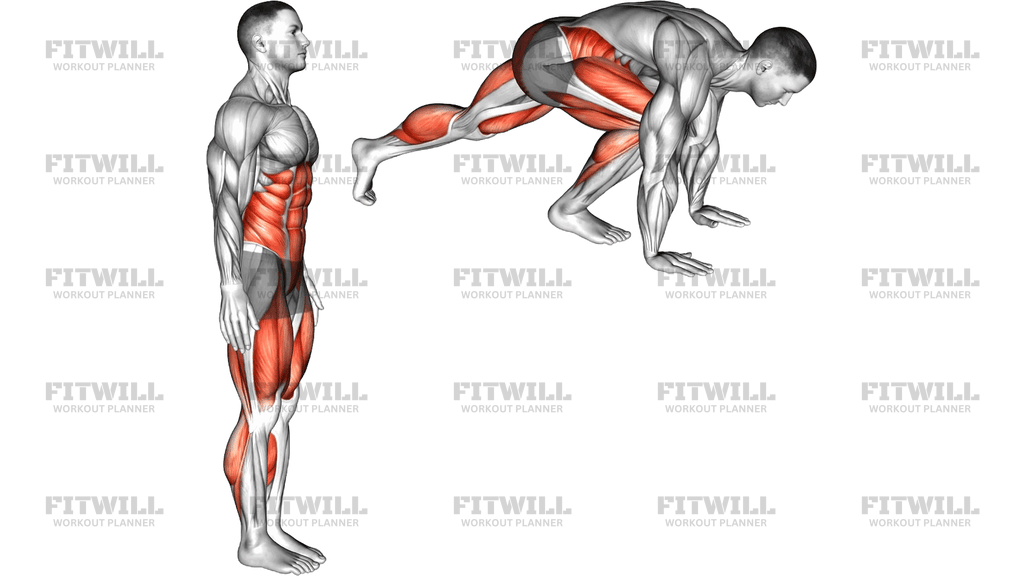
Instructions
- Stand tall with your feet hip-width apart, arms relaxed at your sides, and your weight balanced over the middle of each foot.
- Hinge forward at the hips with a braced trunk, bend your knees, and place both palms flat on the floor about shoulder-width apart, roughly a hand-length in front of your toes.
- Shift your weight onto your hands, then step your right foot straight back and set the ball of that foot down with the knee off the floor.
- Step your left foot back to meet it so you finish in a high plank, with your body forming one straight line from head to heels and your shoulders stacked over your wrists.
- Hold the plank for a brief moment, keeping your abs tight and your hips level, without letting your lower back sag.
- Step your right foot forward and place it flat near the outside of your right hand, then step your left foot forward to meet it, returning to the low crouch.
- Press through your heels and swing your arms slightly forward as you rise back up to a full standing position.
- Exhale as you walk your feet back and forward, and take a full breath as you stand and reset at the top.
- Reset your stance and begin the next rep, alternating which foot steps back first on each repetition to keep the work balanced.
Tips & Tricks
- Place your hands slightly wider than your toes, not right against them — this gives your feet a clear path to walk back without forcing your hips to pike upward.
- The most common mistake is letting the hips pop up high as soon as one foot steps back, which turns the plank into a pike. Think about pushing the crown of your head forward as the leg travels back.
- Alternate the lead foot every rep. Leading with the same leg for an entire set builds a noticeable side-to-side imbalance in the hip flexors and lower back.
- If your hamstrings limit how far you can hinge, bend the knees more rather than rounding your back to reach the floor.
- Keep the stepping foot quiet — deliberately placing the ball of the foot down instead of letting it slap the floor keeps you controlled and protects the ankle.
- When you stand up at the end of each rep, finish tall with your glutes squeezed instead of hunching forward into the next rep. Rushing the stand is where most form breaks happen.
- Control the pace with your breathing: one breath per walk-back, one per walk-forward. If you cannot keep that rhythm, slow down rather than shortening the plank.
- On hard floors, a thin mat under your hands makes long sets much more comfortable without changing the movement.
Frequently Asked Questions
What muscles does the Walk Burpee work?
It works the whole body, with the quads and glutes doing most of the squatting and standing, the hamstrings and hip flexors handling the stepping, and the abs, shoulders, and arms holding the plank. The heart and lungs do a large share of the work as well.
How is the Walk Burpee different from a regular burpee?
You step the feet back and forward one at a time instead of jumping them, and you stand up without a jump at the top. This removes the impact on the knees, ankles, and lower back while keeping the conditioning effect.
Is the Walk Burpee good for beginners?
Yes, it is one of the best ways to learn the burpee pattern. Stepping lets you focus on hand placement, the plank position, and standing tall before you add jumping.
How far forward should my hands be when I set up?
Place your palms about shoulder-width apart and roughly a hand-length in front of your toes. This leaves room for your feet to step back without forcing your hips to lift into a pike.
Why does my lower back ache during the plank phase?
That usually means your hips are sagging or your hands are too far forward, stretching the body line. Tighten your abs, stack your shoulders over your wrists, and shorten the time you spend in the plank until you can hold a straight line.
Should I alternate which foot steps back first?
Yes. Switching the lead leg on each rep keeps the workload even between your hip flexors and prevents one side from dominating the movement over a long set.
What can I use instead of the Walk Burpee if I cannot put my hands on the floor?
Use an elevated surface such as a bench or step platform for your hands, which shortens the reach to the floor. As mobility improves, lower the surface gradually.
How many Walk Burpees should I do?
Start with sets of 8 to 12 reps or 20 to 30 second intervals, focusing on a clean plank and a tall finish. Build volume only while you can keep the body line intact.
Can I do Walk Burpees every day?
Because the impact is low, they recover faster than jumping burpees, but the muscles and joints still accumulate fatigue. Two to four sessions per week with rest days between harder interval days is a sustainable approach for most people.