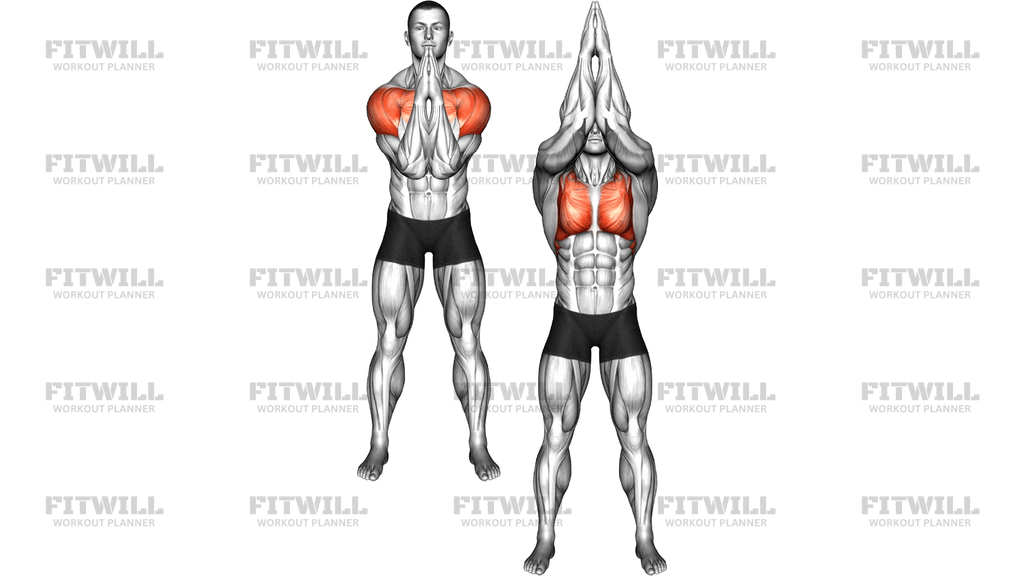
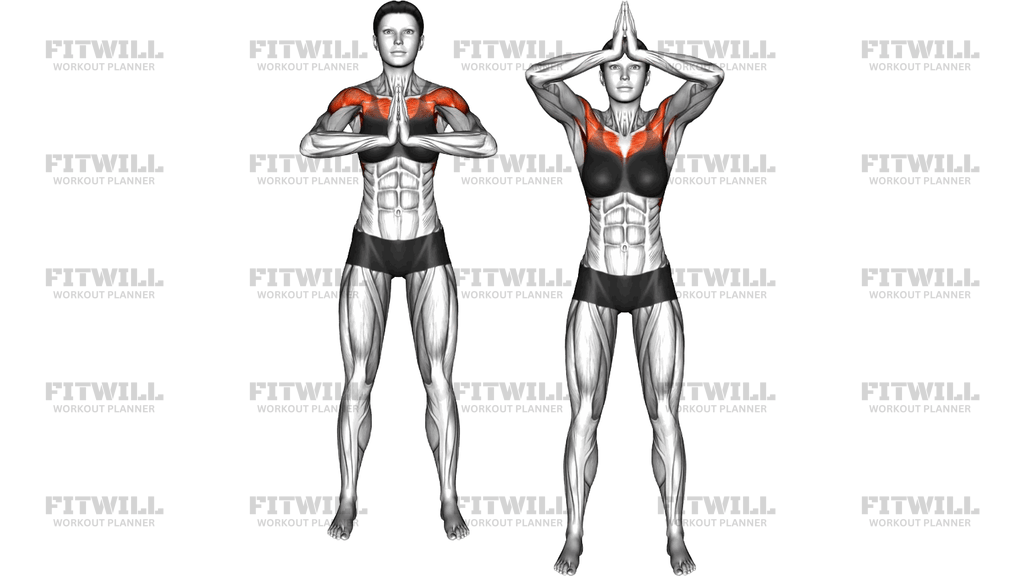
Standing 90 Degrees Arms Rotation
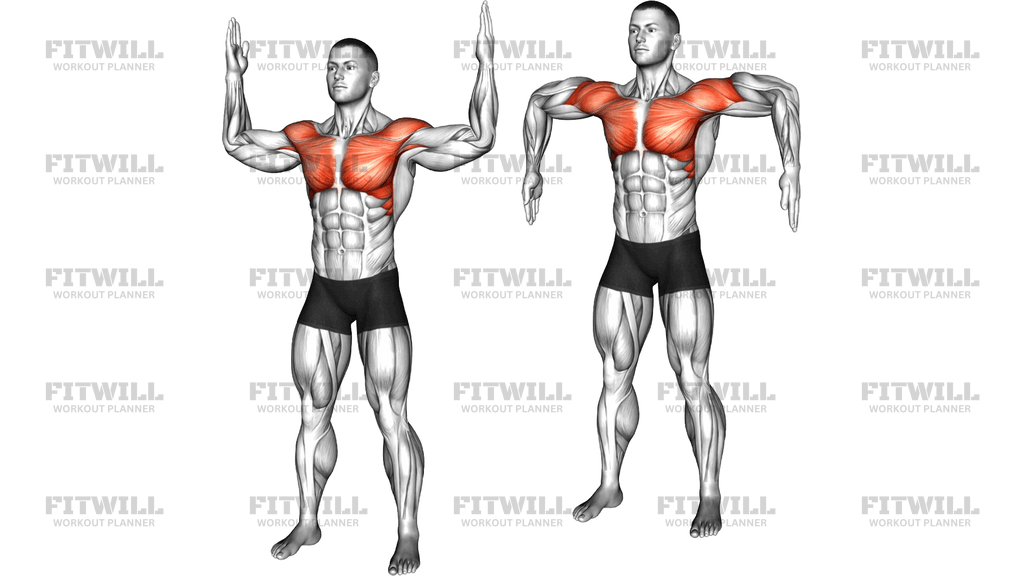
Standing 90 Degrees Arms Rotation is a bodyweight dynamic movement where you hold your upper arms out to the sides with elbows bent at a right angle, then rotate the forearms up and down through a controlled arc. As the forearms swing backward, the chest opens and stretches; as they rotate forward and up, the pectorals and front shoulders contract. This makes it one of the simplest ways to warm up the shoulder girdle while mobilizing the chest at the same time.
Because it requires no equipment and very little space, this rotation fits naturally into almost any pre-workout routine. Lifters preparing for bench presses, push-ups, or overhead pressing benefit from the way it takes the shoulders through external and internal rotation under light muscular tension. It is also a go-to movement for anyone who sits at a desk all day, since the backward rotation counters the rounded, hunched shoulder posture that comes from typing and driving.
The 90-degree elbow position is what makes this exercise distinctive. With the elbow fixed at a right angle, the rotation happens almost entirely at the shoulder joint, which forces the rotator cuff and deltoids to control the arc rather than letting the elbow or wrist absorb the motion. The wide upper-arm position also places the pectoralis major on stretch as the arms rotate back, which is why the chest lights up in both phases of the movement.
Setup matters more than it looks. Stand tall with feet roughly hip-width apart, lift the arms to shoulder height, and bend the elbows so the forearms point straight up with palms facing forward. Keep the ribs stacked over the pelvis and avoid arching the lower back as the arms move. If the torso leans or the shoulders shrug toward the ears, the rotation loses its targeting and the neck compensates.
Execution should be smooth and deliberate: rotate the forearms backward and down until the palms face behind you or the shoulders tell you to stop, pause briefly in the open position, then reverse the arc until the forearms point up again. A typical approach is 10 to 15 controlled rotations per set, either moving both arms together or alternating sides. Move within a pain-free range and let the mobility improve gradually over repeated sessions rather than forcing depth on day one.
Use Standing 90 Degrees Arms Rotation as a warm-up before upper-body training, as an active break during long workdays, or as a low-impact mobility drill on recovery days. Keep the tempo moderate, breathe steadily throughout, and treat it as a movement quality exercise rather than a maximal-effort effort.
[ Workout Log & Planner ]
Put your next workout in Fitwill
Keep your plan and training log ready when you are.


Instructions
- Stand with your feet about hip-width apart, knees soft but not bent deeply, and your weight balanced evenly across both feet.
- Raise both arms straight out to your sides until they are level with your shoulders, then bend your elbows 90 degrees so your forearms point straight up and your palms face forward.
- Draw your shoulder blades gently down and back, keep your chest lifted without flaring your ribs, and brace your core lightly to keep the torso still.
- Inhale, then slowly rotate your forearms backward and downward, keeping the elbows fixed at shoulder height and at a 90-degree angle the entire time.
- Continue the rotation until your palms face behind you or you reach the end of your comfortable shoulder range, and hold the open position for one to two seconds.
- Exhale as you reverse the arc, rotating the forearms forward and upward until they return to the vertical starting position with palms facing forward.
- Keep the movement smooth and continuous, avoiding any jerking, bouncing, or swinging of the torso to generate momentum.
- Complete 10 to 15 rotations, then lower the arms, shake them out briefly, and reset your posture before the next set.
- If one side feels tighter, you can rotate each arm individually, placing the non-working hand on your hip to help keep the torso square.
Tips & Tricks
- The most common mistake is letting the elbows drift forward or drop as the forearms rotate. Keep the upper arms pinned at shoulder height and directly out to the sides so the shoulder joint does the work.
- Do not arch your lower back to fake extra range. If your ribs flare and your spine extends when the arms rotate back, tighten your core slightly and accept a smaller arc.
- Shrugging toward the ears is a sign the upper traps are taking over. Actively press the shoulders down as you rotate to keep the tension on the chest and rotator cuff.
- Start with a smaller arc and expand it over sessions. Forcing the forearms all the way down on the first rep is the usual cause of a pinching feeling at the front of the shoulder.
- Keep the wrists neutral and relaxed. Bending the wrists backward to reach further does nothing for shoulder mobility and only strains the forearms.
- If you feel a pinch rather than a stretch, try angling your upper arms slightly forward of a perfectly straight line instead of straight out to the side, and rotate within that adjusted path.
- Breathe out on the backward rotation and in on the return. Holding your breath tends to create tension that shortens the range you can reach.
- Use this rotation before pressing movements rather than after heavy lifting, when fatigued shoulders are more likely to compensate with poor mechanics.
- Moderate tempo beats speed here. Two to three seconds per full rotation keeps the rotator cuff engaged instead of letting momentum fling the arms through the arc.
Frequently Asked Questions
Which muscles does Standing 90 Degrees Arms Rotation work?
The chest is the primary muscle involved, since the pectorals stretch and contract through the rotation arc. The front and rear shoulders and the rotator cuff muscles control and stabilize the movement.
Why do my elbows have to stay at 90 degrees during Standing 90 Degrees Arms Rotation?
The right-angle elbow position locks the arm into a fixed lever so the rotation happens at the shoulder joint instead of the elbow. This directs the work to the chest and rotator cuff and prevents the movement from turning into an uncontrolled arm swing.
Is Standing 90 Degrees Arms Rotation good for beginners?
Yes, it is low-load and easy to learn, which makes it a solid first shoulder mobility drill. Beginners should simply start with a smaller backward arc and increase range as the shoulders loosen up.
Should I do Standing 90 Degrees Arms Rotation before or after my workout?
It works best as a warm-up before pressing or pulling exercises, when it primes the shoulders and opens the chest. Doing it after training is fine as a light mobility flush, but avoid pushing range hard on already fatigued shoulders.
What causes a pinching sensation at the front of my shoulder during the rotation?
That usually means you are rotating past your current comfortable range or letting the shoulder ride up toward the ear. Reduce the arc, keep the shoulders pressed down, and angle the upper arms slightly forward of straight-out-to-the-side.
Can I do Standing 90 Degrees Arms Rotation with light dumbbells for extra challenge?
It is not recommended. Adding load changes the exercise into an external rotation strength drill and increases stress on the rotator cuff, which should only be done with a deliberate progression, not casually during a mobility set.
How many reps and sets of Standing 90 Degrees Arms Rotation should I do?
Two to three sets of 10 to 15 smooth rotations is a practical dose for warming up. On recovery or desk-break days, a single set whenever the shoulders feel stiff is enough.
Is it normal for one shoulder to rotate further back than the other?
Yes, small side-to-side differences are common, especially if you are dominant on one side or carry stiffness from daily posture habits. Rotate each arm individually for a few extra reps on the tighter side rather than forcing both to match immediately.
What can I substitute if Standing 90 Degrees Arms Rotation bothers my shoulders?
Wall slides or doorway chest stretches offer similar chest-opening and shoulder-blade benefits with less rotation demand. Once the shoulders tolerate it, reintroduce the rotation with a shortened arc.
Should my palms face forward or down at the start of the movement?
At the start the forearms point straight up with palms facing forward, which is the true 90-degree setup. The palms rotate to face behind you only as the forearms swing through the backward arc.