Cross Body Mountain Climber Hop Over Bench
Cross Body Mountain Climber Hop Over Bench is a fast, demanding conditioning drill that combines an incline mountain climber with a rotational knee drive and a hopping leg switch. You set up in a forearm plank with your forearms resting on a flat bench, so your torso is angled upward rather than parallel to the floor. From there, instead of driving the knee straight toward your chest, you pull one knee across your body toward the opposite elbow, then hop the feet so the legs swap positions with each rep.
The bench changes the exercise in two important ways. First, elevating the forearms reduces the load on the shoulders and wrists, which makes the movement more accessible than a floor version while still keeping the core under constant tension. Second, the stable platform lets you focus on driving the knees quickly and cleanly without your upper body wobbling around, so you can move at a pace that genuinely challenges your heart rate.
The cross-body path is what separates this from a standard mountain climber. Bringing the knee toward the opposite elbow forces the obliques to rotate the pelvis while the abs brace to keep your hips from sagging or twisting. Add the hop between reps and you recruit the hip flexors, quads, and calves explosively, and your shoulders and triceps work isometrically to hold the plank position on the bench.
This drill suits anyone with a baseline of plank strength who wants a time-efficient cardio and core combo — for example as a finisher, a circuit station, or a warm-up sharpener for field and combat sports where rotational hip speed matters. Because the bench removes some upper-body load, it is a practical step up for people who find floor mountain climbers hard on the wrists or shoulders but still want a real conditioning stimulus.
Setup quality decides everything here. Place the bench against a wall or on a non-slip surface so it cannot slide, keep your hands stacked under your elbows on the pad, and walk your feet back until your body forms one long line from head to heels. If your hips sit too high, the abs stop working; if they sag, your lower back takes the strain. A tight, neutral plank is the position you return to on every rep.
Move with intent rather than rushing. Drive the knee across until it reaches or passes the hip line, hop the feet to switch legs, and repeat on the other side in a smooth rhythm. Breathe steadily, keep the neck relaxed by looking down at the bench, and stop the set as soon as your hips start to drift — sloppy speed teaches bad patterns and does little extra for conditioning.
[ Workout Log & Planner ]
Put your next workout in Fitwill
Keep your plan and training log ready when you are.


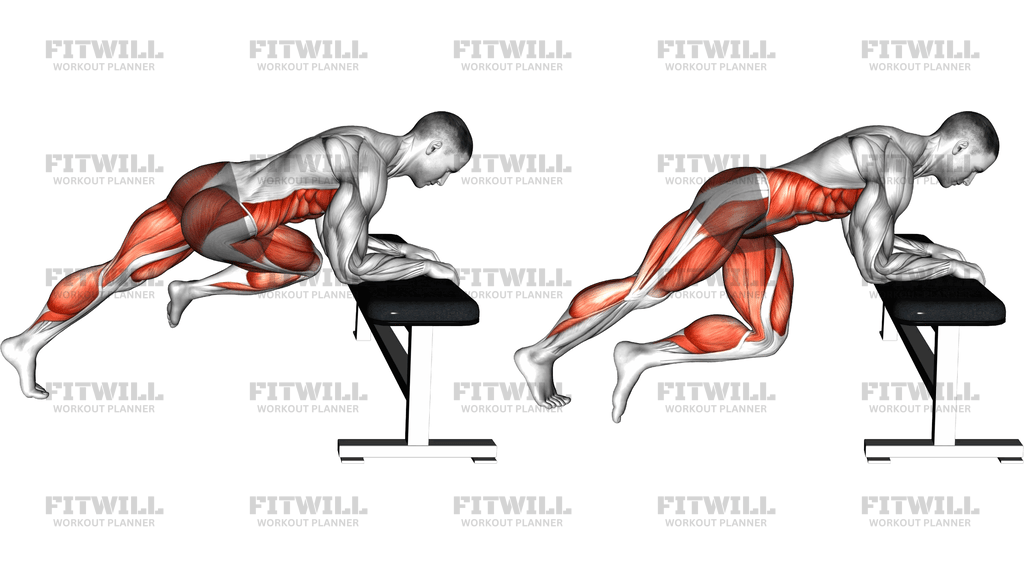
Instructions
- Place a flat bench on a non-slip surface and position yourself behind it, kneeling so the pad is directly in front of you.
- Place both forearms on the bench, elbows stacked under your shoulders, then walk your feet back until your body forms a straight line from head to heels with your weight on your toes.
- Brace your abs and squeeze your glutes so your hips neither sag toward the floor nor pike upward.
- Shift your weight slightly onto one forearm as you drive your opposite knee across your body toward the other elbow, letting your torso rotate naturally a few degrees.
- Push off the balls of both feet and hop to switch leg positions, landing with the other foot forward and the previously driving leg extended back behind you.
- Immediately drive the newly forward knee across toward the opposite elbow to begin the next rep, keeping the motion continuous.
- Exhale sharply on each knee drive and inhale lightly as the legs swap during the hop.
- Keep your hips level and low throughout — the rotation should come from the pelvis, not from lifting one hip toward the ceiling.
- Continue alternating at a controlled rhythm for your target time or rep count.
- To finish, bring both feet down under your hips one at a time, step away from the bench, and stand up slowly rather than jumping straight out of the plank.
Tips & Tricks
- If the bench slides forward with each hop, anchor it against a wall or use a bench with rubber feet — a moving platform ruins the cross-body knee path.
- The most common fault is turning this into a straight mountain climber: check that the knee actually crosses toward the opposite elbow, not just toward the chest.
- Short, quick hops beat big, floaty ones. The goal is a fast leg swap with your hips staying near plank height, not a vertical jump.
- If your inner elbows ache on the pad, widen your forearms slightly and grip the far edge of the bench to lock your upper body in place.
- Let the shoulders shift slightly over the supporting arm during the knee drive, but never let the supporting elbow drift out from under the shoulder.
- Point your toes and land on the balls of your feet softly; heavy heel-striking on the hop transfers shock up through the knees.
- Slow the tempo down before removing it entirely — master the cross-body reach and clean leg switch for a few sessions before chasing speed.
- If your hips pike up as you fatigue, that is your core handing the job off to your hip extensors; end the set and reset your plank rather than grinding on.
- For an easier version, drop the hop and simply step the feet to switch sides, keeping everything else identical.
Frequently Asked Questions
Which muscles does the Cross Body Mountain Climber Hop Over Bench work hardest?
The abs and hip flexors do the bulk of the work, with the obliques heavily involved because each knee crosses toward the opposite elbow. The quads, glutes, and calves power the hop, while the shoulders and triceps hold the plank position on the bench isometrically.
Why use a bench instead of doing cross-body mountain climbers on the floor?
The elevated forearms reduce load on the wrists and shoulders, making the movement easier on the upper body while the stable pad lets you drive the knees faster without wobbling. It is a good middle ground for people who find the floor version uncomfortable but want the same conditioning effect.
Is the Cross Body Mountain Climber Hop Over Bench suitable for beginners?
Yes, with modifications. Start by performing the cross-body knee drive with a slow step-back instead of a hop, and shorten the set to 15–20 seconds so you can hold a clean plank line throughout.
How far should the knee travel on each cross-body drive?
Aim to bring the knee across the midline of your body toward the opposite elbow, at least up to your hip line. Going further adds oblique involvement, but only if your hips stay low and squared.
What is the most common mistake in this exercise?
Letting the hips ride up into a pike as the legs get tired, which turns it into a calf-driven bounce and takes the tension off the abs. Another frequent error is driving the knee straight forward instead of across the body, which removes the rotational challenge entirely.
How should I breathe during the Cross Body Mountain Climber Hop Over Bench?
Exhale sharply with each knee drive and take a short breath as the legs swap during the hop. Do not hold your breath — a steady breathing rhythm is what lets you keep the pace up for the full set.
What can I substitute if I do not have a bench?
Cross-body mountain climbers on the floor from a high plank work the same pattern, though they load the wrists and shoulders more. A low step or sturdy box at knee height also makes a good substitute platform.
How long should a set last?
Because this is a conditioning drill, timed sets of 20–40 seconds work well, or 20–30 total alternating reps. Stop the set when your hips start to sag or your knee path drifts, since speed with a broken plank position has little training value.
Is the hopping motion hard on the knees or lower back?
The bench-supported plank keeps the spine neutral, so most people tolerate it well, but the repeated hopping does load the knees and ankles. If you have sensitive joints, use the step-back version and keep landings soft on the balls of your feet.