Cable Standing Biceps Curl (Rope Attachment)
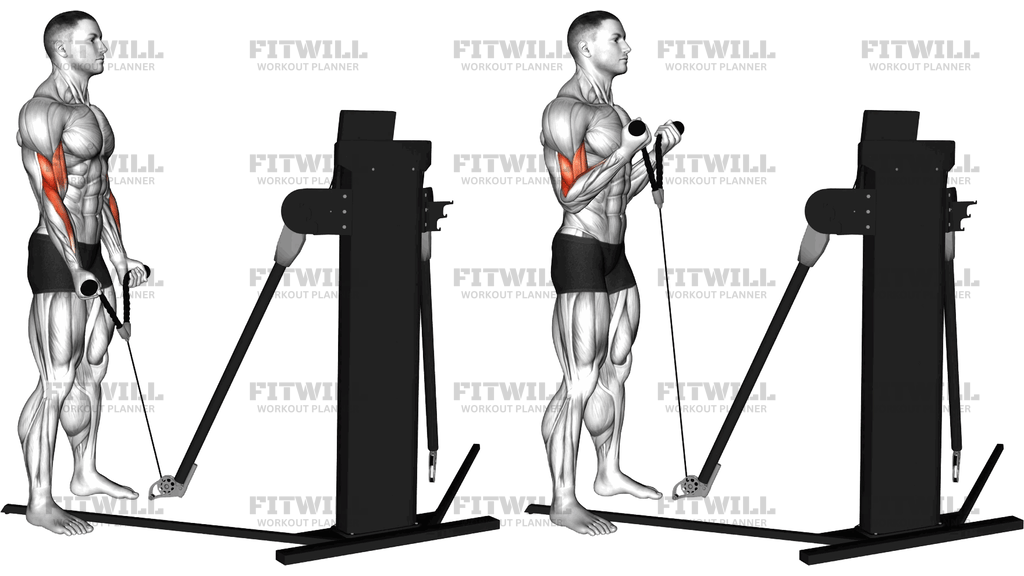
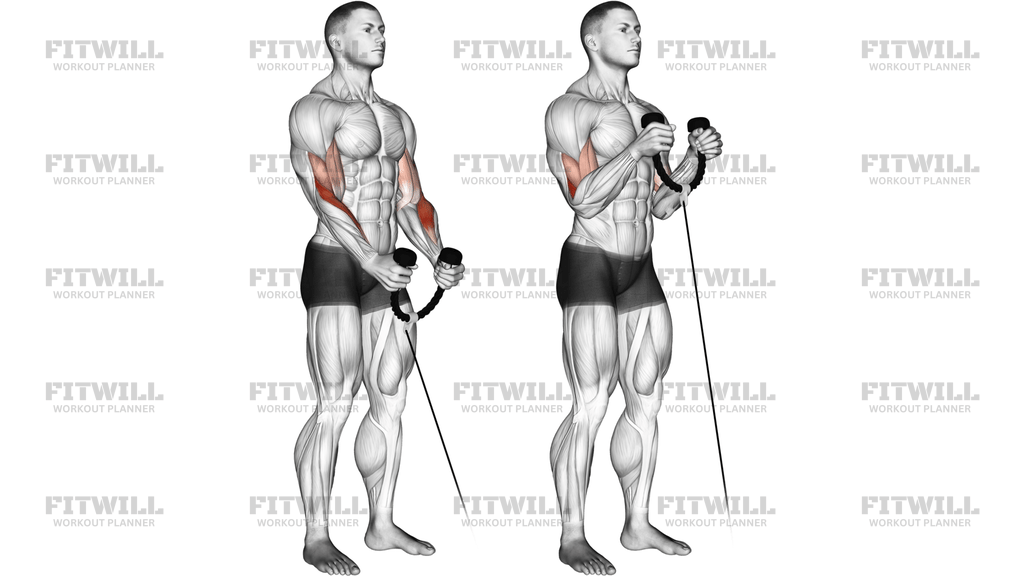
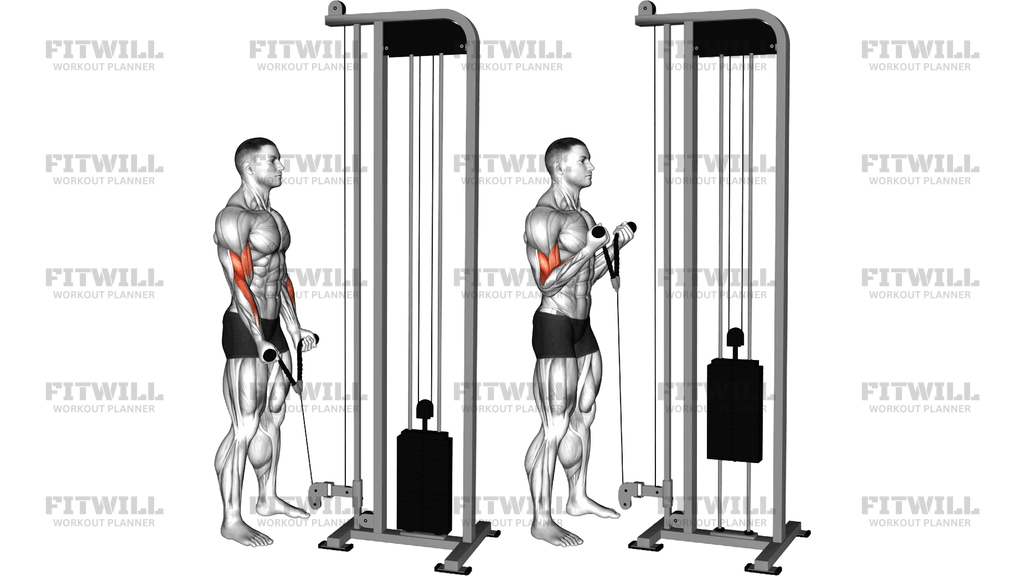
The Cable Standing Biceps Curl (Rope Attachment) is a standing arm exercise performed on a low cable pulley using a rope handle. You grip one end of the rope in each hand with a neutral, thumbs-up position, stand facing away from the machine, and curl the rope ends up and slightly outward toward your shoulders. Because the cable's resistance comes from behind you at a low point, the tension on the biceps stays smooth and consistent through a larger portion of the rep than a dumbbell curl, where the load eases off at the top.
This movement suits a wide range of lifters. Beginners appreciate how the cable guides the path and provides even tension, while more experienced trainees use it to finish arm days with constant-resistance volume that is easy on the elbows and wrists. The neutral grip shifts some work toward the brachialis and brachioradialis, the muscles that add thickness to the upper arm and run down the forearm, so it pairs well with supinated curls using a straight bar or dumbbells.
The setup matters more than most people realize. Standing roughly a step or two in front of the pulley creates an angle where the cable pulls your hands slightly backward at the start, which keeps tension on the biceps even when your arms hang straight down. If you stand too close, the rope goes slack at the bottom and you lose part of the rep. Keeping your elbows pinned to your sides throughout is what separates a real biceps curl from a sloppy front raise.
To perform it well, brace your core, keep your chest tall, and curl by bending only at the elbows. As the rope ends approach your shoulders, let your hands rotate slightly outward and pull the rope ends apart a little to squeeze the biceps at the top. Lower the weight under control until your arms are nearly straight, keeping a slight bend so the tension never fully dumps off.
Common use cases include arm-focused accessory work, hypertrophy blocks, and programs where barbell or dumbbell curls aggravate the wrists, since the rope lets the hands sit in a more natural position. Because the weight stack governs the load, small incremental jumps are easy, which makes progressive overload straightforward.
For safety, choose a weight you can control for the entire range without swinging your torso or shrugging your shoulders. If you have to lean back or use momentum to move the stack, the load is too heavy for clean technique.
[ Workout Log & Planner ]
Put your next workout in Fitwill
Keep your plan and training log ready when you are.


Instructions
- Attach a rope to the low pulley of a cable machine and select your weight on the stack.
- Grab one end of the rope in each hand with a neutral grip, palms facing your body, and step back one or two steps from the machine so your arms angle slightly behind you with tension already on the cable.
- Stand with your feet about hip-width apart, knees slightly soft, chest up, and shoulders pulled down away from your ears.
- Brace your core and lock your elbows against your sides; they should stay in place for the entire set.
- Curl the rope ends up toward your shoulders by bending at the elbows only, letting the cable pull guide your hands slightly outward as you rise.
- At the top, your hands should be near shoulder height with palms turned toward each other; pull the rope ends apart an inch or two and squeeze your biceps briefly.
- Lower the rope slowly back down until your arms are almost fully extended, stopping just short of letting the weight stack touch down or the cable go slack.
- Exhale as you curl up and inhale as you lower the rope back to the start.
- Complete your reps, then set the rope down or let the stack settle gently before stepping away from the machine.
Tips & Tricks
- If the rope goes slack at the bottom of each rep, you are standing too close to the pulley; take a half step back so tension stays on the biceps even with arms fully extended.
- Swinging the torso is the most common fault with this setup. If your shoulders drift back as the hands rise, drop a plate or two on the stack and reset your posture.
- Keep the elbows fixed at your sides. When the elbows travel forward toward the front of the body, the front delts take over and the biceps stop doing the work.
- Pull the two rope ends apart at the top rather than just letting them sit together. This small separation encourages a stronger biceps contraction at peak flexion.
- Stop lowering just before the weight stack bottoms out. Letting the plates clank together removes tension and gives your biceps a rest between reps.
- The neutral grip of the rope is easier on the wrists and elbows than a fixed straight bar, so use it if barbell curls bother your joints.
- Avoid shrugging as you curl. If your upper traps creep up, think about pressing your shoulder blades down and keeping your neck long through the whole set.
- Use a tempo of roughly one second up and two seconds down. The cable's constant tension rewards controlled negatives far more than fast, momentum-driven reps.
- Because the cable pulls slightly behind your body, you may feel a stronger stretch in the biceps at the bottom than with dumbbells. Do not force extra depth by hyperextending the elbows.
Frequently Asked Questions
Which muscles does the Cable Standing Biceps Curl (Rope Attachment) work?
The biceps brachii is the prime mover, while the brachialis and brachioradialis assist heavily because of the neutral grip. The forearm muscles also work to hold the rope ends securely throughout the set.
Why use a rope attachment instead of a straight bar for cable curls?
The rope lets each hand move independently and keeps the wrists in a neutral, thumbs-up position, which many lifters find more comfortable. It also allows you to spread the rope ends at the top for a firmer biceps squeeze.
How far should I stand from the cable machine?
Stand about one to two steps in front of the low pulley so the cable pulls your hands slightly back and behind your hips. If the rope goes slack when your arms hang down, you are standing too close.
Is this exercise good for beginners?
Yes. The cable provides a guided path and even resistance, and the weight stack allows small, precise load increases. Beginners should start light and focus on keeping the elbows pinned to the sides before adding weight.
Can the Cable Standing Biceps Curl (Rope Attachment) replace dumbbell curls?
It can serve as a main biceps builder, but it is best used alongside dumbbell or barbell curls rather than instead of them. The cable keeps tension through the full range while free weights load the biceps hardest in the middle of the rep, so they complement each other.
Why do my shoulders lean back when I curl the rope?
That usually means the weight is too heavy or fatigue has set in, so the torso rocks to help move the stack. Reduce the load, brace your core, and think of keeping your upper back against an invisible wall throughout the set.
Should my elbows move forward at the top of the rep?
No. Once the elbows drift forward, the front delts take over and the biceps lose tension. Keep them locked at your sides and let the hands, not the upper arms, do the traveling.
How heavy should I go on this exercise?
Pick a load you can curl for your target reps without swinging, shrugging, or letting the elbows move. Because the cable offers no resting point, most people need slightly less weight here than on barbell or dumbbell curls.
Is the rope curl safe for the elbows and wrists?
For most lifters it is one of the more joint-friendly curl variations because the neutral grip follows the forearm's natural alignment. If you feel pinching or sharp discomfort, reduce the weight, shorten the range slightly, and stop if the pain persists.
What can I substitute if the rope attachment is taken?
A single handle used one arm at a time on the low pulley is the closest replacement, or you can use an EZ bar attachment for a supinated grip. Both keep the same standing cable setup and movement path.