Cable Standing Biceps Curl (Rope Attachment)
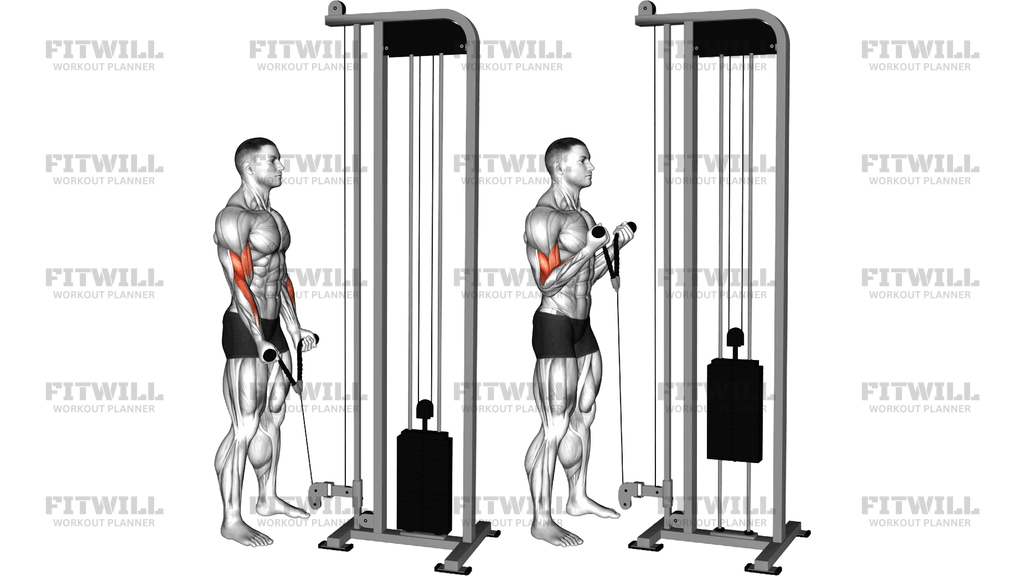
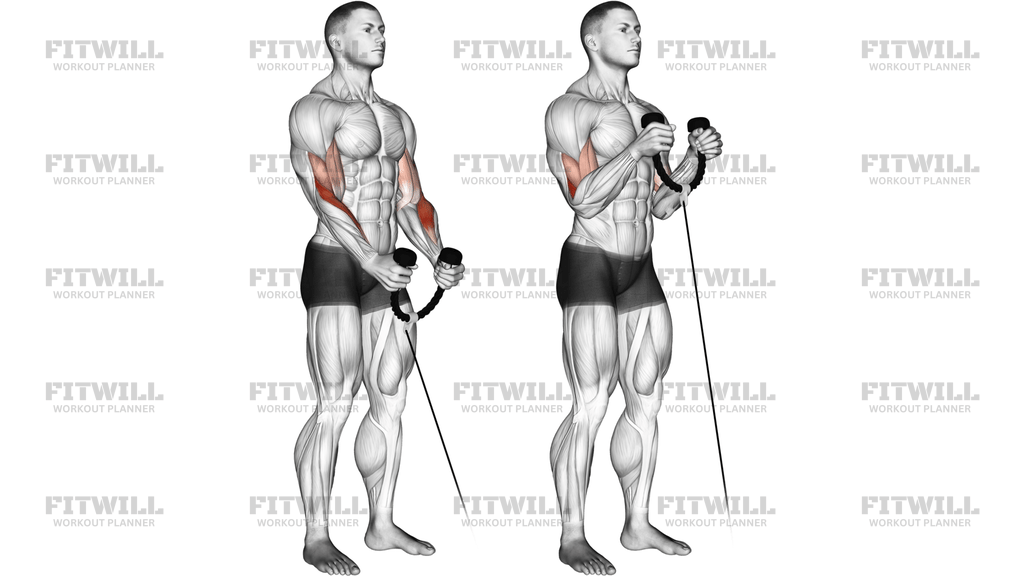
The Cable Standing Biceps Curl (Rope Attachment) is a standing arm exercise performed on a cable machine with a rope clipped to the low pulley. You grip one end of the rope in each hand with a neutral grip, let your arms hang fully extended at your sides, and curl the rope ends up toward your shoulders against the steady pull of the cable. Because the rope lets your hands travel slightly apart as you curl, you can rotate and spread the ends at the top for a strong contraction that a fixed straight bar does not allow.
This movement primarily trains the biceps brachii, with strong involvement from the brachialis and the brachioradialis of the forearm because of the neutral hand position. The continuous tension from the pulley means the biceps stay loaded even at the bottom of the rep, unlike some free-weight curls where tension drops off when the arm hangs straight. It also challenges the forearm flexors and grip to hold onto the rope ends through every repetition.
The setup matters more than most people realize. Standing far enough back from the pulley sets the cable angle so the resistance pulls slightly behind you, keeping the biceps under tension through the whole arc. A stable split or shoulder-width stance, soft knees, and braced core stop you from swinging the torso and turning the exercise into a full-body heave. The rope itself encourages a natural wrist path, which many lifters with cranky elbows or wrists find friendlier than a rigid bar.
To execute it well, keep your upper arms pinned to your sides and let only the elbows flex. Curl until your hands are near shoulder height, spreading the rope ends slightly outward as you rise, then lower under control until the arms are almost fully extended. Smooth tempo on the way down is where much of the growth stimulus lives, so resist the urge to let the stack pull your arms back down.
This exercise fits well as a primary biceps builder on arm days, as a finisher after heavier barbell or dumbbell curls, or as a joint-friendly alternative for lifters who dislike fixed-bar paths. Because the resistance comes from a cable, it is easy to make small weight jumps between sets, which makes it useful for beginners learning curl mechanics as well as experienced lifters chasing higher training volume.
The main safety points are simple: choose a weight you can control through the full range, never jerk the stack off the bottom, and keep your lower back neutral rather than leaning back to assist the pull. If you feel your shoulders shrugging or your elbows drifting forward, the weight is probably too heavy for clean technique.
[ Workout Log & Planner ]
Put your next workout in Fitwill
Keep your plan and training log ready when you are.


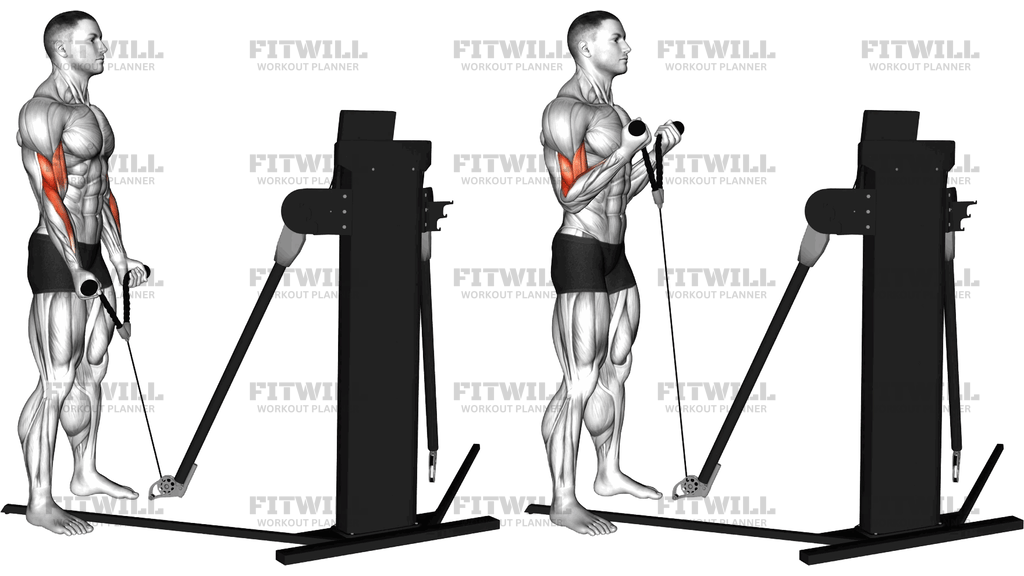
Instructions
- Clip a rope attachment to the low pulley of a cable machine and select your weight on the stack.
- Stand facing the pulley area with feet about shoulder-width apart, then take one rope end in each hand using a neutral grip with your palms facing in and knuckles of each hand resting against the rope ends.
- Step back a short distance so the cable pulls at a slight downward-backward angle, and let your arms hang fully extended at your sides with light tension on the cable.
- Brace your core, keep your chest tall, and pin your upper arms firmly against your torso with elbows stationary.
- Exhale and curl the rope ends up toward your shoulders by flexing the elbows, letting your hands spread slightly apart and wrists rotate naturally as you rise.
- Squeeze the biceps briefly at the top with your hands near shoulder height, without shrugging your shoulders forward.
- Inhale and lower the rope slowly back down until your arms are nearly straight, keeping tension in the biceps at the bottom.
- Pause for a beat with the arms extended, making sure the stack does not slam down, then begin the next repetition.
- Complete all reps, keep your torso upright throughout, and finish the set by releasing one rope end at a time before adjusting the weight.
Tips & Tricks
- If your torso rocks backward on each rep, drop the weight; the cable gives you enough mechanical advantage to cheat heavily, and swinging shifts work away from the biceps.
- Actively spread the two rope ends apart as you curl to the top — this small separation drives a harder peak contraction than simply pulling straight up.
- Keep your elbows glued to your ribs; if they drift forward, the front shoulders take over and the biceps lose tension at the top.
- Do not lock out and relax the elbows hard at the bottom — stop just short of full extension so the cable keeps pulling on the biceps through the whole set.
- The neutral grip is what biases the brachioradialis, so avoid twisting your wrists early; let any supination happen naturally in the last third of the curl.
- Use a two-second lowering phase; because the pulley provides constant resistance, fast negatives waste the part of the rep where this exercise differs most from dumbbell curls.
- Stand far enough back that the rope does not hang slack at the start — a slack line means your first few degrees of curl happen with no resistance.
- If your grip fails before your biceps, wrap your thumb and fingers more firmly around the larger rope knots, or use lifting straps only as a last resort since they change the pulling angle.
- Chalk or dry your hands if the rope ends slip; re-gripping mid-set breaks elbow position and invites form breakdown.
Frequently Asked Questions
Which muscles does the Cable Standing Biceps Curl (Rope Attachment) work?
The biceps brachii is the primary mover, with the brachialis and brachioradialis of the forearm working hard because of the neutral grip. The forearm flexors and grip also stay active to hold the rope ends.
Is the rope grip different from a straight bar cable curl?
Yes. The rope allows a neutral grip and lets your hands spread apart at the top, which follows the natural wrist path and reduces the fixed-wrist strain a rigid bar can cause.
Can beginners do the Cable Standing Biceps Curl (Rope Attachment)?
Absolutely. The cable provides smooth, adjustable resistance and the movement path is guided, making it one of the easier curl variations to learn with clean form.
How far should I stand from the low pulley?
Stand back enough that the cable pulls at a slight downward angle behind your hands and stays taut with your arms hanging at your sides. If the rope goes slack at the start, step closer.
Why do my elbows drift forward during the curl?
This usually means the weight is too heavy or fatigue has set in, so the shoulders help by pulling the elbows up. Reduce the load and consciously pin your upper arms to your torso for the entire set.
What can I substitute if my gym has no rope attachment?
A single handle in each hand at the low pulley, a V-bar attachment, or a straight bar low-pulley curl all train the same pattern, though you lose the hand-spreading element at the top.
Should I lean back to help move the weight?
No. Leaning back turns the exercise into a hip and lower back movement and reduces biceps tension. If you need body English to finish a rep, the weight is beyond what you can control.
Where should this exercise fit in my workout?
It works well as a main biceps movement on arm day or as a finishing pump after heavier barbell or dumbbell curls, since the cable makes small weight increments and high-rep sets easy.
Is it safe to let the arms fully straighten at the bottom?
Straightening is fine as long as you lower under control and do not let the stack yank your arms down. Stop the descent smoothly, keep hold of the rope ends, and reset before the next rep.
Why do my forearms fatigue more on this than on a dumbbell curl?
The neutral, slightly narrower grip places high demand on the brachioradialis and wrist flexors. This is normal, but if your grip gives out early, build forearm strength gradually rather than altering the wrist position.