Band Standing On Bosu Ball Single Leg Abduction
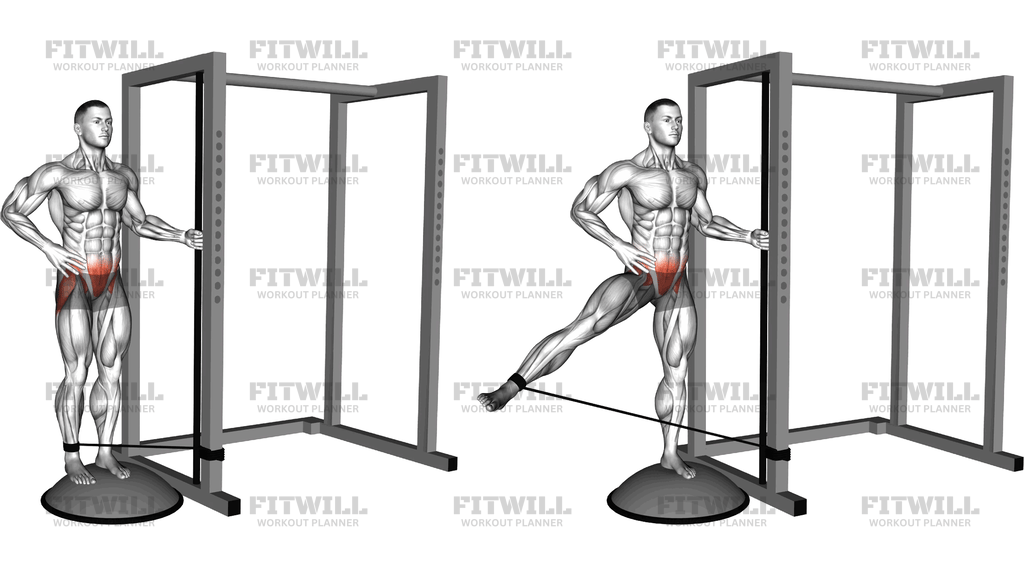
Band Standing On Bosu Ball Single Leg Abduction is a balance-heavy hip exercise that combines two challenges into one: lateral hip strength and single-leg stability. You stand on one leg on top of a Bosu ball with the dome facing up, wear an ankle strap connected to a low-anchored band, and lift the strapped leg out to the side against the band's pull. One hand rests on the rack or frame for light support while the other stays on your hip, which keeps the setup honest without taking the work away from your standing hip.
The main target is the gluteus medius, the muscle on the upper outer side of your hip that lifts the leg sideways and keeps your pelvis level when you walk, run, or stand on one leg. The gluteus maximus, tensor fasciae latae, and deep core muscles assist, while the ankle and small stabilizing muscles of the standing foot work overtime just to keep you centered on the unstable dome. Very few exercises ask the outer hip and the ankle stabilizers to cooperate this directly.
This version is a step up from a standard band standing abduction because the Bosu ball removes the stable floor. On flat ground, most people can swing the leg out with momentum and lean their torso to fake the movement. On the dome, any lean or rush causes visible wobbling, so the exercise forces a slower, cleaner hip motion and a braced trunk. That makes it especially useful for runners and field-sport athletes who need single-leg control, and for people rebuilding hip stability after the basics have become easy.
Setup matters more here than in most abductions. Anchor the band low on a rack upright, put the strap on the leg closest to the anchor, and stand on the opposite leg with your foot placed near the center of the dome. Standing sideways to the anchor with a light grip on the frame gives you a safety hand without letting you pull yourself through the rep. If the anchor is too high or you stand too far from it, the resistance angle changes and the movement stops being a clean abduction.
To execute it well, shift your weight fully onto the standing leg, brace your core, and let the strapped leg hang under the band's tension. Lift it out to the side in a smooth arc, keeping the foot flexed forward and the hips square, until the leg is roughly 30 to 45 degrees out. Pause briefly at the top, then lower with control until the band is taut again. The tempo on the way down is where the stability benefit actually happens.
Because this is a demanding setup, treat it as an accessory movement: two to four sets of 10 to 15 controlled reps per side is plenty. Start with a light band and master the flat-floor version first. If you cannot keep your balance for at least a few reps in a row, regress before you push the resistance, and always position yourself so the support frame is within easy reach.
[ Workout Log & Planner ]
Put your next workout in Fitwill
Keep your plan and training log ready when you are.


Instructions
- Anchor a resistance band low on a rack upright and attach the other end to an ankle strap on the leg closest to the anchor point.
- Place a Bosu ball on the floor with the dome side up, stand sideways to the anchor, and step onto the dome with your non-strapped leg so your foot sits near the center of the dome.
- Hold the rack upright with your inside hand at about hip-to-waist height for light support, and place your outside hand on your hip.
- Take up the band tension so the strapped leg hangs slightly across or beside the standing leg, and shift your weight fully over the standing foot.
- Brace your core, keep your chest tall and hips square to the front, and find your balance on the dome before moving.
- Exhale and lift the strapped leg straight out to the side, away from the rack, in a smooth arc until it is about 30 to 45 degrees from your body.
- Pause for a second at the top with the band taut, keeping the toes pointing forward and avoiding any torso lean away from the leg.
- Inhale and lower the leg back down slowly against the band's pull until it returns near the standing leg without losing tension.
- Complete all reps on one side, then step off the dome carefully, re-strap the band on the other ankle, and repeat on the opposite leg.
Tips & Tricks
- Put the strap on the leg nearest the rack. If the far leg is strapped, the band crosses in front of your body and the pull direction turns the abduction into a diagonal drag.
- Grip the rack with two fingers' worth of pressure, not a full squeeze. If you find yourself pulling on the frame to lift the leg, the band is too heavy or you are drifting into torso rotation.
- The most common failure is a hip hike: the standing hip hikes up and the pelvis tips as the leg rises. Watch yourself in a mirror and keep both hip bones level throughout the arc.
- Place your foot slightly wider than normal across the dome's center at first. A narrow footprint on an unstable surface makes even a light band feel unmanageable.
- Cut the range before you cut the balance. Stopping at 30 degrees with a still torso beats reaching 50 degrees while leaning your trunk sideways.
- Keep the toes of the working leg pointing forward. Turning the foot and hip open turns the movement into a different rotation-dominant action and reduces gluteus medius work.
- If the dome slides on a smooth floor, set it against a mat or in a clear corner area so the base cannot shift under you mid-rep.
- Breathe on the movement rather than holding your breath; breath-holding plus instability is the fastest route to a wobble you cannot recover from.
- Ditch the shoes if your gym allows it. Feeling the dome through the foot makes ankle corrections faster and more precise.
- Expect your first set on the second side to feel worse than the first side. Balance deficits are usually asymmetrical, so train the weaker side first and match, not exceed, its reps.
Frequently Asked Questions
What muscles does Band Standing On Bosu Ball Single Leg Abduction work?
The gluteus medius on the outer hip is the primary mover, assisted by the gluteus maximus and tensor fasciae latae. On the standing side, the deep core and the small stabilizing muscles around the ankle and foot do substantial work controlling the Bosu ball.
Why stand on a Bosu ball instead of the floor for this abduction?
The unstable dome forces the standing hip and ankle to stabilize while the working leg moves, which trains the two systems together. On a flat floor, many people substitute torso lean and momentum; the dome makes those compensations obvious.
Is Band Standing On Bosu Ball Single Leg Abduction suitable for beginners?
Not as a first exercise. Learn the standing band abduction on flat ground first, then progress to the dome with a very light band. If you still wobble excessively, build single-leg balance without resistance before adding the band back.
How high should the band be anchored?
Anchor it at floor level or the lowest setting on the rack upright. A low anchor keeps the resistance pulling sideways and slightly down, which matches the horizontal abduction path; a high anchor changes the angle and turns the movement into something closer to a lateral raise of the leg with a different resistance curve.
Should I hold the rack during the exercise?
Yes, but lightly. A fingertip or single-hand touch on the upright is there for safety and to stop a fall, not to generate force. If you are pulling on the frame each rep, reduce the band tension.
How far should I lift my leg during Band Standing On Bosu Ball Single Leg Abduction?
About 30 to 45 degrees away from your body is enough for most people. Going higher usually requires the pelvis to tilt or the torso to lean, which shifts work away from the outer hip.
Why does my standing foot cramp or shake on the dome?
That is the small intrinsic foot and ankle muscles working hard to correct on an unstable surface. It usually improves with practice; shorten your sets, go barefoot if possible, and keep your weight centered over the dome rather than on your toes.
What can I use instead if I do not have a Bosu ball?
Do the same band abduction standing on the floor, or on a folded exercise mat or balance pad for a milder instability challenge. The hip training is similar, just with less demand on the standing-leg stabilizers.
How many reps and sets should I do?
Two to four sets of 10 to 15 controlled reps per side works well, with the tempo kept even on the lift and the lowering. Because balance is the limiting factor, err toward more sets of fewer quality reps rather than grinding through wobbly ones.
Is it safe to lose balance on the Bosu ball mid-set?
Usually, if the area around you is clear and the rack is within reach. Step off the dome with the free leg first, reset the band tension, and start the set again rather than trying to recover a rep with a jerky movement.