Push Up Jack
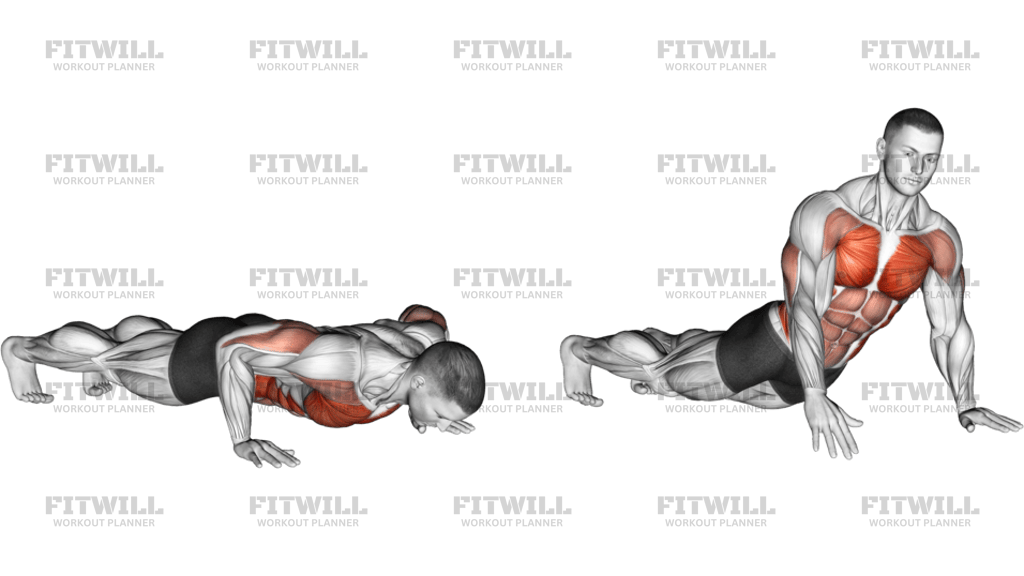
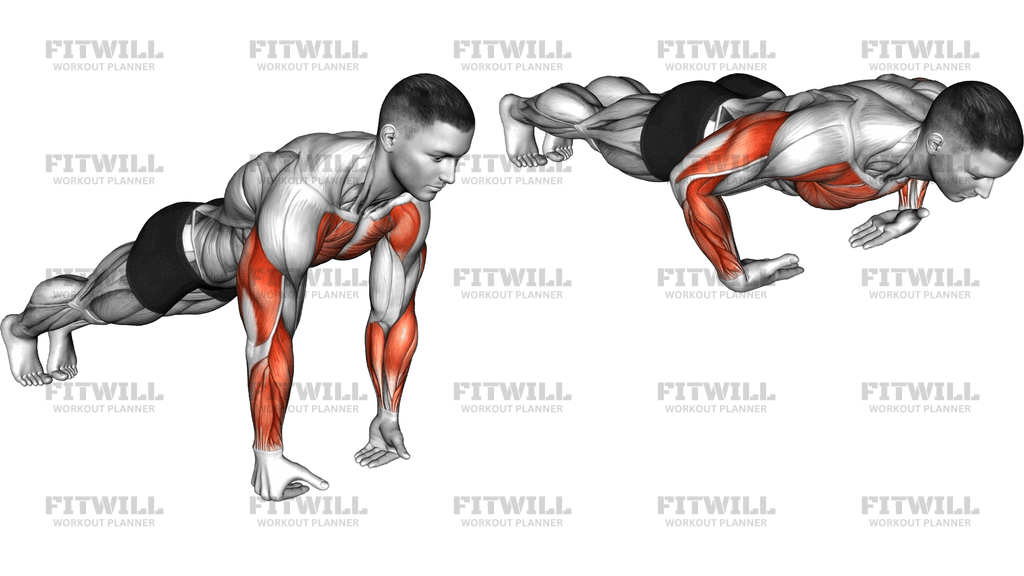
The Push Up Jack is a hybrid bodyweight exercise that combines a standard push-up with the leg action of a jumping jack. From a strong plank position, you jump both feet out wide as you lower your chest toward the floor, then jump the feet back together as you press back up. The result is a movement that trains upper-body pressing strength and lower-body power at the same time, while your core works overtime to keep your trunk stable through two moving parts.
This exercise earns its place in conditioning circuits, bootcamp-style workouts, and athletic training blocks because it raises your heart rate quickly without any equipment. It suits people who already own a solid push-up and are looking for a bigger metabolic challenge, or athletes who want to train explosive hip movement and pressing strength in one rep. If you can perform ten to fifteen clean push-ups with good form, you are ready to try the jack variation.
The main movers are the chest, front shoulders, and triceps, which handle the pressing portion. The glutes, inner thighs, and calves drive the wide-and-together foot pattern, and the entire core braces to stop your hips from sagging or bouncing as your feet leave and return to the floor. Because two actions happen in one rep, the demand on coordination is higher than either a push-up or a jumping jack alone.
Setup matters more than speed here. Hands placed slightly wider than shoulder width, a straight line from head to heels, and a braced midsection give you a stable base for both the press and the foot jump. If your hips drop or your hands drift, the exercise turns into a sloppy, low-reward grind, so it is worth slowing down before adding speed.
To execute well, think of the arm and leg actions as one synchronized beat: feet jump wide exactly as your chest descends, and feet snap back together exactly as you press up. Land softly on the balls of your feet with your knees neither locked nor collapsed. Move at the fastest pace you can control, not the fastest pace you can survive.
Common uses include timed intervals, finishers at the end of an upper-body session, and metabolic circuits where push-ups and jumping jacks would otherwise be paired separately. If the full version is too demanding, drop to your knees for the press or step the feet out wide instead of jumping. Stop the set when your form breaks, since a fatigued Push Up Jack with sagging hips places unnecessary stress on the lower back and shoulders.
[ Workout Log & Planner ]
Put your next workout in Fitwill
Keep your plan and training log ready when you are.


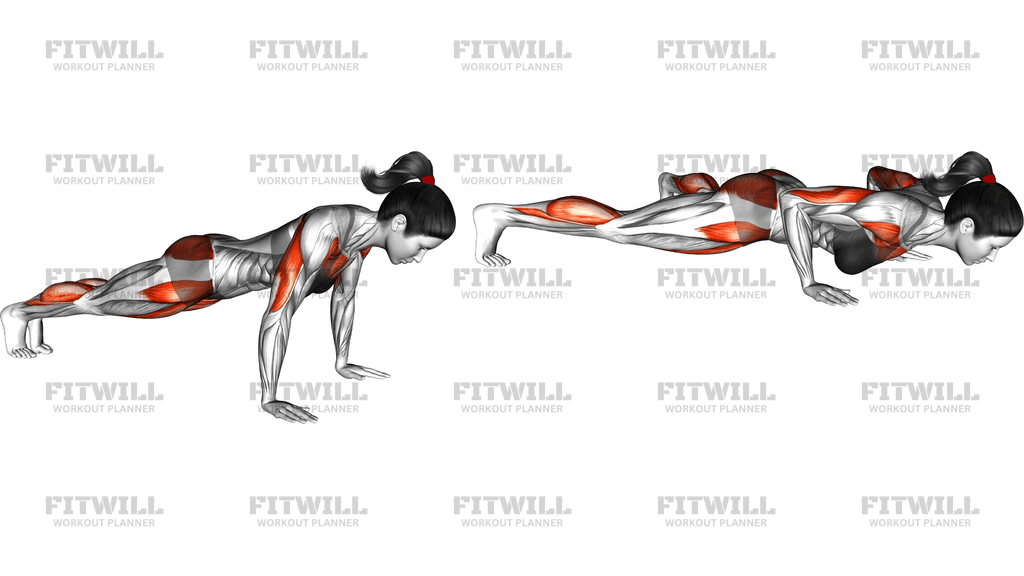
Instructions
- Place an exercise mat on the floor and set your hands slightly wider than shoulder width, fingers spread and pointing forward.
- Extend both legs behind you so your body forms one straight line from head to heels, resting on the balls of your feet with feet together.
- Brace your core and squeeze your glutes so your hips are locked in line with your shoulders before you move.
- Inhale, then jump both feet out wide to the sides at the same time you bend your elbows and lower your chest toward the floor.
- Lower until your chest is a few inches from the mat, keeping your elbows at roughly a 45-degree angle to your torso.
- Press explosively through your palms to straighten your arms while jumping your feet back together in the same beat.
- Exhale as you press up and land softly on the balls of your feet with your body back in the straight plank line.
- Reset your brace briefly at the top, then repeat for your target repetitions or time interval.
- If timing the two actions together breaks down, slow the tempo down or step the feet wide and back instead of jumping until coordination improves.
Tips & Tricks
- The most common mistake is letting the hips sag when the feet jump wide, which strains the lower back; keep your glutes tight and think of holding a rigid plank even while your feet are moving.
- If your chest stops descending because your shoulders fatigue before your legs do, the jack pattern is stealing from your press; finish with regular push-ups or reduce the reps per set.
- Land on the balls of your feet with soft knees rather than flat-footed slaps, which keeps the jumping rhythm quiet and protects your joints.
- Keep your hands planted for the entire set. If your palms creep forward or inward between reps, your base widens and your pressing line weakens.
- Sync the beats rather than separating them: feet land wide at the bottom of the push-up, feet meet at the top. Counting out loud can help you find the rhythm.
- Widen your hand position slightly more than a normal push-up if you feel shoulder pinching, since the added lower-body movement can pull your torso path off line.
- On a slippery floor, use a mat or wear appropriate footwear, because the feet sliding out rather than jumping cleanly turns the movement into a floor scramble.
- Cap your sets before your hips start bouncing on each landing; once your midline moves with every jump, the core benefit disappears and the lower back takes over.
- For a harder version, add a small hop with both hands leaving the floor at the top, but only after you can keep the basic pattern tight for ten or more reps.
Frequently Asked Questions
What muscles does the Push Up Jack work?
The chest, front shoulders, and triceps drive the push-up, while the glutes, inner thighs, and calves power the wide-and-together jump. Your core stays active the whole time to keep your hips level while both ends of your body move.
Is the Push Up Jack suitable for beginners?
It is best for people who can already do ten or more solid push-ups. Beginners can regress it by performing the push-up from the knees and stepping the feet wide and back instead of jumping.
How is the Push Up Jack different from doing push-ups and jumping jacks separately?
Combining them forces you to coordinate an upper-body press and a lower-body jump in the same beat, which raises the heart rate higher and demands more trunk stability than either exercise alone. It also cuts the time needed to train both patterns.
Why do my hips sag when my feet jump out wide?
Sagging hips usually mean your core and glutes are not braced before the jump, or fatigue has set in. Reset your plank at the top of each rep, squeeze your glutes, and stop the set if the sagging continues.
Should my feet land wide at the bottom or the top of the push-up?
Your feet should land wide as your chest reaches the bottom, then return together as you finish pressing up. This keeps the arm and leg actions synchronized and makes the rhythm repeatable.
Can I replace the Push Up Jack in a circuit with something easier?
Yes, a regular push-up paired with side steps into a wide stance works the same patterns with far less impact. Knee push-ups with a slow stepping jack are another low-impact substitute.
Is the jumping motion hard on the knees or lower back?
Landing softly on the balls of your feet with a braced core keeps the impact manageable for healthy knees and backs. If either area is irritated, choose the stepping version instead and keep your plank line strict.
How many reps of the Push Up Jack should I do?
Start with sets of six to eight reps or timed intervals of fifteen to twenty seconds, focusing on keeping the press and jump in sync. Add reps only while your hips stay level and your chest still reaches proper depth.
Do I need any equipment for the Push Up Jack?
No, your body weight and floor space are enough. An exercise mat is helpful for wrist comfort and to keep your feet from slipping during the jump.