Lying Abduction Leg Raise On Floor
The Lying Abduction Leg Raise On Floor is a bodyweight movement performed lying on your back with the legs lifted straight up toward the ceiling and then opened out wide into a controlled V shape before drawing back together. Because your legs work against gravity while your torso stays anchored to the floor, the outer hip and glute muscles — particularly the gluteus medius and tensor fasciae latae — have to drive the entire opening, while the adductors on the inner thigh control the return and get a deep stretch at the widest point.
This position is unusual compared with standing or side-lying abduction work. With your hips flexed to roughly ninety degrees and the legs vertical, the gluteus medius works through a different part of its range than it does in standing side leg lifts or banded walks. That makes the movement a useful complement for anyone whose outer hips rarely get trained directly: desk workers with tight, inactive hips, runners and cyclists who hammer the quads and hip flexors but neglect abduction, and people building hip stability for squats or single-leg work.
The setup matters more than it looks. Lying flat with your lower back pressed toward the floor and your arms relaxed at your sides gives your pelvis a stable base. If your lower back arches or your pelvis rocks side to side as the legs open, you lose the isolation and start shifting work into the lumbar area. Keeping the knees straight is equally important — soft knees turn the movement into something vague, while locked-out but not strained legs make the quads and hip abductors do the actual work.
To execute it well, raise both legs until they point at the ceiling, then think about pushing your heels out and away from each other rather than just letting gravity drop the legs. The descent should be slow and symmetric, stopping well before you feel the lower back peel off the floor, then pull the legs back up along the same path using the inner thighs and glutes together. The whole arc looks like an opening and closing compass drawn in the air.
Because no equipment is required, this fits easily into warm-ups, glute and hip circuits, pilates-style floor sessions, or cool-downs where you want controlled range of motion without load. Start with a modest number of reps and a narrower range than feels maximal — the outer hips fatigue quickly, and once they do, form degrades into pelvic rolling almost without you noticing. If the floor is hard on your spine or tailbone, a thin mat or folded towel is enough to make it comfortable without changing the mechanics.
[ Workout Log & Planner ]
Put your next workout in Fitwill
Keep your plan and training log ready when you are.


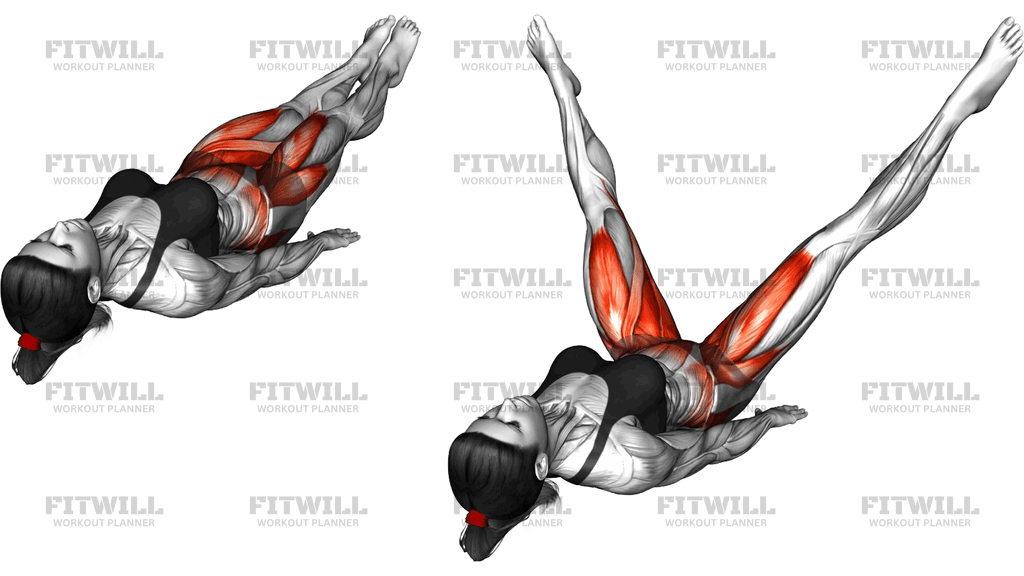
Instructions
- Lie flat on your back on the floor with your legs extended and your arms resting at your sides, palms down.
- Press your lower back gently toward the floor and engage your abdominals to settle your pelvis into a neutral position.
- Raise both straight legs up until they point at the ceiling and your hips are bent to about ninety degrees, feet together.
- Point your toes toward the ceiling or slightly pulled back, and keep both knees fully straight throughout the set.
- Inhale, then slowly lower both legs out to the sides in a wide arc, letting them separate like an opening V.
- Stop when you feel a strong stretch through the inner thighs and outer hips, or when your lower back starts to lift away from the floor.
- Exhale and pull both legs back up along the same path until your feet are together above your hips again.
- Keep the movement symmetric — both legs should travel the same distance at the same speed.
- Pause briefly with the legs vertical at the top, then begin the next repetition.
- Complete your set, then lower the legs back to the floor with control rather than dropping them.
Tips & Tricks
- If your hamstrings are tight, your legs may drift forward past your hips as you open them — keep checking that your feet stay above hip height, not behind you.
- The most common mistake is letting the pelvis roll from side to side as the legs drop. Place one hand lightly on your hip bones and make sure they stay level with each other.
- Do not chase a wide V on day one. A shorter range with a flat lower back builds more outer hip strength than a deep split with an arched spine.
- Think 'push the heels apart' instead of 'let the legs fall.' This small cue keeps the gluteus medius engaged through the whole descent instead of just resisting gravity at the end.
- If your lower back lifts off the floor at the bottom, reduce the range immediately — that is the point where your core has stopped controlling the pelvis.
- Keep the knees straight but not jammed. If your knees ache, a very slight softening of the joint is fine as long as the legs stay visually straight.
- Move slowly enough that each rep takes several seconds. Fast swinging turns this into a momentum exercise and the outer hips barely contribute.
- Breathe out on the closing phase, when the adductors and glutes pull the legs together — holding your breath here is a common sign the effort is too high.
- If your tailbone feels pressured on a hard floor, slide a folded towel under your hips rather than bending the knees to escape discomfort.
Frequently Asked Questions
What muscles does the Lying Abduction Leg Raise On Floor work?
The primary movers are the hip abductors, mainly the gluteus medius and tensor fasciae latae on the outer hip. The inner thighs work hard on the way back up, and the quadriceps and core hold the legs straight and stabilize the pelvis.
Why are the legs lifted straight up instead of staying on the floor?
Raising the legs vertically puts the hip abductors at a mechanical disadvantage, which means they work against gravity through a longer range. It also adds a stretch for the inner thighs at the bottom of the arc that floor-based side leg lifts do not provide.
Is the Lying Abduction Leg Raise On Floor suitable for beginners?
Yes, since it uses only body weight and the floor provides full support for the spine. Beginners should simply use a narrower range and fewer reps until they can keep the lower back flat and the pelvis still throughout the movement.
My lower back arches when my legs open — what should I change?
That means your core is losing control of the pelvis, so the legs are traveling further than your hips can currently manage. Stop the descent earlier, squeeze your abdominals harder, and gradually widen the range over the following weeks.
How is this different from a side-lying leg raise?
A side-lying leg raise works one hip at a time from a stacked position, while this version trains both hips together with the legs elevated. You get symmetric loading, a stronger inner thigh stretch, and more demand on the core to hold the pelvis level.
Can I do this exercise every day?
Light, controlled sets can be done most days since the load is low, but if the outer hips feel sore or fatigued, give them a rest day. Treat it like any strength exercise — quality reps with recovery beat high daily volume.
Do I need a mat for the Lying Abduction Leg Raise On Floor?
No, the movement works fine on a firm floor, and the hard surface actually helps you feel whether your lower back stays flat. A thin mat or folded towel is purely for comfort under the spine and tailbone.
What can I use if this is too difficult or too easy?
To make it easier, bend the knees slightly or reduce how far the legs open. To make it harder, slow the tempo, add a pause at the widest point, or loop a light resistance band around the ankles so the abductors pull against extra tension.
Should my knees stay locked during the leg raise and opening?
Keep the legs essentially straight so the quadriceps hold the position, but do not strain the knee joints. If you feel pinching behind the knee, a very slight bend is acceptable as long as the legs still look straight from the outside.
Is this movement safe for people with hip issues?
The floor supports the spine and the load is minimal, which makes it gentler than most weighted hip work, but anyone with an existing hip condition should move within a pain-free range and confirm the exercise fits their situation before adding it to a routine.