Forearm Supination
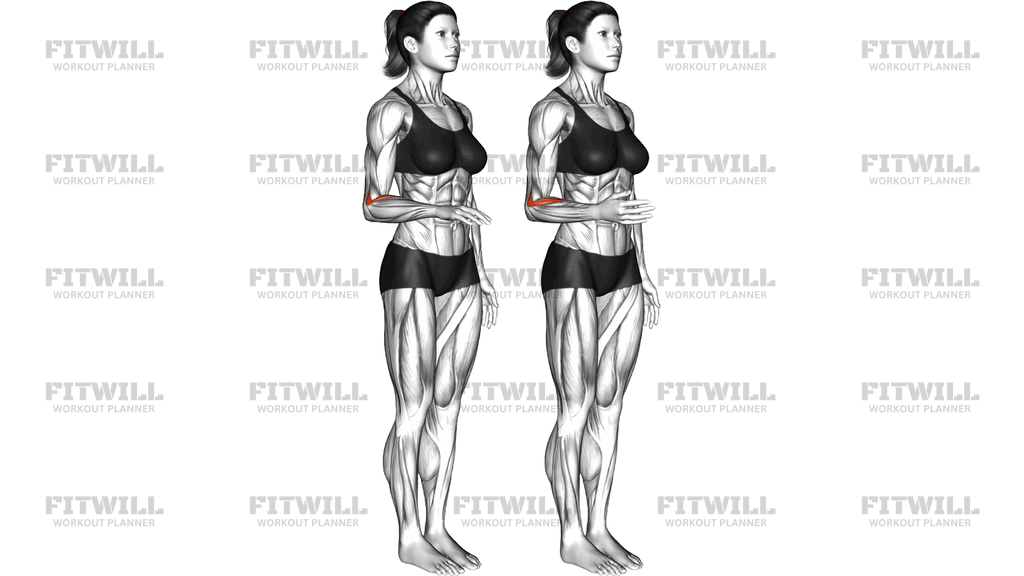
Forearm Supination is a rotational movement where you turn your palm from facing down to facing up, keeping your elbow bent and pinned to your side. The rotation happens at the forearm, not the shoulder, so the upper arm stays completely still while the radius and ulna cross and uncross around each other. The highlighted area at the outer elbow in the movement marks the supinator, the small muscle whose entire job is rolling the palm upward, with the biceps lending a hand as a secondary supinator.
This movement rarely gets trained on its own, which is exactly why it is worth doing. Most grip work focuses on squeezing and wrist curls, but rotation is how your forearm actually functions in daily life: turning a doorknob, using a screwdriver, carrying groceries with the palm up, or catching yourself during a fall. Climbers, tennis and racquet sport players, golfers, and anyone rehabbing an elbow after irritation from heavy pulling all benefit from direct supination work.
The setup matters more than it looks. With the elbow bent to roughly 90 degrees and tucked against your ribs, the supinator works in isolation. If the elbow drifts away from the body or the shoulder rotates to fake the motion, you turn a precise forearm exercise into a sloppy arm swing and lose the point entirely. Because you are working unweighted, the focus is on clean range and end-range control rather than load.
To perform it well, stand tall with feet about hip width and soften your knees. Bend one elbow to 90 degrees, keep it lightly touching your side, and start with the forearm parallel to the floor and the palm facing down. Slowly rotate the forearm so the palm turns up toward the ceiling, pause briefly at the top without shrugging or flaring the elbow, then rotate back down with the same control. The slower you go, the more you will feel the outer forearm near the elbow doing the work.
A common use case is high-rep, unweighted sets as a warm-up before pulling or grip training, or as a gentle strength and mobility drill during elbow recovery. You can also make it harder later by holding a light dumbbell or hammer by the handle end, but master the bodyweight version first. Move only into a pain-free range, and stop if you feel pinching at the elbow joint itself rather than muscular effort.
[ Workout Log & Planner ]
Put your next workout in Fitwill
Keep your plan and training log ready when you are.


Instructions
- Stand upright with your feet about hip width apart, knees soft, and shoulders relaxed down away from your ears.
- Bend one elbow to roughly 90 degrees and tuck it lightly against your side so the upper arm cannot swing.
- Start with your forearm parallel to the floor and your palm facing down, hand open and relaxed.
- Brace your core lightly and keep your wrist straight and neutral, letting the rotation come from the forearm itself.
- Slowly rotate your forearm outward and upward until your palm faces the ceiling, keeping the elbow glued to your ribs.
- Pause for one to two seconds at the top with the palm fully up, feeling the contraction along the outer forearm near the elbow.
- Rotate back down under control until the palm faces the floor again, avoiding any drop or bounce at the bottom.
- Exhale as you rotate the palm up and inhale as you return to the start.
- Complete all reps on one side, then switch arms, keeping the elbow bent at 90 degrees and the torso square throughout.
Tips & Tricks
- The most common mistake is letting the elbow drift forward or away from the body, which shifts the work to the shoulder. Check in a mirror that your upper arm stays vertical and touching your ribs.
- Do not let the wrist flop backward as the palm turns up; a straight, neutral wrist keeps the rotation at the forearm where it belongs.
- If you cannot get the palm fully toward the ceiling, rotate only as far as feels clean. End-range supination improves gradually, and forcing it strains the elbow.
- Avoid shrugging the shoulder as you reach the top of the rotation. If your shoulder creeps up, reset with a tall posture and lighter effort.
- Speed is the enemy here. A two-second rotation up and two seconds down produces far more forearm involvement than fast, repeated spins.
- Once bodyweight reps feel easy, hold a light dumbbell like a hammer at its handle end for added resistance, keeping the same elbow-tucked position.
- Alternate which arm you start with each session so your non-dominant side gets the same quality of work.
- If your elbow feels pinchy rather than muscularly tired, shorten the range slightly or lower the angle of your upper arm instead of pushing through the discomfort.
Frequently Asked Questions
What muscles does Forearm Supination work?
The main muscle is the supinator, a small muscle at the outer elbow and upper forearm that turns the palm upward. The biceps assists as a secondary supinator, especially when the elbow is bent and effort increases.
Why is my elbow kept bent at 90 degrees during Forearm Supination?
A bent elbow pinned to your side isolates the rotation at the forearm and stops the shoulder from helping. It also puts the supinator in its strongest working position.
Can beginners do Forearm Supination?
Yes, it is one of the safest ways to train the forearms because there is no external load. Beginners should focus on slow, controlled rotations and a pain-free range before adding any resistance.
How many reps of Forearm Supination should I do?
Fifteen to twenty controlled reps per side works well for strength and endurance. If you later add a light weight, drop to ten to fifteen reps with even slower tempo.
Is Forearm Supination good for tennis elbow or golfer's elbow?
Gentle supination work is commonly used in elbow rehabilitation programs because it loads the forearm muscles lightly through rotation. If you have an active or painful condition, get clearance from a healthcare professional first and stay in a comfortable range.
How is Forearm Supination different from forearm pronation?
Supination turns the palm up toward the ceiling, while pronation turns the palm down toward the floor. They use different forearm muscles, so training both gives you balanced rotational strength.
Why does my shoulder move when I try Forearm Supination?
That usually means your elbow has drifted away from your ribs, so the shoulder is rotating to compensate. Tuck the elbow back against your side and slow the movement down until only the forearm turns.
Can I add weight to Forearm Supination?
Yes, once the bodyweight version feels easy, hold a light dumbbell or a hammer near the head end so the lever length increases the demand. Start very light, because the supinator is a small muscle.
Should I feel Forearm Supination in my wrist?
You should feel it along the outer forearm near the elbow, not inside the wrist joint. If your wrist hurts, keep the wrist straight and reduce the rotation range rather than forcing the palm fully up.
When is the best time to use Forearm Supination in a workout?
It works well as a warm-up before pulling, climbing, or grip training, or as a finishing drill for the forearms. Because it is low load, you can also do it daily as a mobility habit.