Muscle Up (On Vertical Bar)
The Muscle Up (On Vertical Bar) is an advanced bodyweight movement performed on a pull-up and dip station. You begin hanging from the overhead bar with a shoulder-width overhand grip, pull explosively toward the bar, and instead of stopping at the chin, you transition your torso up and over the bar, pressing down into the parallel handles until your arms are locked out in a straight-arm support above the bar. It is essentially a pull-up and a dip stitched together by one demanding transition phase.
This exercise is useful for calisthenics athletes, obstacle course racers, and strength trainees who have already built a solid foundation of strict pull-ups and dips and want a new challenge. Because it forces you to move from a pulling position to a pushing position in one continuous effort, it develops coordination and timing that neither a pull-up nor a dip can train alone. It is also a common benchmark skill in gymnastics-style strength training, so it appeals to anyone chasing visible, measurable progress with bodyweight work.
The primary muscles involved are the lats and upper back, which drive the initial pull. The biceps assist hard during the pull, the triceps and shoulders take over during the press-out, and the upper traps and scapular muscles control the transition over the bar. Your core works throughout to keep the body from swinging wildly, and the forearms and grip are under constant tension from the hang to the support.
Setup matters more than most people expect. The bar height, grip width, and how you position your wrists all determine whether the transition is smooth or impossible. A slightly higher pull and an aggressive lean over the bar as you reach the top of the pull make the movement far easier than trying to muscle through with the arms alone. Starting from a controlled dead hang, rather than a big swing, keeps the path predictable and spares your shoulders.
To execute it well, think of the movement in three phases: an explosive pull to the chest, a fast transition where the elbows rise above the bar and the torso leans forward over it, and a strong press to full lockout in support. Descend with control rather than dropping, either back over the bar into the hang or down to the floor if the station allows. Quality reps matter far more than grinding out ugly ones.
Because the Muscle Up (On Vertical Bar) places significant load on the shoulders and elbows during the transition, build up gradually. If you cannot yet perform several strict pull-ups and dips, train those separately and use band-assisted or jump-assisted muscle ups to learn the path before attempting full repetitions from a dead hang.
[ Workout Log & Planner ]
Put your next workout in Fitwill
Keep your plan and training log ready when you are.


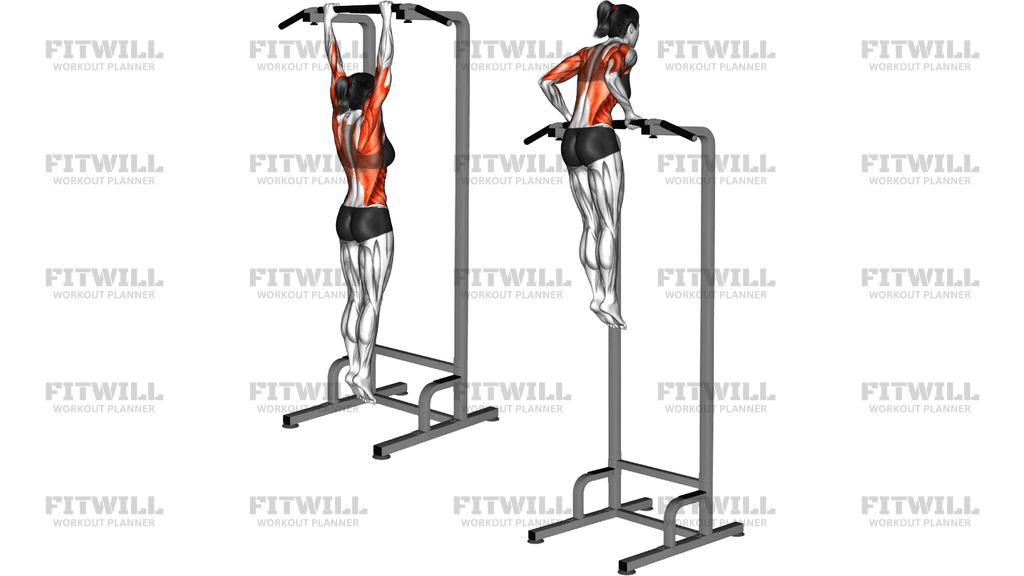
Instructions
- Stand under the pull-up bar of a power tower and reach up to grip it with an overhand grip, hands about shoulder-width apart, thumbs wrapped around the bar.
- Pull your shoulder blades down and together, then lift your feet off the floor so you hang with arms fully extended, legs together and slightly in front of the body to reduce swinging.
- Brace your abdominal muscles and squeeze your glutes lightly to keep the body in one connected line before you start pulling.
- Initiate the pull by driving your elbows down toward the floor, moving explosively enough that your chest rises toward and past the bar.
- As your chest reaches bar height, lean your torso forward over the bar and let your elbows travel up and back so your forearms clear into the pressing position.
- Immediately press down through the parallel handles, extending your elbows until you sit tall in a straight-arm support above the bar with shoulders away from your ears.
- Pause briefly in the support, then lower yourself under control by bending the elbows and reversing the transition back into the hang, or dismount with soft knees if the station height allows.
- Exhale during the pull and press, and inhale as you lower back to the hang.
- Reset your grip and your hang completely before starting the next repetition, keeping your feet still to avoid building momentum from a swing.
Tips & Tricks
- If you can pull your chest to the bar but stall there, the transition is the weak link. Practice the transition alone by jumping into the top position and slowly lowering through it, training the exact path your elbows need to travel.
- A slight lean over the bar at the top of the pull is your friend. Keeping your torso perfectly vertical makes the forearms catch on the bar and turns an achievable rep into an impossible one.
- Avoid pulling with bent arms and yanking with the head. Start from a fully extended hang with shoulders engaged so the lats contribute instead of just the biceps.
- Excessive kipping or a big leg swing may get you over the bar, but it robs you of strength gains and puts your shoulders in a vulnerable position at speed. Keep the legs quiet and accept fewer reps.
- Bending the knees and tucking the heels slightly can help you finish the transition without swinging, but do not kick the legs upward to steal momentum.
- Keep your wrists wrapped firmly around the bar rather than hanging by the fingers. A loose grip often causes slipping at the exact moment the transition demands the most from your hands.
- Work on strict dips separately. Many people can pull high enough but lack the pressing strength to lock out at the top, which is one of the most common reasons for failed reps on this movement.
- If your grip gives out before your pulling strength does, build forearm endurance with dead hangs and scapular pull-ups before adding more muscle up volume.
- Stop the set when your reps get noticeably slower or messier. A failed transition with fatigue in the shoulders is where form breakdown and strain tend to happen.
Frequently Asked Questions
Which muscles does the Muscle Up (On Vertical Bar) work the most?
The lats and upper back drive the pull, while the biceps assist during the pulling phase and the triceps and shoulders take over during the press to support. The traps and core stabilize the transition over the bar.
How many pull-ups and dips should I be able to do before trying the Muscle Up (On Vertical Bar)?
A common guideline is at least 8-10 strict pull-ups and 8-10 strict dips with clean form. Without that base, the transition phase will stall and the shoulders will take unnecessary strain.
Should I use a false grip for the Muscle Up (On Vertical Bar)?
You do not need a false grip on a vertical bar station because the parallel handles give you a natural place to press from at the top. A standard overhand grip with the thumbs wrapped works well; focus on pulling high and leaning over the bar instead.
Why do I stall with the bar at my chest and cannot get over it?
This is the most common sticking point and usually means your transition technique, not your pulling strength, is the issue. Practice jumping into the support position and lowering slowly through the transition so your body learns the elbow path.
Is swinging or kipping acceptable during this exercise?
A small, controlled knee tuck can help finish the transition, but large swings from the hips should be avoided. Excessive kipping makes the movement less effective for strength and loads the shoulders at speed.
Can beginners train the Muscle Up (On Vertical Bar)?
Beginners should first build strict pull-up and dip strength, then use band-assisted or jump-assisted muscle ups to learn the movement path. Attempting full reps too early risks strain around the shoulders and elbows.
What is a good substitution if I cannot perform a full Muscle Up (On Vertical Bar) yet?
Use chest-to-bar pull-ups, straight-arm dips, and negative muscle ups where you start in support and lower slowly through the transition. Together these cover both halves of the skill.
How should I lower down after finishing a rep?
Reverse the movement under control by bending the elbows, guiding yourself back over the bar into the hang, then extending the arms fully before the next rep. Dropping from the support position jars the shoulders and elbows and wastes the eccentric strength benefit.
Is the Muscle Up (On Vertical Bar) safe for the shoulders?
It is generally safe when you have adequate pulling and pressing strength, start each rep from a controlled hang, and keep the transition smooth. If you feel pinching at the front of the shoulder during the transition, reduce the range, slow down, and build more base strength before continuing.