Seated Floor Marching With Arms Pump
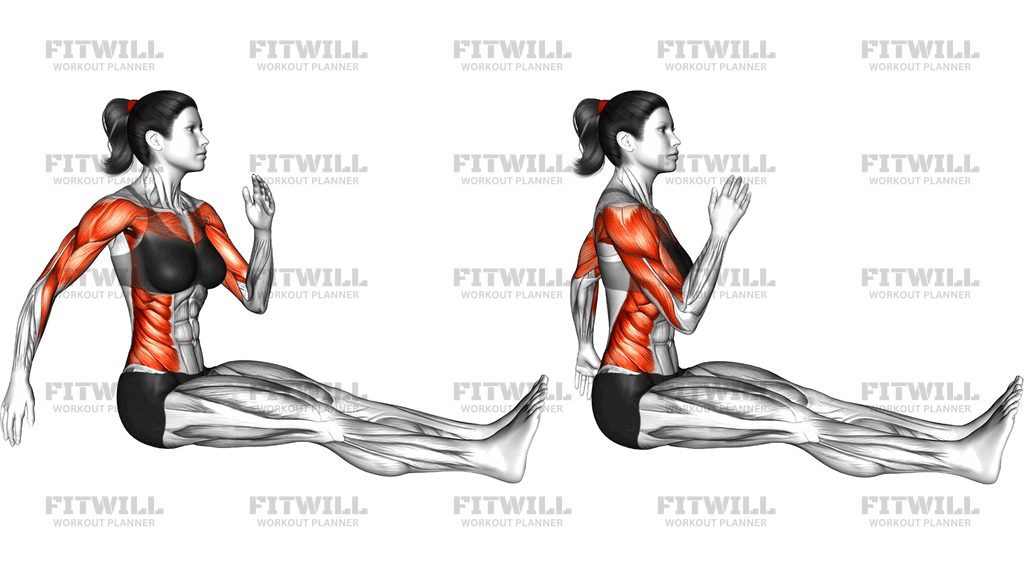
Seated Floor Marching With Arms Pump is a low-impact conditioning drill performed sitting on the floor with the legs extended straight ahead. From this tall, grounded position you drive the arms in an alternating running or marching rhythm — one elbow punches forward while the other swings back — just like pumping the arms during a brisk walk or jog. The floor removes the balance demand of standing versions, so all your attention can go to clean arm mechanics and keeping the trunk quiet and controlled.
This movement is a great fit for beginners, older adults, anyone returning from a layoff, and people who need a joint-friendly way to raise their heart rate. It also works well as a warm-up before lower-body training, as an active recovery drill between harder sets, or as a building block toward full standing marching and running drills. Because nothing is loaded and nothing leaves the floor except the arms (and optionally the heels), it is easy to scale simply by changing tempo and duration.
The shoulders and arms do the visible work: the front delts drive the arm forward, the triceps extend it, and the biceps help fold the elbow back up on each return. What keeps the exercise honest is the trunk — the abdominals and obliques must brace to stop your torso from rocking and twisting with every arm swing. If you add a light marching lift of the heels or knees, the hip flexors and thighs join in as well.
The setup is what separates this from just waving your arms around. Sitting tall on your sit bones with the shoulders stacked over the hips gives the arms a stable base to swing from, and the extended legs anchor the pelvis. If you slouch, the lower back rounds, the rib cage collapses, and every arm pump becomes a whole-body rock — which defeats the purpose. A firm cushion under the sit bones can help if tight hamstrings pull you backward.
To execute it well, keep the elbows bent around ninety degrees and brush them close to the ribs as they pass. The front hand rises to roughly chin or shoulder height; the back hand trails behind the hip. Swap positions with a crisp, even rhythm rather than rushing, and keep your gaze forward so the neck stays relaxed. Breathe steadily throughout — a light exhale with each forward drive works well.
Practically, this is an exercise you will usually perform for time rather than reps: twenty to forty seconds builds the pattern, and longer intervals turn it into a modest cardio effort. Stay honest about posture — if you catch yourself rocking, leaning back, or shrugging, slow down or shorten the set. The point is a tall spine, quiet hips, and sharp arm mechanics, not speed for its own sake.
[ Workout Log & Planner ]
Put your next workout in Fitwill
Keep your plan and training log ready when you are.


Instructions
- Sit on a mat or firm floor with both legs extended straight in front of you and the feet flexed, toes pointing up.
- Sit tall on your sit bones, stacking the shoulders directly over the hips; place a folded towel or low cushion under the sit bones if tight hamstrings pull your lower back into a round.
- Bend both elbows to about ninety degrees and bring the arms into a running stance: one hand up near shoulder height in front, the other hand back beside the hip.
- Brace the abdominals lightly, as if bracing for a gentle push, so the trunk is stable before the arms start moving.
- Pump the arms by swapping positions in one smooth stroke: the front elbow drives down and back past the ribs while the back elbow drives forward and up, keeping both elbows brushing close to the sides of the torso.
- Keep the torso still and facing forward — no rocking, leaning, or twisting — and let the legs stay extended and relaxed along the floor.
- Optionally add the marching element by lifting one heel or knee slightly off the floor with each opposite arm drive, then lowering it as the arms switch.
- Breathe in a steady rhythm, exhaling lightly on each forward arm drive; avoid holding your breath as the tempo picks up.
- Continue for a set time or a set number of pumps, then pause with both hands resting on your thighs, recheck your tall seated posture, and reset before the next set.
Tips & Tricks
- If your torso starts rocking with each pump, slow the tempo before anything else — the rock almost always comes from swinging faster than your core can stabilize.
- Shrugged shoulders near the ears are the most common fault here; before each set, take one breath, drop the shoulders down the back, and start pumping from that position.
- Slouching mid-set usually comes from tight hamstrings dragging the pelvis backward, not laziness — prop the sit bones up on a cushion rather than fighting to sit flat on the floor.
- Keep the elbows tracking close to the body; arms flaring wide turns this into a shoulder raise and loses the running-arm pattern you are trying to groove.
- Match the effort of both arms — the trailing arm tends to get lazy behind the hip, so consciously drive it back to full extension each stroke.
- If you add the heel or knee lift, keep it small; a big marching lift will tip you backward when the legs are extended this far in front.
- Do not let the chin poke forward to meet the raised hand — keep the head stacked over the rib cage and the eyes on a fixed point ahead of you.
- Aim for an even, metronome-like rhythm rather than bursts of speed; this drill rewards crisp timing, not velocity.
- If your lower back feels strained instead of worked, reduce the pace and recheck that you are hinged at the hips with a tall spine, not arching to chase range.
Frequently Asked Questions
What muscles does Seated Floor Marching With Arms Pump work?
The shoulders and arms do the driving — front delts, biceps, and triceps — while the abdominals and obliques work hard to keep the trunk from rocking. Adding the optional heel or knee lift brings the hip flexors and thighs into play.
Should my legs move during Seated Floor Marching With Arms Pump, or stay on the floor?
The base version keeps both legs extended and still on the floor, with only the arms pumping. If you want the marching element, add a small, controlled heel or knee lift on the side opposite the forward arm.
Is Seated Floor Marching With Arms Pump a cardio or a strength exercise?
It sits between the two: done briskly for longer intervals it raises the heart rate like low-impact cardio, while the trunk-stabilizing demand gives the core a muscular endurance challenge. Treat it as conditioning rather than heavy strength work.
Why do my hamstrings feel tight when I sit tall with my legs extended?
Extended-leg sitting pulls on the hamstrings and tips the pelvis backward, which rounds the lower back. Elevating the sit bones on a folded towel or firm cushion tilts the pelvis upright and usually resolves it.
How is Seated Floor Marching With Arms Pump different from pumping arms while standing?
Standing versions add balance and leg work but also let you cheat by bouncing and swaying. Seated, the floor anchors your pelvis, so the arms must do the work and the core must control the torso with nowhere to hide.
I feel this only in my shoulders — is my core actually working?
The core works to prevent movement, so it often feels less obvious than the pumping arms. Test it: if your torso stays perfectly still and untwisted through a full set, the abs and obliques are doing their job.
How long should each set of Seated Floor Marching With Arms Pump last?
Start with twenty to thirty seconds of clean, even pumping and build toward forty to sixty seconds as your posture holds up. Stop the set the moment your torso starts rocking or your shoulders creep up.
Can beginners and older adults do this exercise safely?
Yes — it is one of the more accessible conditioning drills because it is unloaded, seated, and low-impact. Beginners should prioritize the tall seated posture and slow rhythm before adding speed or the leg lift.
What should I do if my lower back aches instead of feeling supported?
Stop and recheck your setup: sit bones elevated, spine tall, ribs stacked over the pelvis, and no arching to chase a bigger arm swing. If discomfort persists, shorten the set or substitute a chair-seated version where the feet rest flat on the floor.