Reverse Plank March
The Reverse Plank March is a body weight core exercise that combines a static reverse plank hold with alternating knee drives. You start seated on the floor with your hands planted behind your hips, press through your palms to lift your pelvis so your body forms one straight line from shoulders to feet, and then, while holding that elevated position, pull one knee at a time in toward your chest. The result is a movement that challenges your trunk to stay extended and level while your hips and legs move independently beneath you.
Unlike a standard reverse plank, where the only job is to hold still, the march adds a dynamic element that forces your abs, hip flexors, and glutes to work together. Each time you drive a knee forward, the support base shifts and your torso wants to sag or twist. Keeping the hips high and square through that shift is where the real training effect lives, and it makes this variation noticeably harder than the static hold despite using no equipment.
This movement is useful for anyone who spends a lot of time sitting, because the reverse plank position opens the front of the hips and loads the glutes and lower back in extension, which is the opposite of the posture a desk creates. It also builds straight-arm shoulder strength and teaches the triceps and front delts to support the body with the arms behind the torso, a position rarely trained outside of movements like this and the crab hold.
Setup matters more than most people expect. If your hands are too far behind you or your fingers splay outward, your wrists and shoulders end up in a compromised angle before the march even begins. Place your palms directly under your shoulders with fingers pointing toward your body or slightly out, and keep your weight spread across the whole palm rather than dumping it onto the heel of the hand.
To execute it well, think of pushing the floor away to lift the chest and hips together, squeezing the glutes to reach full extension, and then pulling each knee toward your chest without letting the pelvis drop or rotate. Move at a steady pace rather than racing through the reps, and exhale as each knee comes in. The moment your hips sink below the line of your shoulders and knees, reset rather than grinding through a collapsed position.
The Reverse Plank March fits well as a core finisher after lower body training, as a warm-up activation drill for glutes and trunk stability, or as a main core movement in body weight-only routines. Because it loads the shoulders in extension, anyone with cranky wrists or limited shoulder extension should test the hold position first and shorten the sets until the position feels secure.
[ Workout Log & Planner ]
Put your next workout in Fitwill
Keep your plan and training log ready when you are.


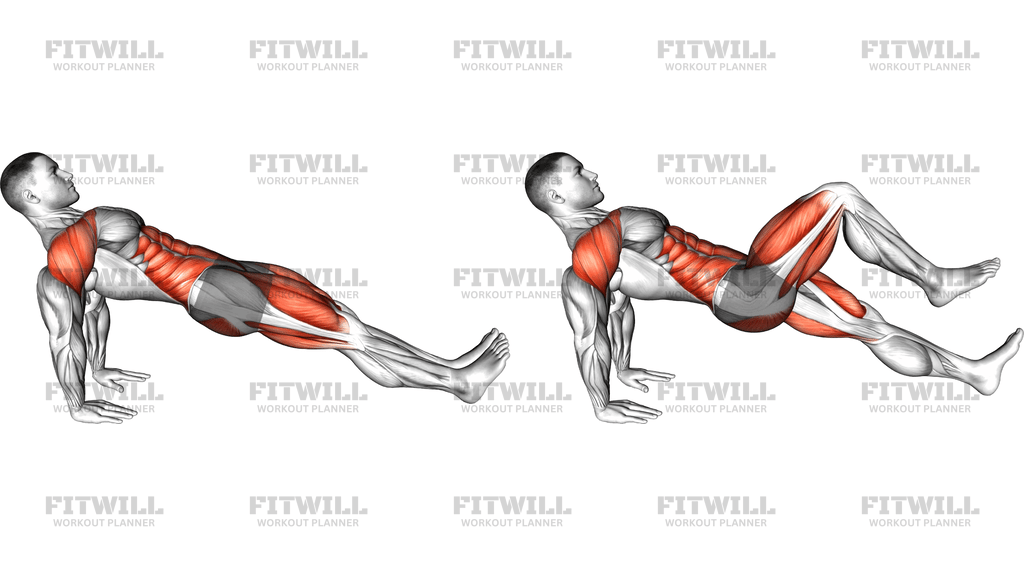
Instructions
- Sit on the floor with your legs extended in front of you and place your palms flat on the floor directly behind your shoulders, fingers pointing toward your body or angled slightly out.
- Roll your shoulders back, press your upper arms toward parallel, and keep your chin gently tucked so your neck stays in line with your spine.
- Press through your palms and squeeze your glutes to lift your hips off the floor until your body forms a straight line from your shoulders through your knees to your ankles.
- Brace your abs as if bracing for a light punch and point your toes or flex your feet, whichever keeps your knees tracking straight ahead.
- Exhale and drive one knee in toward your chest, keeping the foot of the moving leg off the floor as it travels.
- Extend that leg back out to the full reverse plank position without letting your hips drop or rotate.
- Repeat the knee drive with the opposite leg, alternating in a controlled marching rhythm.
- Breathe steadily throughout, exhaling as each knee comes in and inhaling as it returns, and avoid holding your breath as the reps get harder.
- Once form starts to slip, lower your hips to the floor with control, shake out your wrists, and reset before the next set.
Tips & Tricks
- If your hips sag when a knee comes in, you are likely losing glute tension on the support leg. Squeeze the glute of the planted leg harder before starting the march.
- Do not let the pelvis rotate toward the driving knee. Imagine a glass of water balanced on your hip bones and keep it level throughout each rep.
- If your wrists complain, warm them up first and spread your fingers wide, gripping the floor slightly to distribute load across the whole hand instead of the heel of the palm.
- Slow the knee drive down before adding reps. A fast, sloppy march lets momentum hide a sagging torso, while a two-second pull keeps the abs doing the work.
- Keep a soft bend in the supporting knee if your hamstrings feel overly stretched at full extension; the priority is a level, elevated pelvis, not locked-out knees.
- Avoid shrugging into your ears. Actively push the floor away to keep space around your shoulders, since the arms are doing real support work here.
- If your hips start creeping downward rep by rep, that is your cue to end the set. The exercise only trains the right pattern while the hips stay at shoulder height.
- Point the toes of the moving leg slightly as it travels in to avoid scraping the floor and to keep the knee path clean toward the chest.
- Start with shorter sets on a smooth, non-slippery surface. A mat helps if your tailbone or palms feel pressure, but make sure it does not slide under your hands.
Frequently Asked Questions
What muscles does the Reverse Plank March work?
The primary work comes from the abs and deep core, which hold the trunk extended while the legs move. The glutes and hip flexors drive and control the marching action, while the triceps, front delts, and lower back support the body in the straight-arm reverse plank position.
Is the Reverse Plank March suitable for beginners?
Beginners should first master a static reverse plank hold for 15 to 30 seconds with the hips staying level. Once that feels solid, slow single knee drives with brief pauses between reps are a good entry point before continuous marching.
Why do my hips drop when I drive a knee in during the Reverse Plank March?
This usually means the glutes and abs have lost tension as the support base shifts. Squeeze the glute of the standing leg, brace the abs before each knee lift, and slow the tempo until the pelvis stays at full height throughout.
Should my fingers point toward or away from my body in the Reverse Plank March?
Point your fingers toward your body or angled slightly outward, with palms flat under your shoulders. This keeps the wrists and shoulders in a safer angle for the straight-arm support position.
How many reps or how long should I perform the Reverse Plank March?
Start with 2 to 3 sets of 8 to 12 total knee drives, or hold-and-march intervals of 20 to 30 seconds. Progress by slowing the tempo or adding a short pause at the top of each knee drive rather than rushing more reps.
What is a good substitute if the Reverse Plank March hurts my wrists?
Try the same movement on fists with knuckles on a mat, or use a bench or low step to raise your hands and reduce the wrist extension angle. If wrist pain persists, switch to a standard forward plank knee drive while you address the wrist issue.
How is the Reverse Plank March different from a regular reverse plank?
The regular version is a static hold where the body stays still, while the march alternates knee drives that shift your weight from side to side. The marching version demands more coordination and anti-rotation control because the pelvis must stay level while one leg moves.
Should I look up, down, or straight ahead during the Reverse Plank March?
Keep your chin gently tucked and your gaze toward the ceiling or slightly past your hands, so your neck stays in line with your spine. Craning the head back to look up adds unnecessary strain while your shoulders are already under load.
Is it safe to do the Reverse Plank March with lower back discomfort?
The movement trains the trunk in extension and generally feels fine when performed with the glutes engaged and the hips held high. If you have ongoing back issues, check with a qualified professional first and start with the static hold before adding the march.