Pike Push Up (Between Benches)
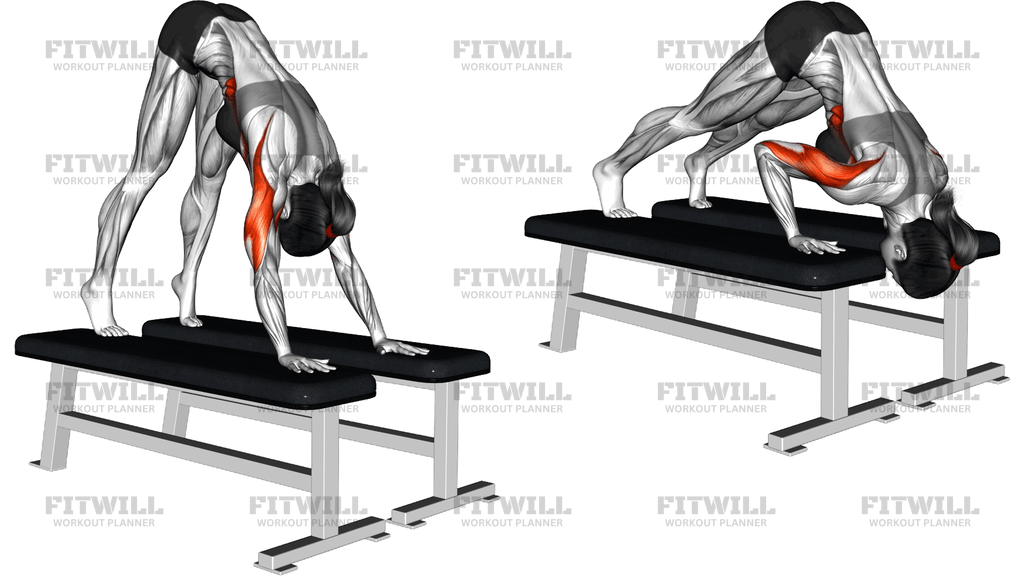
The Pike Push Up (Between Benches) is an overhead-pressing body weight movement that places your feet on one flat bench and your hands on a second flat bench set parallel to it. Your hips hike up into a steep pike, and you lower your head and shoulders down into the gap between the two benches, then press back up. The bench setup is what makes this version special: because your hands are elevated to bench height and your head drops between them, you get a deeper stretch and a longer pressing range than a floor pike push up allows.
This exercise is essentially a body weight overhead press. The front delts do most of the pressing work, with the side delts, triceps, and upper chest assisting, and the traps and serratus working hard to keep your shoulder blades stable as you press. It is a popular progression for anyone building toward a handstand push up, since it trains the same vertical pressing pattern with your hips acting as a counterweight instead of your full body weight.
The two-bench setup matters for a few reasons. Elevating your hands means your head can travel below palm level, which extends the range of motion at the bottom where the shoulders work hardest. Elevating your feet on the second bench loads more of your body weight through your arms than a floor pike, so the movement feels closer to a real overhead press. The benches also give your feet a stable platform so you can focus on pressing rather than balancing.
To execute it well, keep your hips high throughout and think of moving your torso vertically rather than forward. Your spine should stay long, with your head relaxed between your arms at the bottom instead of craned upward. Bend your elbows at roughly a 45-degree angle to your torso, letting them track slightly forward rather than flaring wide, and press until your arms are straight again at the top.
This exercise suits intermediate trainees who already own solid floor pike push ups and want more load and range, handstand push up aspirants working on strength in the bottom position, and home lifters who have benches but no overhead press equipment. Because it is demanding on the shoulders, start with modest volume and only descend as far as you can control, stopping the set when your pressing form starts to drift.
[ Workout Log & Planner ]
Put your next workout in Fitwill
Keep your plan and training log ready when you are.


Instructions
- Place two flat benches parallel to each other with a gap of roughly shoulder width between them, leaving enough space for your head and torso to drop down between them.
- Grip the edge of one bench with your hands about shoulder-width apart, fingers wrapped around the edge or thumbs locked under it so your palms cannot slide off.
- Step your feet up onto the other bench and walk them in until your hips are piked high over your shoulders, forming an upside-down V with your legs nearly straight.
- Brace your core and press your shoulder blades apart so your upper back is active before you start the rep.
- Bend your elbows and lower your head and shoulders straight down into the gap between the benches, keeping your hips elevated and your elbows angled around 45 degrees from your torso.
- Descend until the top of your head is just below the level of your hands or until you reach your deepest controlled depth, without letting your shoulders collapse.
- Press forcefully through your palms to straighten your arms and return to the top of the pike, keeping your hips high the entire time.
- Exhale as you press up and inhale slowly as you lower down between the benches.
- Finish each rep with fully locked arms and an active shrug position, then reset your brace before starting the next repetition.
- When you finish the set, step one foot off the bench at a time rather than dismounting quickly to keep your balance.
Tips & Tricks
- The most common fault is letting the hips drift back toward the feet as you lower, which turns the rep into a shallow push up. Cue yourself to push your hips up and slightly forward over your hands throughout the descent.
- Check the benches for stability before your first rep; a bench that rocks or slides under your hands or feet will throw off your balance at exactly the wrong moment.
- If your head taps the bench or floor at the bottom, you are descending too fast. Slow the lowering phase to two or three seconds and treat the tap as a sign to shorten the depth.
- Keep your neck neutral and let your head hang naturally between your arms at the bottom. Craning your chin up to watch the descent shortens the range and strains the neck.
- If your palms feel like they are sliding on the bench edge, reposition so the heel of your hand sits squarely on the edge and grip with your whole hand rather than resting on open fingers.
- Your elbows should move forward and slightly out, not straight out to the sides. Wide elbow flaring in this deep range is the usual culprit behind shoulder discomfort in this exercise.
- Warm up your shoulders and wrists with easier floor pike push ups before adding the bench depth; jumping straight into the full range on cold shoulders is a common mistake.
- If your hamstrings pull your hips down and shorten the pike, allow a small knee bend. A slightly bent knee with high hips beats a straight leg with a flattened torso.
- Progress by adding reps first, then by moving the benches slightly closer so your torso becomes more vertical and your shoulders carry more of your body weight.
Frequently Asked Questions
What muscles does the Pike Push Up (Between Benches) work?
The front delts are the primary movers, supported by the side delts and triceps during the press. Your upper chest, traps, and serratus also contribute, especially at the bottom of the range where the shoulder blades must stay controlled.
Why use two benches instead of doing pike push ups on the floor?
Elevating your hands on one bench lets your head sink below palm level, which extends the range of motion beyond what the floor allows. Putting your feet on the second bench also shifts more of your body weight onto your arms, making the exercise noticeably harder than a floor pike push up.
Is the Pike Push Up (Between Benches) suitable for beginners?
It is best treated as an intermediate progression. Beginners should build a base with floor pike push ups first, then try this version with a shallow range before lowering the head fully between the benches.
How far apart should the two benches be?
Set them roughly shoulder-width apart so your hands and feet each sit naturally on their own bench while your head and shoulders can pass cleanly into the gap. Too wide, and your shoulders lose the vertical pressing line; too narrow, and your head has nowhere to go.
How is this exercise different from a handstand push up?
Both use a vertical pressing pattern, but here your hips act as a counterweight so you press less than full body weight and your feet stay anchored to a bench. The Pike Push Up (Between Benches) is commonly used as a stepping stone toward handstand push ups.
My lower back aches after this exercise. What am I doing wrong?
That usually means your hips have dropped out of the pike, letting your spine sag into an arched position under load. Stop the set, reset with your hips high and ribs tucked, and shorten the range if you cannot hold the pike through the whole rep.
Can I substitute another exercise if I do not have two benches?
Yes. A single bench or a set of parallettes under your hands with feet on the floor gives a similar extended range, and the standard floor pike push up is the simplest fallback. Chairs can work in a pinch, but only if they are heavy and completely stable.
How deep should I lower between the benches?
Lower until the top of your head is just below hand level or until your depth stops being smooth and controlled, whichever comes first. Depth beyond that point adds risk without adding meaningful pressing work.
Is this exercise safe for the shoulders?
It is generally safe when your elbows stay around 45 degrees to your torso, your depth matches your control, and your shoulder warm-up is adequate. If you have a history of shoulder impingement, start with a partial range and stop any rep that produces pinching rather than muscular effort.