Dumbbell Sit Up
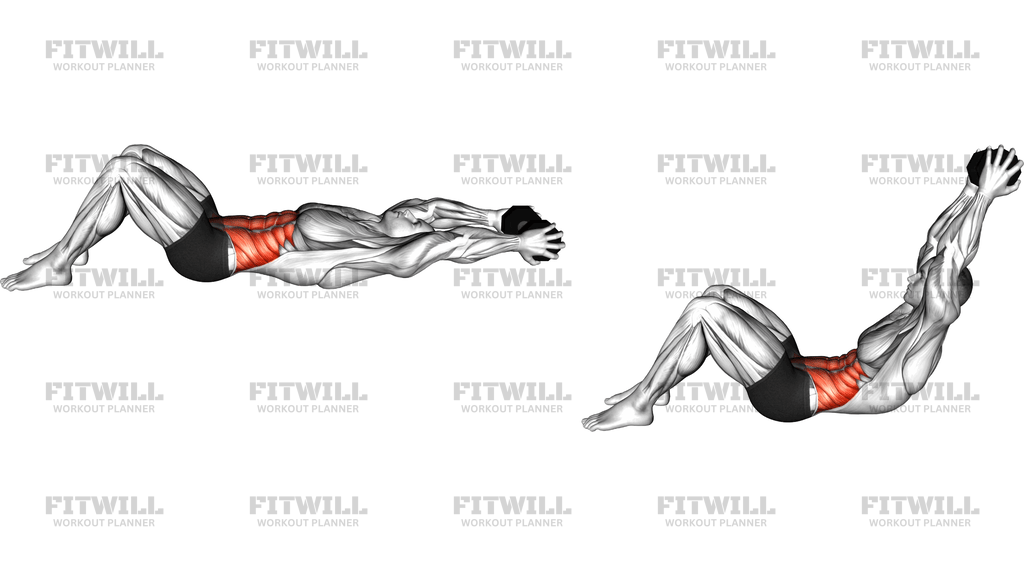
The Dumbbell Sit Up is a weighted trunk-flexion exercise performed on the floor with a dumbbell hugged against your chest. You start flat on your back with your knees bent and your feet planted, cradle the dumbbell with both hands just below your sternum, and curl your torso all the way up until you are sitting upright, then lower back down under control. Adding load to a classic sit up turns a bodyweight movement into a progressive strength exercise you can keep getting stronger on over months and years.
The main muscle at work is the rectus abdominis, the sheet of muscle running down the front of your belly that pulls your ribs toward your pelvis. Because the torso has to travel through a large range of motion from the floor to a seated position, the hip flexors assist strongly as you approach the top, and the deep core muscles work throughout to keep your spine moving as one smooth piece rather than a collection of separate segments.
This exercise suits intermediate lifters and anyone who has already built comfort with unweighted sit ups and wants more resistance. It is also a practical choice for home training, since it requires only a dumbbell and a floor surface, ideally an exercise mat to cushion your spine. Because the weight sits on your chest rather than overhead or behind your head, it is easier to keep your neck relaxed and your movement pattern honest than with many other weighted ab exercises.
Setup matters here more than most people expect. Lie back so your entire spine is supported by the floor, place your heels roughly a foot from your glutes, and hold the dumbbell vertically against your upper chest with both hands wrapped around one end or cupping the head of the bell. If the weight drifts away from your body mid-rep, it lengthens the lever arm and jerks your low back, so keep it pinned to your torso for the whole set.
Execution is about curling and hinging rather than yanking. Exhale as you peel your shoulder blades off the floor, keep pulling your ribs toward your hips, and continue up until your torso is roughly vertical over your thighs. Lower slowly, letting one vertebra at a time contact the floor, and pause briefly with your head and shoulders down before starting the next rep. A controlled lowering phase is where much of the strength benefit lives, so resist the temptation to crash back down.
Common use cases include building core strength for squatting and pulling, adding measurable progression to ab training through weight increases, and conditioning the trunk for sports that require forceful flexion or seated power transfer. Start with a light dumbbell, keep reps in the eight to fifteen range, and only add load when you can complete every rep with your low back staying quiet and your neck free of strain.
[ Workout Log & Planner ]
Put your next workout in Fitwill
Keep your plan and training log ready when you are.


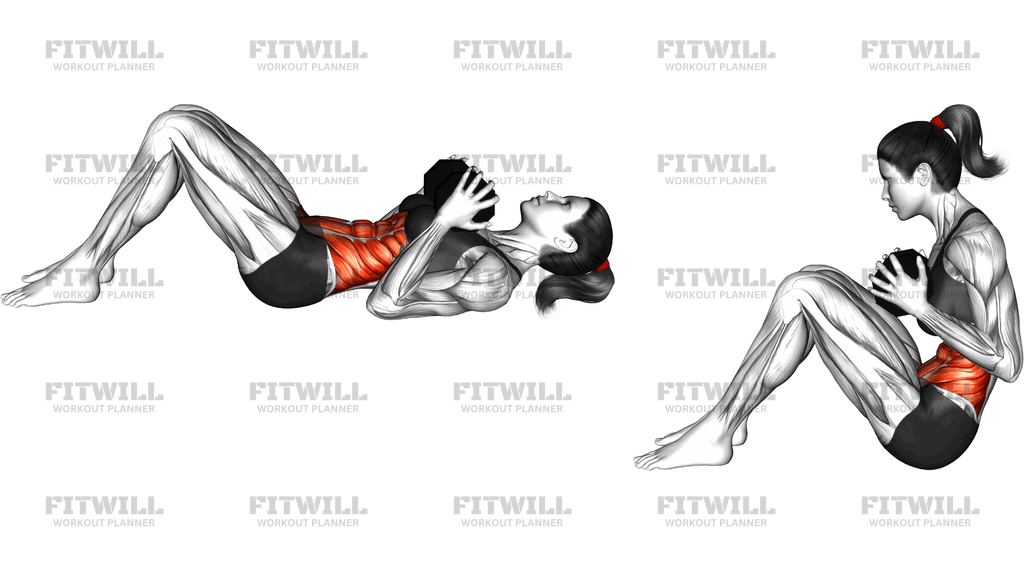
Instructions
- Place an exercise mat on the floor and sit in the middle of it with a dumbbell within easy reach.
- Lie flat on your back, bend your knees to about 90 degrees, and plant your feet flat on the floor about hip-width apart.
- Pick up the dumbbell and hold it vertically against your upper chest, wrapping both hands around the head of the bell with your elbows tucked close to your ribs.
- Gently draw your ribs down toward your pelvis and brace your abs as if preparing for a light tap to the stomach.
- Exhale and curl your shoulder blades off the floor, leading with your chest and keeping the dumbbell pressed firmly against your torso.
- Continue flexing your spine and driving your torso up until you are sitting fully upright with your chest near your thighs.
- Pause for a beat at the top, then inhale and lower yourself back down slowly, touching your head and shoulders to the mat before the next rep.
- Breathe out on the way up and in on the way down, never holding your breath through the sticking point.
- Complete your reps, then set the dumbbell on the floor beside you before standing up to rest.
Tips & Tricks
- Keep the dumbbell in constant contact with your chest; if it drifts toward your chin or away from your body, the rep gets harder on your low back without training your abs better.
- Do not jerk your head forward to start the rep — if your shoulders will not leave the floor without throwing your chin, the dumbbell is too heavy.
- Push slightly through your heels as you rise so your feet stay planted; letting your heels lift means your hip flexors are dominating the movement.
- Control the descent for two to three seconds instead of dropping back down; the eccentric portion is where most of the ab strength is built.
- If your low back arches off the mat at the bottom, reduce the range slightly or use a lighter dumbbell until you can keep your pelvis neutral.
- Aim your chest toward the ceiling as you rise rather than reaching the dumbbell toward your knees, which keeps tension on the abs instead of turning it into a partial hip hinge.
- Use a hex-style dumbbell or hold it by the head rather than the handle so it sits flat against your chest and does not roll during the rep.
- Chin stays tucked and relaxed the whole time — imagine holding an orange under your chin rather than craning your neck forward.
Frequently Asked Questions
What muscles does the Dumbbell Sit Up work?
The rectus abdominis across the front of your trunk does most of the work, with the hip flexors assisting as you rise toward the seated position. The deep core muscles stabilize your spine throughout the rep.
Is the Dumbbell Sit Up suitable for beginners?
Beginners should master unweighted sit ups and crunches first, since adding load makes faultless technique more important. Once you can perform fifteen clean bodyweight reps, start with a light dumbbell of five to ten pounds.
How should I hold the dumbbell during the Dumbbell Sit Up?
Hold it vertically against your upper chest with both hands wrapped around the head of the bell and your elbows tucked in. This keeps the load close to your center of mass and stops it from rolling or pulling you sideways.
Why do my hip flexors feel the Dumbbell Sit Up more than my abs?
This usually happens when you yank yourself up from the floor instead of curling up slowly with your ribs drawing toward your pelvis. Slow the first third of the rep down, and push gently through your heels to reduce hip flexor dominance.
Can I do the Dumbbell Sit Up every day?
Your abs respond to training like any other muscle and need recovery to grow stronger. Two to four sessions per week with at least a day between weighted sessions is a better long-term approach.
What can I use instead of a dumbbell for this exercise?
A medicine ball, kettlebell, or weight plate hugged to the chest all work well. The key is holding the load against your sternum with both hands so it moves with your torso.
Should my feet be anchored during the Dumbbell Sit Up?
Keeping your feet unanchored forces your abs to do more of the work, since you cannot pull with your legs. If you are very new to the movement, tucking your feet under a sturdy object can help you learn the pattern, but progress back to free feet.
How heavy should the dumbbell be?
Choose a weight you can lift for eight to fifteen controlled reps without your lower back arching off the floor or your form breaking at the bottom. When fifteen smooth reps feel easy, increase the weight in small increments.
Is the Dumbbell Sit Up safe for my lower back?
For most healthy trainees it is safe when performed with a controlled tempo and a weight that keeps the dumbbell pinned to the chest. If you have a history of back issues or feel any pain during the rep, stop and choose a less flexion-loaded core exercise.