Lever Standing Single Leg Curl (Plate Loaded)
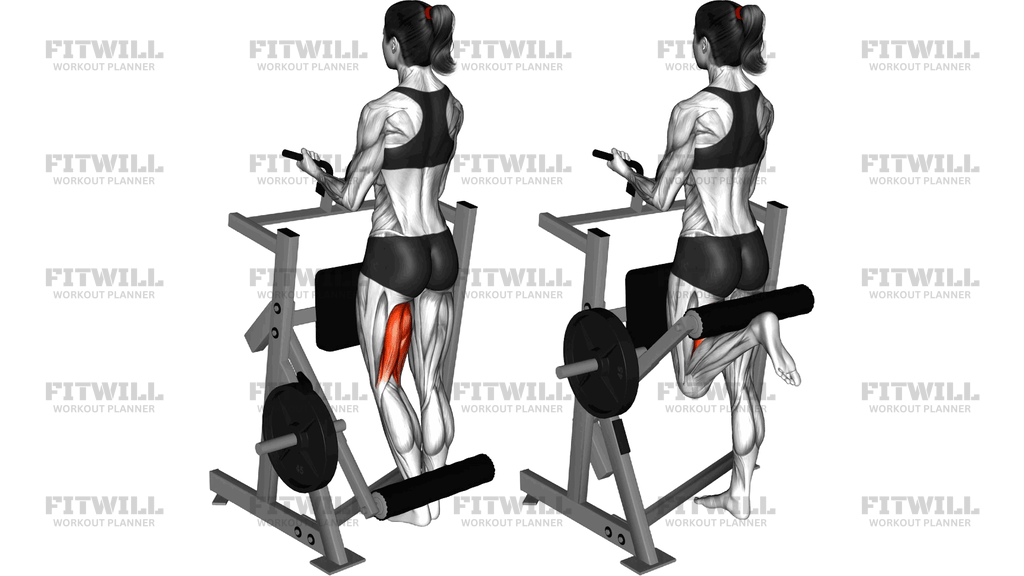
The Lever Standing Single Leg Curl (Plate Loaded) is a standing hamstring isolation exercise performed on a plate-loaded leverage machine. You brace against the machine's chest pad and handles, hook one ankle behind the roller pad, and curl your heel up toward your glute while standing on the opposite leg. Because you work one leg at a time, the resistance arm and roller follow your actual knee path, which makes this one of the most joint-friendly ways to load the hamstrings directly.
The exercise targets the hamstrings through their main function, knee flexion, with the biceps femoris on the outer thigh doing much of the visible work. The gastrocnemius of the calf assists as a secondary knee flexor, and the glute and calf of the standing leg work hard just to keep you stable. The standing position also keeps the hip in a neutral, extended angle, which emphasizes the shorter hamstring head differently than a lying or seated leg curl would.
Single-leg work earns its place in almost any program. Most lifters discover a noticeable side-to-side strength gap once they stop curling both legs together, and training one leg at a time exposes and corrects that imbalance. It is especially useful for runners, sprinters, and field sport athletes, whose hamstrings work one leg at a time at speed, and for anyone rehabbing a knee or returning from a hamstring strain who needs controlled, isolated loading.
Setup matters more on this machine than it first appears. Your chest should rest firmly against the pad, your working knee should sit just behind the axis of the lever arm, and the roller pad should sit on the back of your ankle, not on your calf. If the pad rides too high, your gastrocnemius takes over and your knee joint gets squeezed; if you lean away from the chest pad, your lower back starts arching to cheat the weight up. Take the time to adjust the machine before adding plates.
Execution is straightforward: flex your knee to pull the roller up toward your glute, pause briefly at the top when the contraction peaks, then lower the pad back down under control. Keep your hips square and your torso pressed into the pad for every rep. Complete all repetitions on one side before switching legs, and expect the standing leg to fatigue from balance demands on heavier sets.
As a plate-loaded leverage machine, this setup offers a smooth, fixed arc of motion without a cable's constant pull, and you can make small load jumps with individual plates. It fits well as a main hamstring builder on leg days, as a finishing movement after squats or deadlifts, or as a lower-back-friendly alternative for lifters who cannot tolerate heavy hip-hinge work that week.
[ Workout Log & Planner ]
Put your next workout in Fitwill
Keep your plan and training log ready when you are.


Instructions
- Stand facing the machine and adjust the chest pad so your torso rests snugly against it, then set the roller pad on the back of your working ankle just above the heel.
- Grip the front handles with both hands and position your working knee directly behind the pivot point of the lever arm, with the standing foot flat and a few inches forward for balance.
- Load weight plates onto the peg to the appropriate side, starting light since the single-leg leverage moves quickly.
- Brace your core, squeeze the handles, and press your chest into the pad so your torso and hips stay square and still.
- Curl your heel up and back toward your glute by bending your knee, letting the roller travel along its fixed arc.
- Pause for a beat at the top of the rep, squeezing your hamstring hard when your heel is closest to your glute.
- Lower the roller back down slowly until your knee is almost fully straight, keeping tension in the hamstring rather than letting the weight slam down.
- Exhale as you curl the weight up and inhale as you lower it back to the start.
- Complete all reps on the working leg, then switch sides, adjust the pad to the other ankle, and match the repetitions with the other leg.
Tips & Tricks
- Keep your chest glued to the pad for the whole set. If your torso pops off the pad or your shoulders rise, the weight is too heavy and your lower back is helping.
- Check the roller pad height each set. If it sits on your calf instead of your ankle, the gastrocnemius takes over the movement and the hamstring loses its intended load.
- Do not let your working hip drift forward as you curl. Your knee should point down toward the floor and your thigh should stay in line with your torso.
- If you lose balance on the standing leg during heavy sets, shift that foot slightly forward and grip the handles harder before adding more load.
- A slight heel turn outward at the top of the curl biases the biceps femoris, while keeping the ankle neutral gives a more balanced hamstring contraction.
- Avoid locking the knee hard at the bottom. Stop just short of full extension so tension stays on the hamstring and the knee joint stays protected.
- Slow down the lowering phase, aiming for two to three seconds down. Most lifters rush this part, but the controlled lowering is where the standing curl builds strength.
- Start with your weaker leg and match the reps with your stronger leg to even out side-to-side differences over time.
- If the machine allows, set the lever so the roller returns without clanging the weight stack or plates, keeping the set quiet and continuous.
Frequently Asked Questions
What muscles does the Lever Standing Single Leg Curl (Plate Loaded) work?
It primarily trains the hamstrings through knee flexion, with the biceps femoris doing much of the work. The gastrocnemius of the calf assists, and the glutes and stabilizers of the standing leg keep you balanced.
How is a standing single leg curl different from a lying or seated leg curl?
The standing version keeps your hip extended and trains one leg at a time, which changes the hamstring's length-tension position and highlights imbalances. Seated curls put the hip in flexion, which many lifters find gives a stronger hamstring stretch.
Is the Lever Standing Single Leg Curl (Plate Loaded) suitable for beginners?
Yes, once the pad height and chest pad are adjusted correctly it is one of the simpler hamstring machines to learn. Start with a light plate or two to master the balance and pad position before loading heavier.
Why does my calf cramp during this exercise?
The gastrocnemius crosses the knee and helps with flexion, so it works alongside the hamstrings here, especially if the roller pad sits too high on your calf. Lower the pad to the back of your ankle and reduce the weight until the cramping stops.
How do I know the roller pad is in the right position?
The pad should rest on the back of your ankle just above the heel, and your knee should line up behind the lever's pivot point. If the pad presses into your calf or your knee feels pinched at the top, stop and readjust before continuing.
Can I use this machine if I have lower back discomfort?
The chest pad supports your torso and the standing position avoids loaded hip hinging, which many lifters with sensitive lower backs appreciate. Keep the load moderate, stay pressed into the pad, and stop if any position causes pain.
What is the most common mistake on this exercise?
Swinging the torso away from the chest pad to heave the weight up, which shifts work from the hamstring to the lower back and momentum. Cut the weight until you can complete every rep with your chest and hips still.
What can I substitute if my gym has no standing leg curl machine?
A cable leg curl with an ankle strap, a stability ball leg curl, or a single-leg Romanian deadlift all train the hamstrings one leg at a time. The cable version is the closest match in movement pattern.
How many sets and reps should I do per leg?
Two to four sets of 8 to 15 reps per leg works well for most goals. Because each side rests while the other works, you can keep the rest periods short and still recover adequately.
Should I train both legs in every session or alternate?
Train both legs in the same session and start with your weaker side, matching the repetitions with your stronger side. This keeps the imbalance visible and prevents one leg from doing more total work over time.