Weighted Sandbag Romanian Deadlift
The Weighted Sandbag Romanian Deadlift is a hip-hinge exercise that uses a loaded sandbag instead of a barbell or dumbbells to load the hamstrings, glutes, and lower back. You stand tall holding the bag by its handles at hip height, push your hips back, and let the bag travel down your thighs until you feel a strong stretch along the back of your legs, then drive your hips forward to stand back up. Because the sand shifts inside the bag, your grip, forearms, and trunk stabilizers work harder than they would with a rigid weight of the same load.
This movement suits lifters who want strong hamstrings and glutes without stressing the lower back the way a heavy barbell pull can. The sandbag sits closer to your body and is easier to release or set down if your position breaks down, which makes it a smart choice for home training, beginners learning the hinge pattern, and lifters managing cranky backs. It also fits well as an accessory lift after squats or deadlifts, or as the main lower-body pull in a minimalist setup where a sandbag is the only weighted tool available.
The primary muscles trained are the hamstrings, which lengthen under load as you hinge and contract to pull you back upright. The glutes take over near the top of each rep to finish the lockout, and the erector spinae in the lower back work statically to hold your spine neutral. The lats, upper back, and forearms contribute by keeping the bag pulled in close and under control throughout the set.
Setup matters a lot here. Because sandbag handles are often softer and lower than a barbell, a small change in stance width or bag placement shifts how much load reaches your hamstrings versus your lower back. Feet roughly hip-width apart, the bag held against your thighs, and a braced ribcage give you a repeatable path every rep.
To execute it well, think of the movement as pushing your hips backward rather than bending down. Keep your knees softly bent, your chest proud, and the bag sliding down the front of your legs. Stop when your torso feels like it wants to round or the stretch in your hamstrings peaks, then squeeze your glutes to return. Common uses include strength work in the 6 to 10 rep range, higher-rep conditioning circuits, and hypertrophy blocks where the awkward grip of a sandbag is a feature rather than a drawback.
For safety, never let your lower back round at the bottom, and never lift a weight you cannot lower under control. If you feel the movement in your spine instead of your hamstrings, reduce the load or shorten your range until your hinge mechanics improve.
[ Workout Log & Planner ]
Put your next workout in Fitwill
Keep your plan and training log ready when you are.


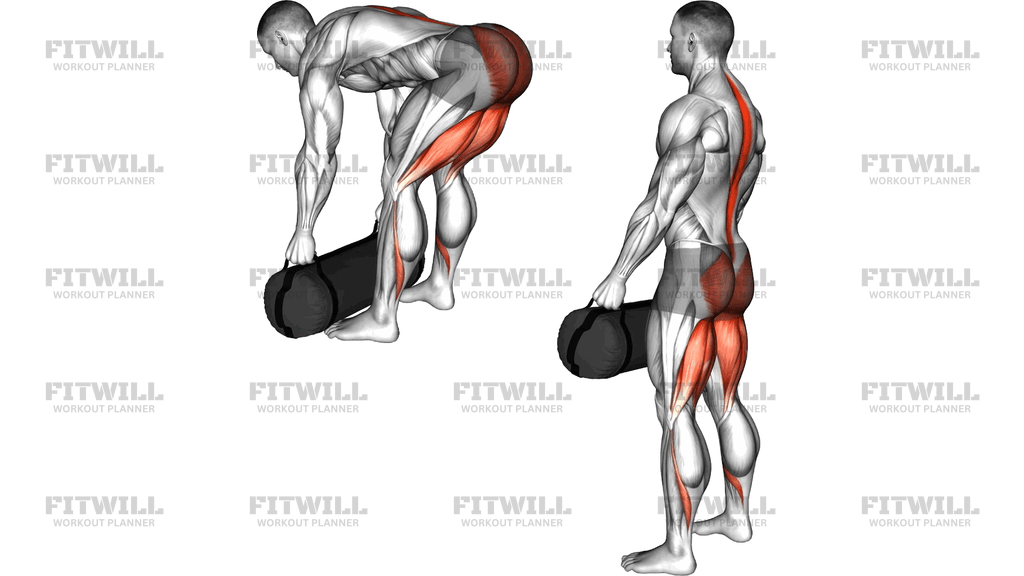
Instructions
- Stand with your feet about hip-width apart and place the weighted sandbag vertically on the floor in front of your shins.
- Hinge down, grip the bag firmly by its side handles with both hands, then stand all the way up so the bag hangs at hip height in front of your thighs.
- Pull your shoulders back and down, squeeze your abs, and tuck your ribs so your spine is neutral before starting the rep.
- Keeping a soft bend in your knees, push your hips straight back and let the bag slide down the front of your thighs.
- Continue lowering until you feel a strong stretch in your hamstrings or your torso approaches parallel to the floor, whichever comes first, with the bag staying in contact with your legs.
- Pause briefly at the bottom, then drive your hips forward and squeeze your glutes to stand back up to a full standing position without leaning back.
- Exhale as you return to standing, then take a fresh breath and re-brace your trunk before the next rep.
- Complete your set, then lower the bag to the floor by hinging with a flat back, setting it down under control rather than dropping it.
Tips & Tricks
- The most common fault is turning this into a squat. If your knees travel forward and your hips drop, reset and focus on pushing your hips backward while your shins stay nearly vertical.
- Keep the sandbag touching your legs on the way down. If the bag drifts away from your thighs, the load moves to your lower back and the hamstring stretch is lost.
- Sand shifts as you move, so squeeze the handles hard on every rep. A loose grip on a wobbling bag is a frequent cause of the torso drifting out of position mid-set.
- Stop your descent when your hips stop moving backward. Pushing deeper by rounding your lower back takes tension off the hamstrings and puts it on your spine.
- Use a slower lowering phase than you think you need. The sandbag is forgiving at the bottom, which tempts lifters to drop fast and bounce out of the stretch.
- If your grip fails before your hamstrings, try holding the bag by its main body wraps instead of the narrower handles, or simply lower the weight and hold the position longer.
- Reset your brace every rep rather than once per set. The shifting sand makes each rep slightly different, and a fresh breath keeps your ribcage from flaring as the set gets hard.
- Finish each rep with your glutes, not by arching your lower back. Leaning back at the top is a sign the load is too heavy or you are rushing the lockout.
Frequently Asked Questions
Which muscles does the Weighted Sandbag Romanian Deadlift work?
The hamstrings are the primary mover, with the glutes driving the lockout and the lower back muscles holding your spine neutral. Your forearms, grip, and upper back also work hard to control the shifting sand throughout each rep.
Is the Weighted Sandbag Romanian Deadlift good for beginners?
Yes, it is one of the friendlier ways to learn the hip hinge. The bag sits close to the body, the load is easy to adjust, and you can set it down instantly if your form slips.
How deep should I lower the sandbag on each rep?
Lower until you feel a strong hamstring stretch or your hips stop moving backward, often around torso parallel to the floor. Going deeper by rounding your lower back adds no benefit and shifts stress to your spine.
Why does the sandbag feel harder to control than a barbell for this movement?
The sand shifts inside the bag, so your grip, forearms, and trunk have to constantly correct small changes in the load. This added instability is part of the exercise's value, but it means you should start lighter than with a rigid barbell.
Should my knees bend during the Weighted Sandbag Romanian Deadlift?
Yes, but only to a small, fixed angle set at the start. If your knees keep moving forward as you lower, the drill becomes a squat and your hamstrings lose the lengthening stretch that makes this exercise effective.
What can I use instead of a sandbag for this exercise?
A barbell, dumbbells, or a kettlebell all work for the same hinge pattern. The sandbag version is simply easier on the grip demands at the start, sets down faster if you fail, and loads your forearms and stabilizers more.
How do I know if I am hinging correctly instead of squatting?
Your hips travel backward, your shins stay close to vertical, and the bag slides down your thighs rather than swinging away from your body. Filming yourself from the side for a set makes this easy to check.
Is it safe for my lower back?
When performed with a neutral spine, controlled tempo, and a sensible load, the movement strengthens the muscles that support your back. If you feel sharpness or rounding under load, reduce the weight and your range, and stop if discomfort persists.
How many sets and reps should I do of the Weighted Sandbag Romanian Deadlift?
For strength and muscle, 3 to 4 sets of 6 to 10 controlled reps works well. For conditioning circuits, lighter bags and higher reps are common, but keep the hinge position strict as fatigue builds.