L Sit Rope Climb
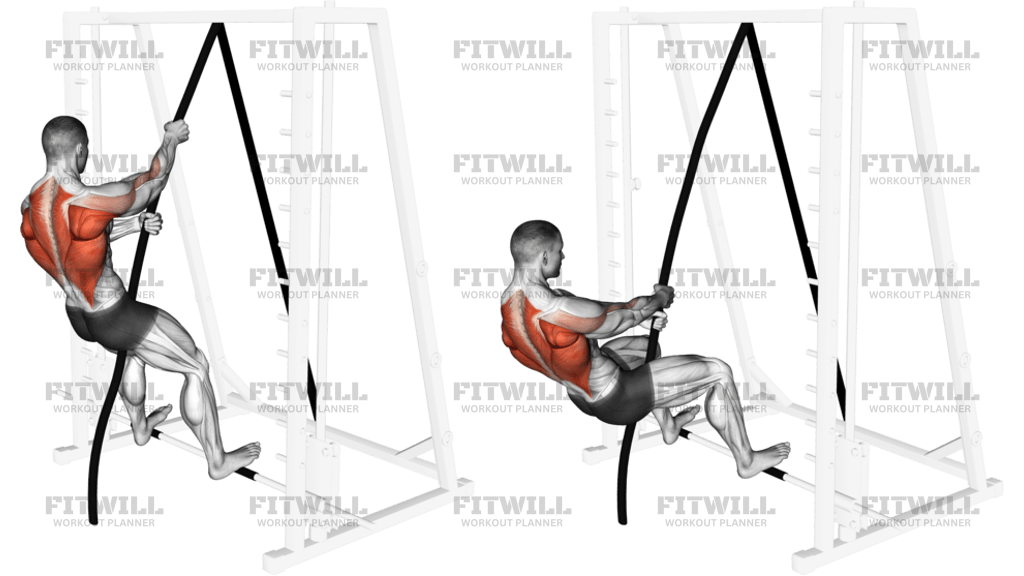
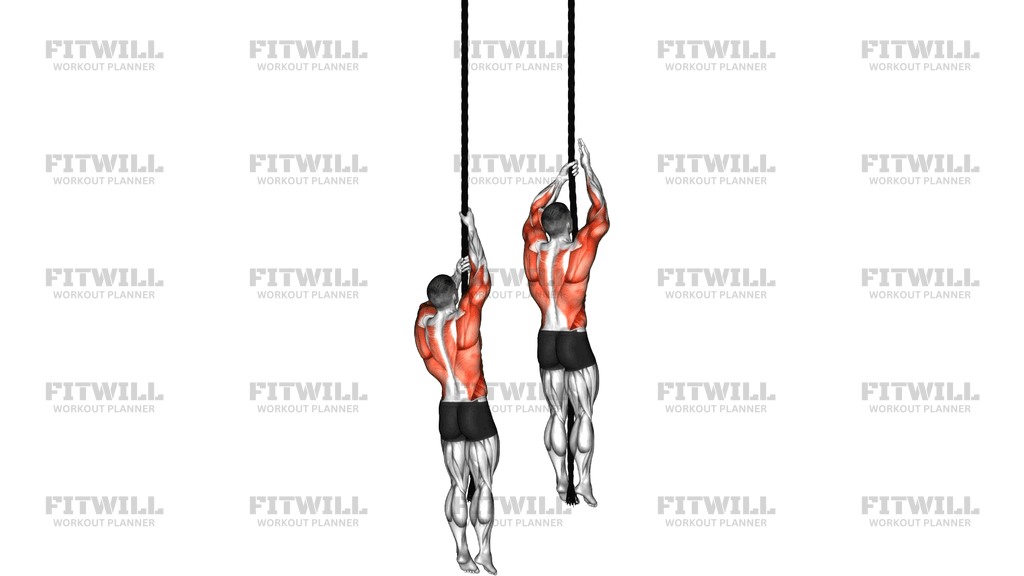
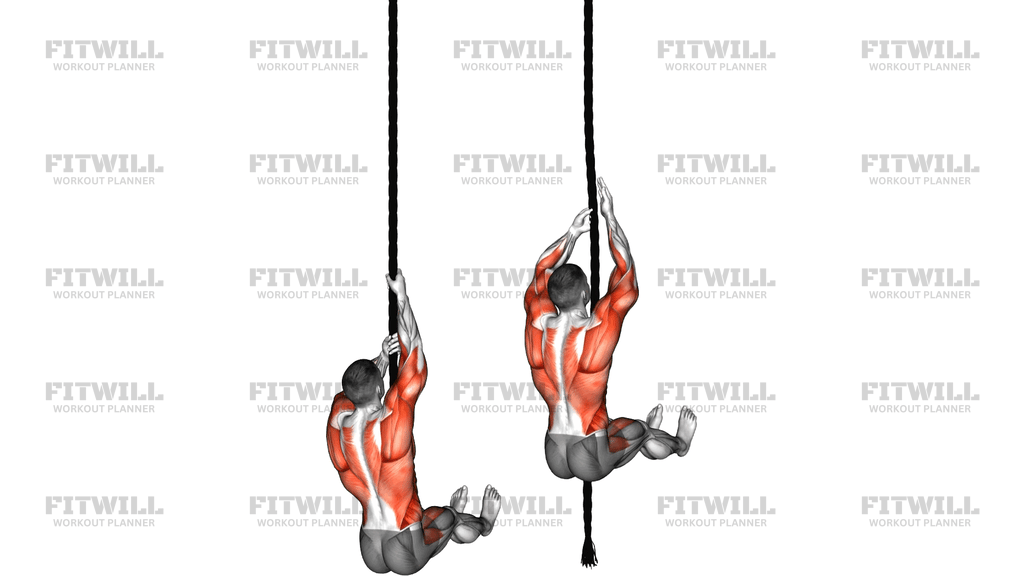
The L Sit Rope Climb is an advanced variation of the traditional rope climb in which you hold your legs straight out in front of your body in an L-position for the entire ascent and descent, rather than using your legs to pinch and drive up the rope. Your arms, back, and grip do all of the work while your core fights to keep the legs elevated and horizontal. It is one of the most demanding bodyweight pulling patterns you can perform on a hanging rope.
This movement is built for people who already own a solid legless rope climb or several strict pull-ups and want a harder stimulus. Calisthenics athletes, obstacle course racers, gymnasts, and tactical athletes use it to close the gap between standard climbing and true upper-body-dominant hanging work. If your normal climb relies heavily on the legs, this variation exposes that immediately and gives you a clear path to fixing it.
The primary work comes from the lats and upper back as you pull hand over hand, with heavy contributions from the biceps and forearms. Because the legs stay extended forward, the hip flexors and deep abdominal muscles work isometrically the whole time to prevent the legs from dropping. The grip takes a beating too, since each hand has to anchor the rope while the other reaches for the next hold with no leg support to share the load.
Setup matters more here than in a leg-assisted climb. The rope needs to hang securely from a solid anchor with clearance around it, and you should start from a seated or hanging position with the legs already extended before the first pull. Starting with bent or dangling legs and trying to lift them mid-climb almost always leads to a collapse in body position and a stalled pull.
Execution is a repeated cycle: reach one hand as high as possible, pull the elbow down toward your ribs until your torso rises, match the other hand above it, and repeat. The L-position must stay locked, meaning thighs parallel to the floor and knees straight, even as fatigue builds. Coming down is where many people get sloppy, so slide deliberately hand over hand rather than letting gravity win.
Treat this as a strength skill, not a conditioning task, at least at first. Short sets of one to three climbs with full rest let you practice clean positions. If you lose the L-shape partway up, climb down and reset rather than finishing a rep with compromised form, and never let go of the rope from a height.
[ Workout Log & Planner ]
Put your next workout in Fitwill
Keep your plan and training log ready when you are.


Instructions
- Stand facing a securely anchored climbing rope and grasp it with both hands stacked above your head, using a firm wrap around each hand.
- Lift your legs together until they are fully extended straight in front of you, forming an L-shape with your torso, knees locked and toes pointed forward.
- Brace your abdominal wall and squeeze your thighs together to lock the L-position before you begin pulling.
- Reach one hand up the rope as high as you can while keeping the opposite hand anchored at chest height.
- Pull the high elbow down toward your ribs, driving your torso upward along the rope while your legs stay extended and motionless.
- Match your other hand above the first, then alternate reaching and pulling hand over hand toward the top of the rope.
- Keep your chest tall and shoulders active, avoiding the urge to lean back or swing to gain momentum.
- Descend by sliding each hand down the rope under control, resisting gravity with the same pulling muscles instead of dropping hand over hand quickly.
- Exhale on each pull and breathe steadily through the climb; avoid holding your breath through consecutive pulls.
- Once your feet touch the floor, lower your legs slowly, shake out your grip, and rest fully before attempting another climb.
Tips & Tricks
- If your legs drop below parallel during the climb, you have run out of hip flexor or core strength; stop the set there, because finishing with sagging legs turns it into a standard legless climb.
- Chalk your hands generously. Without leg assistance, the rope carries your entire weight through your grip, and a slippery rope is the most common cause of an early release.
- Do not try to yank yourself up with the arms alone. Initiate each pull by pulling the elbow down and back so the lats do the lifting and the biceps only assist.
- Keep one hand always wrapped and loaded above the other. Both hands reaching at the same time leaves you briefly unsupported and is a real fall risk.
- Point your toes and squeeze your legs together in the L-sit. Separated or loose legs leak tension and make the hold far harder than it needs to be.
- Practice the L-Sit hold on parallel bars or the floor first. If you cannot hold a 20 to 30 second L-Sit on solid ground, build that before adding a climbing pull to it.
- Descending is usually harder than ascending for beginners. Slow the descent down deliberately rather than trying to match your climbing speed on the way down.
- Wear long socks or pants if your ankles or calves contact the rope, since rope friction burns are common when the legs are held near the rope's line.
- If you stall partway up, finish the climb to a safe point, descend under control, and end the set. Fatigue-gripping the rope near your limit is how grip failures happen.
Frequently Asked Questions
What muscles does the L Sit Rope Climb work?
The lats and upper back drive the pulling, with strong support from the biceps, forearms, and grip. Holding the legs extended keeps the hip flexors and abdominal muscles under constant isometric tension.
How is the L Sit Rope Climb different from a regular rope climb?
In a regular climb you use your legs to pinch the rope and drive upward, which takes load off the arms. In the L Sit Rope Climb the legs never touch the rope and stay extended forward, so the pull, grip, and core do all of the work.
Can beginners do the L Sit Rope Climb?
Most beginners should not start here. Build toward it with leg-assisted rope climbs, legless climbs, strict pull-ups, and floor or parallette L-Sit holds before combining all three demands.
How high do I need to climb for the L Sit Rope Climb to count?
Any height works as long as the legs stay locked in the L-position for the full ascent and descent. A short, clean climb with straight legs is worth more than a tall climb with sagging hips.
Why do my legs keep dropping during the climb?
Your hip flexors and abdominals are fatiguing under the combined pulling demand, or your torso is leaning back and opening the hip angle. Slow down, keep your chest stacked over your hips, and shorten the climb until you can hold the position.
What can I substitute if I do not have a climbing rope?
Legless pull-ups on a pull-up bar with legs held in an L-position train the same combination of pulling strength and core tension. Towel pull-ups are another option that stresses the grip in a similar way.
How do I protect my hands and grip on the rope?
Use chalk, wrap the rope firmly rather than squeezing as hard as possible, and stop the set when your grip starts to slip. Ripped calluses and sudden grip failure are the two most common problems on rope work.
Is it safe to let go and drop from the rope?
No. Always descend hand over hand under control until your feet are on the floor, and only release the rope when you are standing at the bottom. Dropping from height risks ankle, knee, and lower back injuries.
How many L Sit Rope Climbs should I do in a workout?
Treat them as a strength skill: one to five single climbs with full rest between attempts is plenty. Quality positions beat volume, and this movement fatigues the grip fast enough to degrade form quickly.