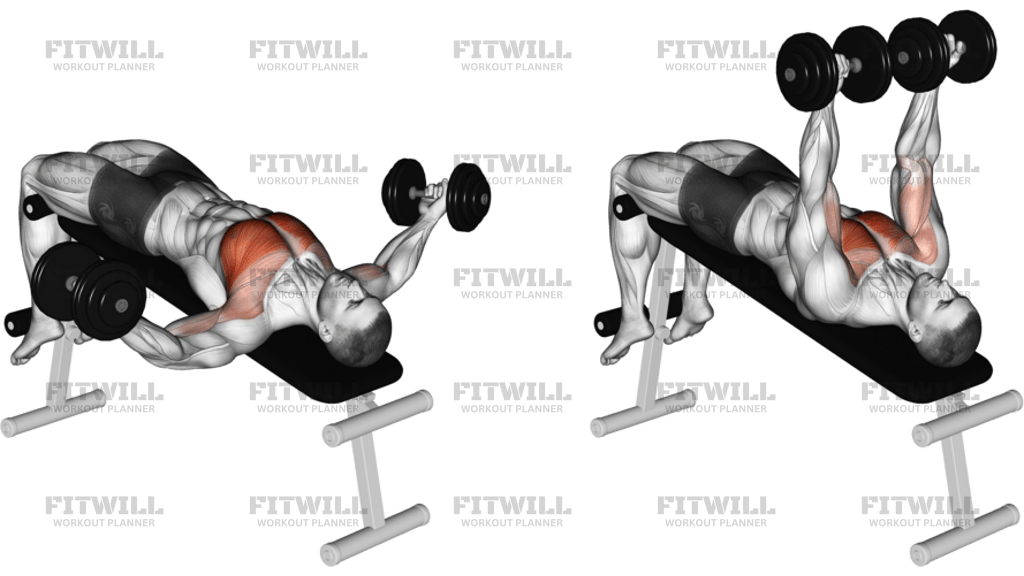
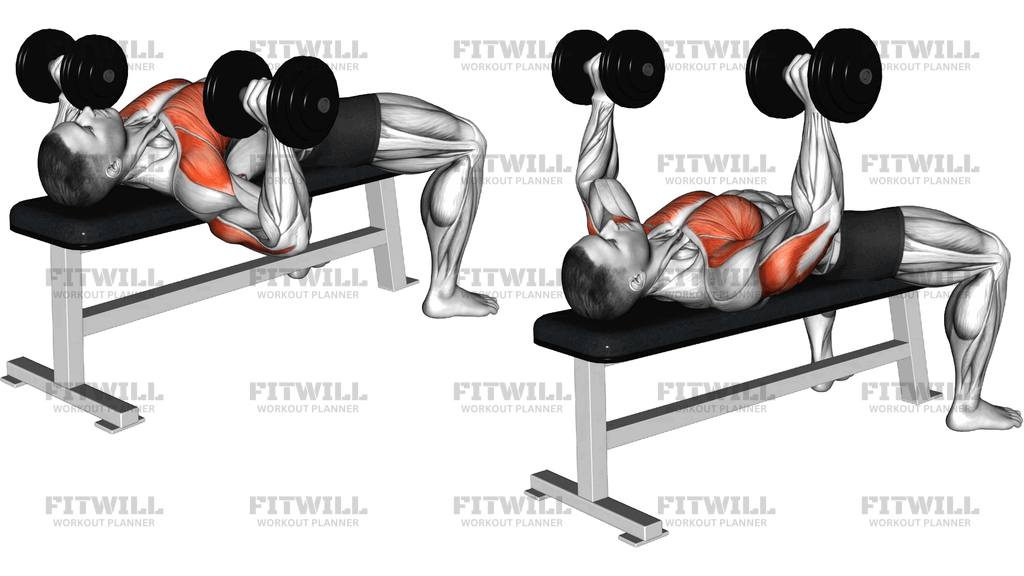
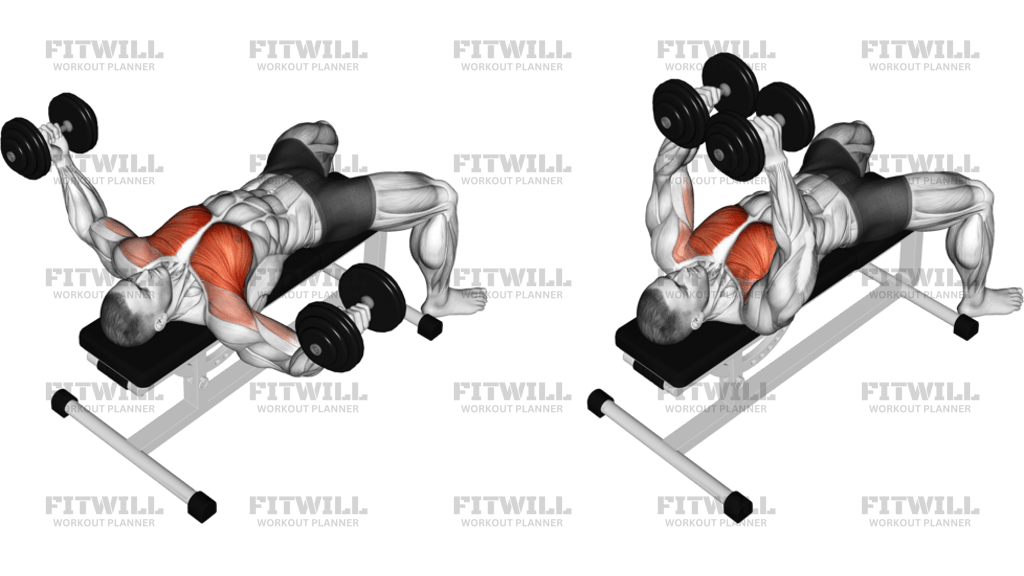
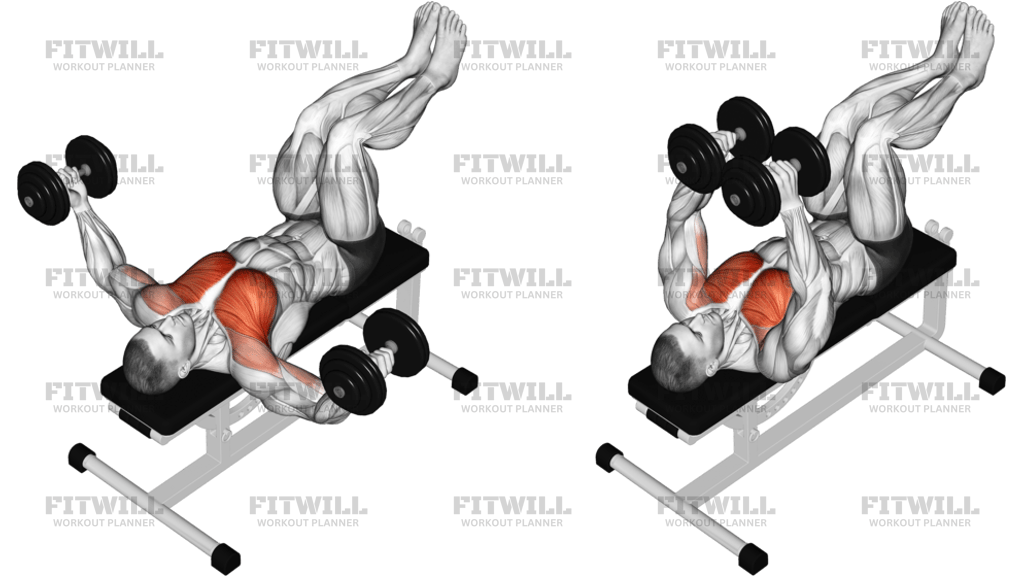
Dumbbell Lying Bench Poliquin Fly
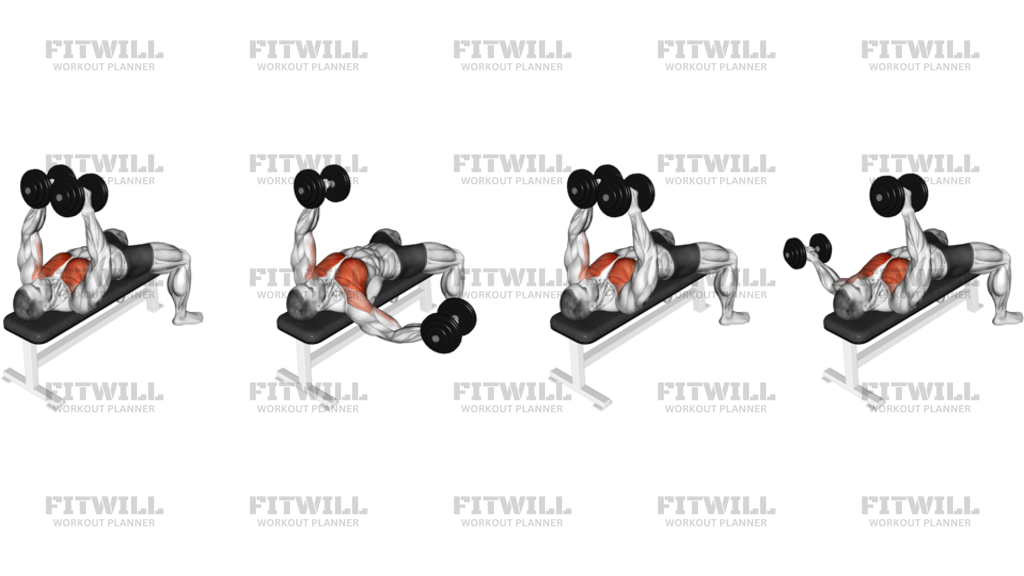
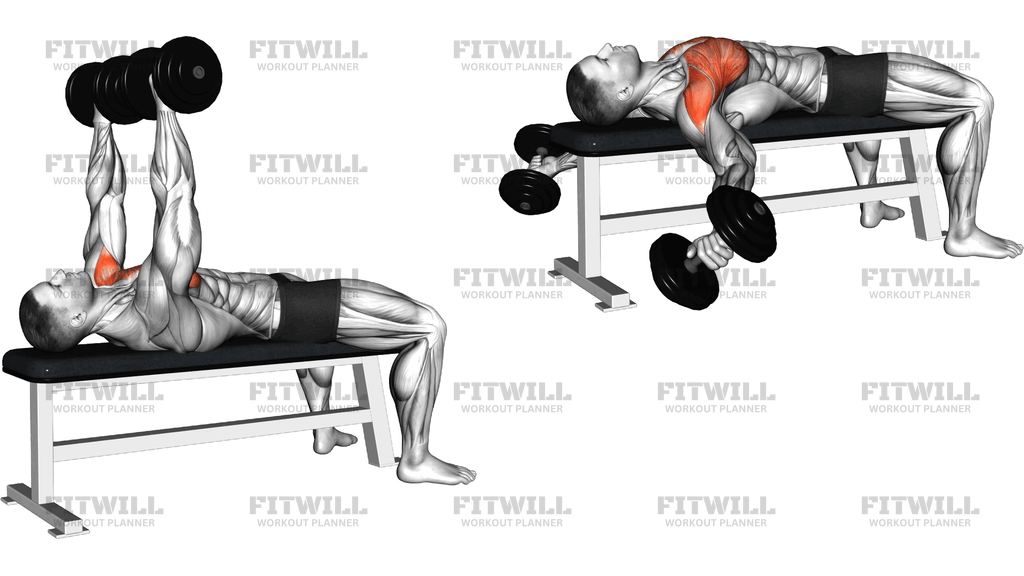
The Dumbbell Lying Bench Poliquin Fly is a flat-bench chest fly with a built-in grip rotation, popularized by strength coach Charles Poliquin. Instead of keeping the palms fixed in one position as in a standard dumbbell fly, you start at the top with your palms facing forward (away from your body), rotate your hands so the palms face each other as you lower into the stretch, then rotate back to the palms-forward position as you sweep the dumbbells up and in over your chest. This rotating element lengthens and loads the pectoral fibers through a wider arc than a fixed-grip fly.
The main target is the chest, particularly the sternal portion of the pectoralis major that dominates on a flat bench. The front delts assist on the lift, and the biceps and forearms work isometrically to hold the dumbbells steady while the hands rotate. Because the arms stay mostly straight with only a soft bend at the elbows, the tension stays on the chest rather than shifting to the triceps the way it does in pressing movements.
This variation suits lifters who already own the standard dumbbell fly and want a new stimulus for chest growth and stretch-position strength. The rotation forces you to slow down and control every inch of the arc, which makes it useful as a hypertrophy finisher at the end of a chest day. It is also a good option for people whose shoulders feel pinched during fixed-grip flies, since the palms-forward position at the bottom can feel friendlier to some shoulder structures, though anyone with shoulder pain should reduce the range first and consult a professional if discomfort persists.
Setup matters more here than in most fly variations. Lie flat on a bench with your head supported and feet planted, and bring the dumbbells straight up over your chest before the first rep begins. Because you are lowering under rotation with relatively straight arms, going too heavy turns the movement into a sloppy partial press and puts unnecessary stress on the shoulder capsule and elbow joints. Choose a weight you could fly strictly for 10-15 repetitions and master the rotation pattern with it before adding load.
To execute well, think of the arms as a pair of compass arms hinged at the shoulders: the elbow angle barely changes, and the hands simply travel a wide arc out to your sides and back. Lower on a slow count of two to three seconds, let the rotation happen gradually as the dumbbells descend, pause briefly at a comfortable stretch, then sweep the weights back over the chest while rotating to palms-forward at the top. Squeeze the chest at the top without clanging the dumbbells together, and keep your shoulder blades pinned back and down against the bench for the entire set.
[ Workout Log & Planner ]
Put your next workout in Fitwill
Keep your plan and training log ready when you are.


Instructions
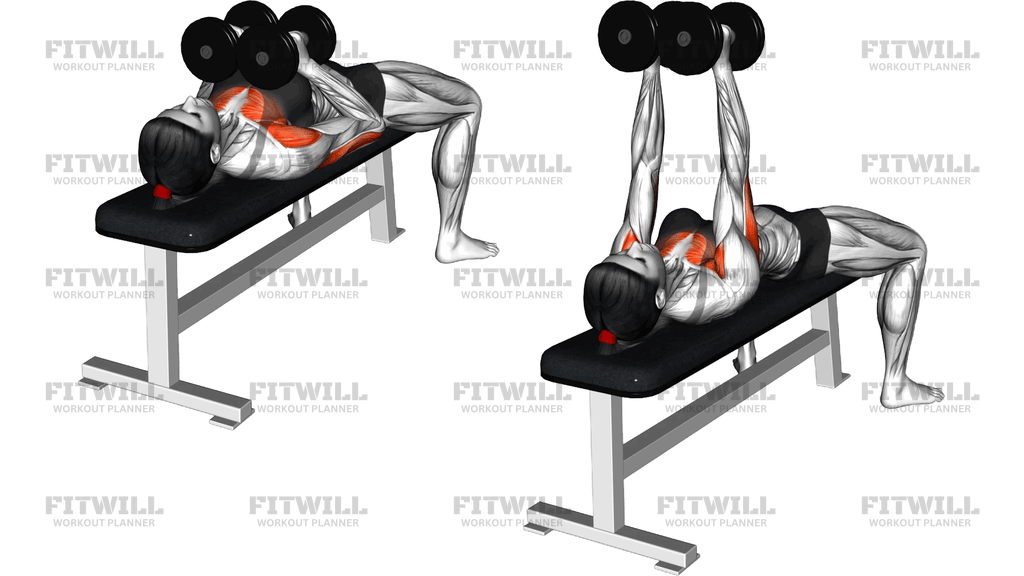
- Sit on a flat bench and place a dumbbell on each thigh, then lie back and kick the weights up so both arms are extended straight over your chest with palms facing forward.
- Set your feet flat on the floor on either side of the bench, brace your core lightly, and pull your shoulder blades back and down so they stay in contact with the bench.
- Soften your elbows to a fixed, comfortable bend of roughly 15-25 degrees and commit to holding that angle for the whole set.
- Begin the first rep by opening your arms out to the sides in a wide arc while rotating your hands so your palms gradually turn to face each other.
- Keep lowering until the dumbbells reach roughly chest height and you feel a distinct stretch across your pecs, without letting the elbows drop below the bench line.
- Pause for a beat at the stretched position, keeping tension in the chest rather than relaxing the shoulders.
- Sweep the dumbbells back up along the same wide arc, rotating your hands so the palms face forward again by the time the weights meet above your chest.
- Stop just short of the dumbbells touching, squeeze your pecs for a moment, then start the next repetition.
- Exhale as you sweep up, inhale slowly through the lowering phase, and keep breathing steadily on every rep.
- After your final rep, guide the dumbbells back toward your chest, then sit up and lower them to the floor with control rather than dropping them from the bench.
Tips & Tricks
- If your palms barely rotate during the descent, the variation loses its point — make the turn of the hands deliberate, finishing palms-facing-each-other at the bottom and palms-forward at the top.
- The most common mistake is letting the elbow angle open up as the arms lower, which turns the fly into a partial press and shifts load off the chest; check that your elbow bend looks the same at the bottom as at the top.
- Going too deep is a frequent issue on this bench setup — if your upper arms sink noticeably below the bench or your shoulders roll forward, cut the depth until the stretch feels strong but comfortable.
- Keep the weights moving on a smooth arc around the shoulder joint, not straight out to the sides in a line, which grinds on the shoulder joint at the bottom.
- A weight that feels fine on a standard fly is often too heavy here because the rotation demands extra control — drop about 20-30% from your usual fly weight when you first try it.
- Do not let your lower back arch off the bench as the arms descend; if it does, the dumbbells are too heavy or the range is too deep for your current shoulder mobility.
- Squeeze the chest hard at the top but stop the dumbbells an inch or two apart — clanging them together releases tension and can jar the wrists.
- Because the biceps hold an isometric contraction while the forearms rotate, grip and elbow comfort limit this lift faster than chest fatigue; if your elbows complain, reduce the weight and slightly reduce the depth.
- Perform this movement early in its learning phase with a mirror or a training partner watching from the side, since rotated wrists make it easy to drift out of position without noticing.
Frequently Asked Questions
How is the Dumbbell Lying Bench Poliquin Fly different from a regular dumbbell fly?
The regular fly keeps the grip fixed, usually with palms facing each other, while the Poliquin version rotates the hands during each rep — palms forward at the top, turning to palms-facing-each-other at the stretched bottom, then rotating back up. This adds rotational demand and changes the feel of the stretch across the chest.
Which muscles does the Dumbbell Lying Bench Poliquin Fly work?
The chest, especially the sternal fibers of the pectoralis major, is the primary mover. The front delts assist, and the biceps, forearms, and wrist stabilizers work hard isometrically to control the dumbbells through the rotation.
Why do the palms start facing forward at the top of this fly?
Starting palms-forward and rotating into the descent changes the line of pull on the pec fibers and forces strict control through the stretch. It is the defining feature of the Poliquin protocol and the reason the movement feels different from a fixed-grip fly.
Is the Dumbbell Lying Bench Poliquin Fly suitable for beginners?
It can be, but beginners are usually better served by learning the standard flat-bench dumbbell fly first, since managing the rotation plus the wide arc is a lot to coordinate. A beginner who wants to try it should use very light dumbbells and a shortened range for the first few sessions.
How deep should I lower the dumbbells on this fly?
Lower until you feel a clear stretch across the chest with your upper arms at about bench level or just above. If your shoulders roll forward, your lower back arches, or you feel pinching at the front of the shoulder, the rep is going too deep.
What is the most common mistake with the Dumbbell Lying Bench Poliquin Fly?
Using too much weight and bending and straightening the elbows so it becomes a sloppy partial press. The elbow angle should stay essentially locked at a soft bend, with the movement coming from the shoulders sweeping a wide arc.
What can I substitute if I do not have dumbbells for this exercise?
A cable fly from a low or middle pulley gives a similar arc with constant tension, and resistance-band flyes lying on a bench work in a pinch. For the rotational element specifically, the closest match is a dumbbell fly on a bench, so any fly variation is a reasonable stand-in for the overall training effect.
Where should this exercise fit in my chest workout?
It works best as a secondary or finishing movement after pressing exercises like bench presses or push-ups, when the chest is pre-fatigued and strict control matters more than heavy load. Two to four sets of 10-15 slow reps is a typical dose.
Is it safe for my shoulders to rotate the wrists during a fly?
For most lifters the rotation is benign and can even feel smoother than a fixed pronated grip, because the palms-forward stretch position is shoulder-friendly. If you have a history of shoulder instability or current pain, start with a very light weight, limit the depth, and stop and get assessed if discomfort appears.
Why do my forearms and biceps fatigue before my chest on this movement?
Because they hold the dumbbells steady while the hands rotate, which is more isometric work than a standard fly demands. That is normal early on; if it stays the limiting factor, reduce the weight so the chest, not the arms, is what ends the set.