Resistance Band Standing Single Arm Triceps Stret
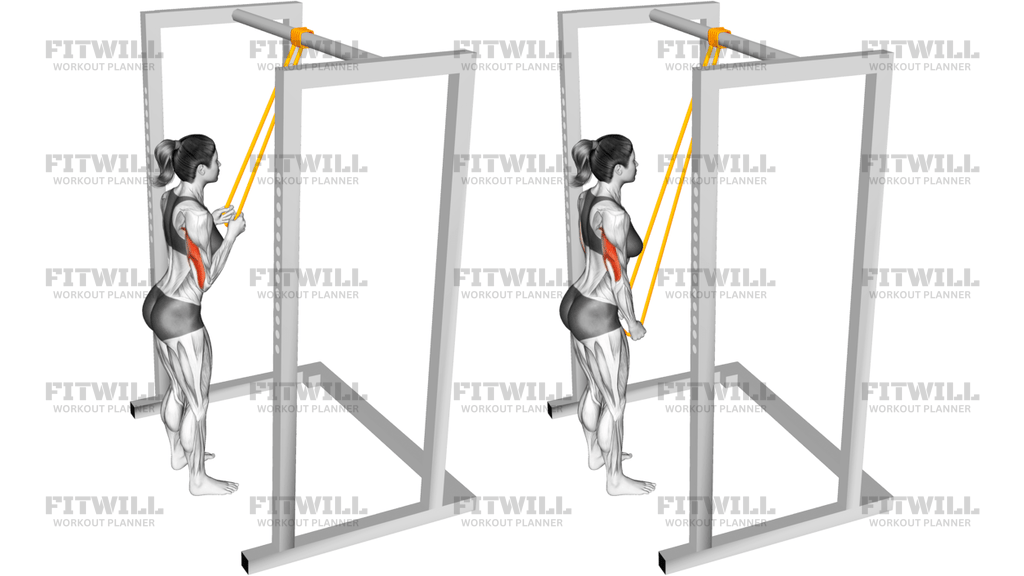
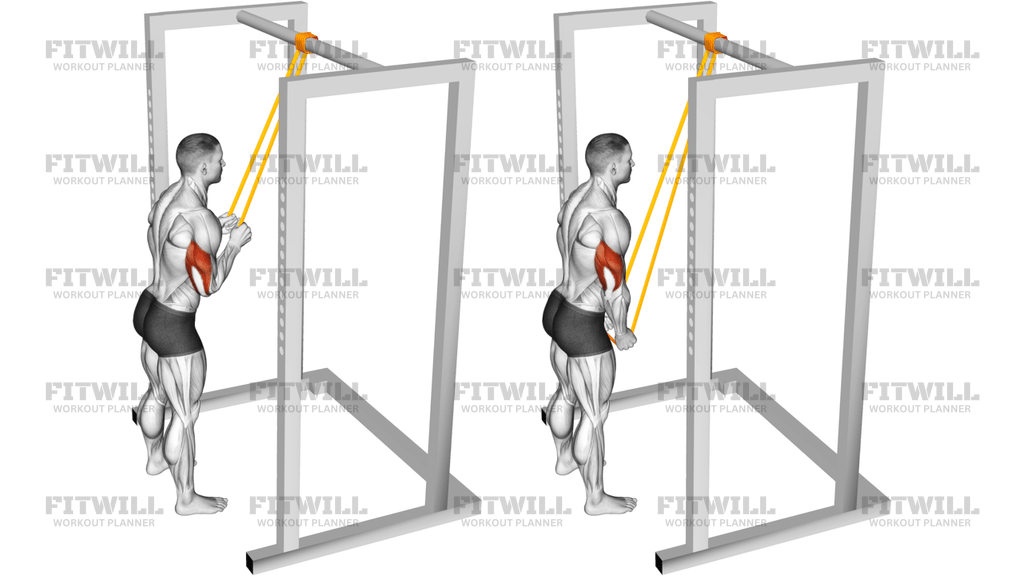
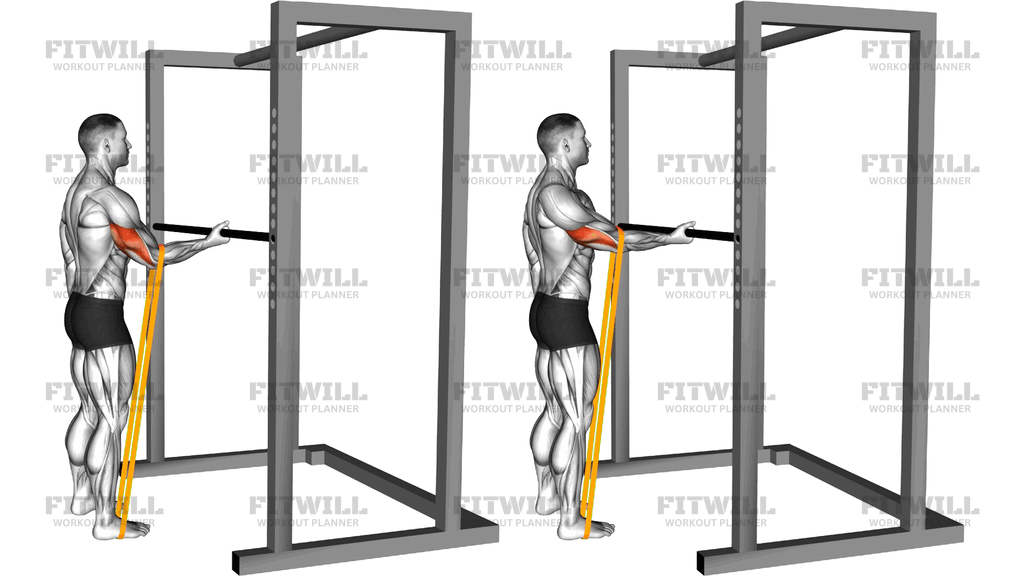
The Resistance Band Standing Single Arm Triceps Stretch is a standing, single-arm triceps exercise that uses a band anchored under your foot to load the elbow extension. Your working hand grips a fixed bar or upright at roughly chest height for anchor and balance, while the band runs up from the floor behind your forearm. As you straighten your elbow against that tension, the triceps have to work through the exact range the band challenges most, which is the locked-out, extended position where pressing movements often go weakest.
This setup suits lifters who want focused triceps work without a cable station, people rehabbing or easing back into pressing after time off, and anyone who struggles to feel one arm working at a time. Because each side is trained separately, it exposes and helps correct left-to-right differences in arm strength and control, something you rarely notice on two-handed pushdowns or close-grip pressing.
The main muscle at work is the triceps brachii, all three heads, since the elbow extends from a bent position with the upper arm held still. The shoulder stays largely passive, which is exactly what you want from an isolation movement. Your legs, hips, and trunk work quietly to keep you upright while the band pulls, and the hand on the fixed bar gives you a reference point so the effort stays in the back of the arm rather than leaking into your shoulder or torso.
Setup details matter more here than on a machine. The band needs to sit behind the forearm, not slide toward the wrist or elbow crease, and the anchor foot must keep steady tension through the whole rep. If your stance is too close, the band goes slack at the bottom and the set loses its challenge; too far and the start position becomes a strain on the forearm. Stand far enough that the first rep already feels loaded but still allows a full bend of the elbow.
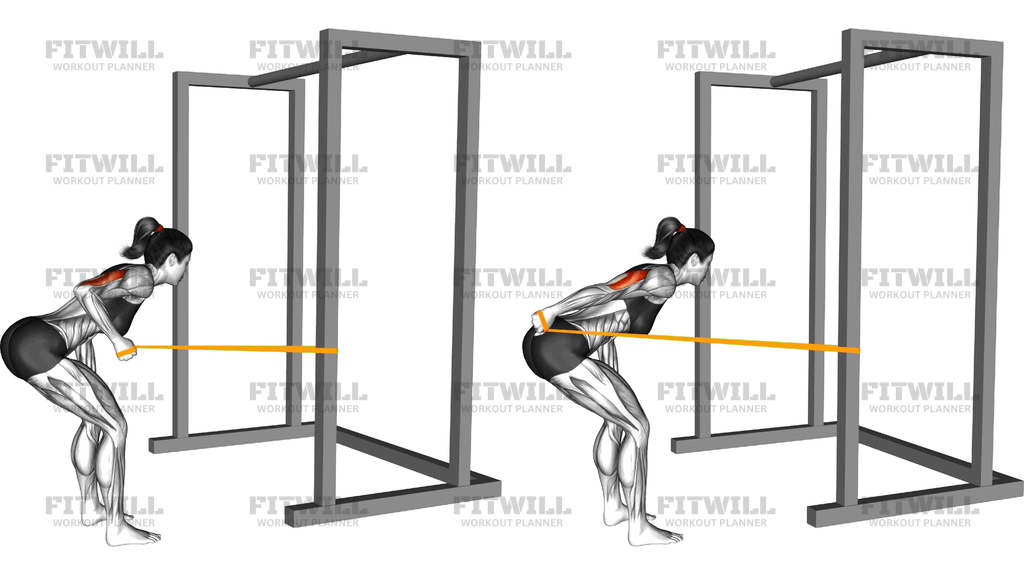
To perform it well, keep the upper arm pinned against your side and move only at the elbow. Straighten the arm forward and down against the band until it is fully extended, pause briefly to feel the triceps shorten, then bend the elbow back with control instead of letting the band snap your forearm rearward. The hand on the bar should hold you steady, not push or pull to help the working side.
Because the band's resistance increases as the arm straightens, this movement pairs nicely with free-weight pressing or dipping, which load the triceps hardest while the elbow is bent. Use moderate tension and higher reps, keep the tempo honest on the way back, and switch sides only after finishing all reps on the first arm so both sides get identical work.
[ Workout Log & Planner ]
Put your next workout in Fitwill
Keep your plan and training log ready when you are.


Instructions
- Anchor a resistance band under your working-side foot, standing on the middle of it so it cannot slip out from under you.
- Grip a fixed bar or rack upright at about chest height with the same-side hand, palm facing down, and let the band run up the back of that forearm, looping it just below the elbow.
- Take a small staggered stance with the non-working leg slightly behind you for balance, feet about hip-width apart.
- Brace your core, keep your ribs stacked over your hips, and allow a slight forward lean from the ankles toward the anchored arm.
- Start with your elbow bent so the band is already pulling your forearm back toward your body.
- Extend your elbow, sweeping your forearm forward and down against the band until your arm is fully straight alongside your hip.
- Squeeze the triceps for a beat at full extension without shrugging the shoulder or rolling it forward.
- Bend the elbow slowly and let the band draw your forearm back to the start under control, stopping before the band goes slack.
- Exhale as you extend the elbow, inhale as you return, and keep the breathing steady throughout the set.
- Complete all reps on one arm, then re-anchor the band under the other foot and repeat on the second side.
Tips & Tricks
- Check where the band sits before every set: behind the forearm just below the elbow is the target, and if it slides toward the wrist the leverage changes and the forearm takes over.
- The most common fault is letting the upper arm drift forward as you press, which turns this into a shoulder movement; imagine gluing your elbow to your ribs for the entire set.
- If the band slackens at the bottom of each rep, step your anchor foot forward a few centimeters until the very first bend of the elbow already meets light tension.
- Do not fully relax at the start position; the band snapping the forearm back is the fastest way to lose control of this exercise, so own the last third of the return.
- Keep your wrist neutral and your grip on the fixed bar relaxed; squeezing the bar hard recruits the forearm and disguises whether the triceps are actually doing the work.
- A slight lean toward the working side is fine, but if your torso twists to finish reps, the band is too heavy, so drop to a lighter loop rather than borrowing momentum.
- Because band tension peaks with the arm straight, this is an ideal finisher after presses or dips when you want the triceps challenged in the locked-out range.
- Barefoot or flat-soled shoes both work for anchoring, but make sure the band sits under the midfoot, not the arch, so it cannot roll off as you fatigue.
- If your shoulder shrugs up on the working side, exhale fully and consciously drop the shoulder blade down before your next rep.
Frequently Asked Questions
Which muscles does the Resistance Band Standing Single Arm Triceps Stretch work?
The triceps brachii across all three heads is the primary mover, since the exercise is pure elbow extension with the upper arm fixed. The legs, hips, and trunk only work to keep you stable while the band pulls.
Why does one hand grip a fixed bar during this exercise?
The fixed bar gives your working hand a stable anchor so the movement happens only at the elbow, and it helps you stay balanced while the band pulls from below. It also prevents you from swinging the torso to cheat the rep.
Is the Resistance Band Standing Single Arm Triceps Stretch suitable for beginners?
Yes, as long as you start with a light band and a modest stance distance. Beginners should master keeping the upper arm still at their side before adding tension or volume.
Where exactly should the band sit on the arm?
Loop it behind the forearm just below the elbow. If it slides toward the wrist, the resistance lever changes and the forearm and grip start sharing the load that should belong to the triceps.
What is the most common mistake with this movement?
Letting the elbow drift forward or the shoulder shrug as the band gets harder near full extension. Both faults shrink the triceps work, so pin the elbow to your side and keep the shoulder blade quiet throughout.
What can I use instead of a fixed bar for the supporting hand?
Any sturdy upright, door frame, or rack post at chest height works, as long as it does not move when you lean on it. The anchor hand is for stability only, so height matters more than shape.
How is this different from a cable triceps pushdown?
A cable loads the arm fairly evenly through the range, while a band under your foot gets heavier as the elbow straightens. This makes the band version especially useful for strengthening the fully extended position, and it requires no cable station.
How many reps and sets should I do?
Two to three sets of 12 to 20 reps per arm works well, since band tension is light at the start of each rep. Rest briefly between sides, and finish the first arm completely before switching so both arms get matched volume.
Is it safe to lock the elbow out at the end of each rep?
A firm, controlled straightening of the elbow is the point of the exercise, but avoid slamming into the lockout or hyperextending under heavy tension. Pause briefly at full extension rather than bouncing.