Resistance Band Seated Single Leg Knee Extension
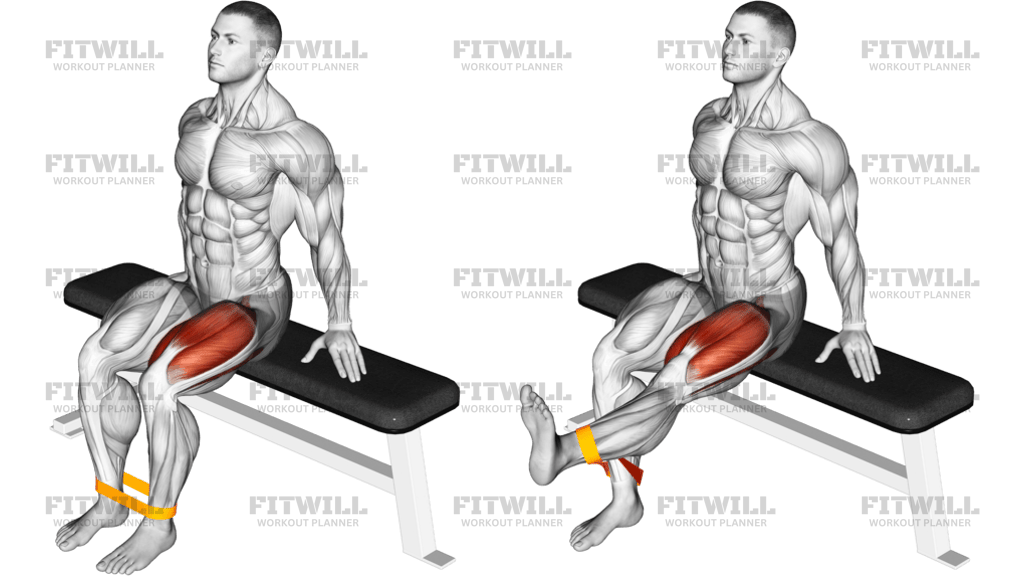
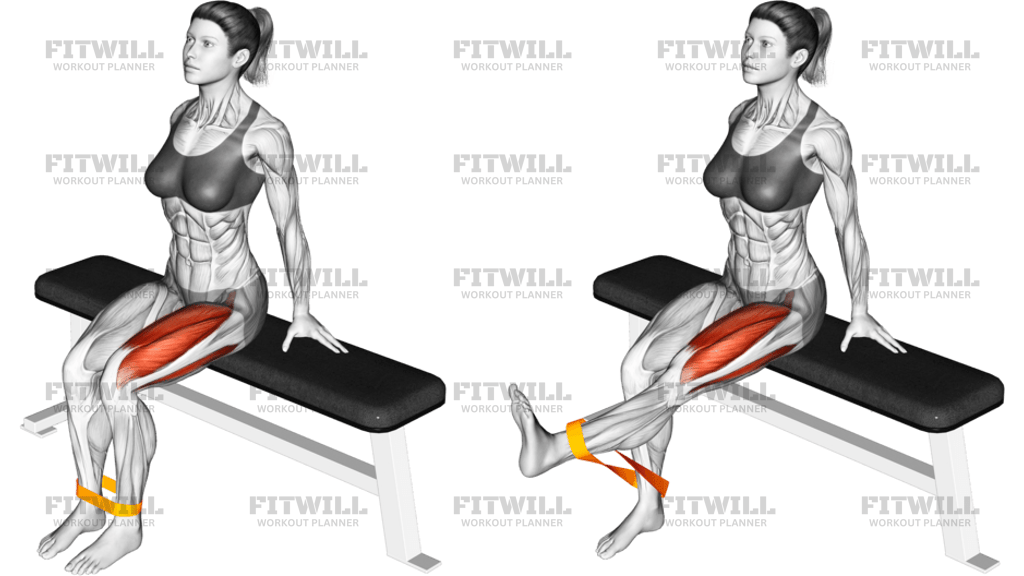
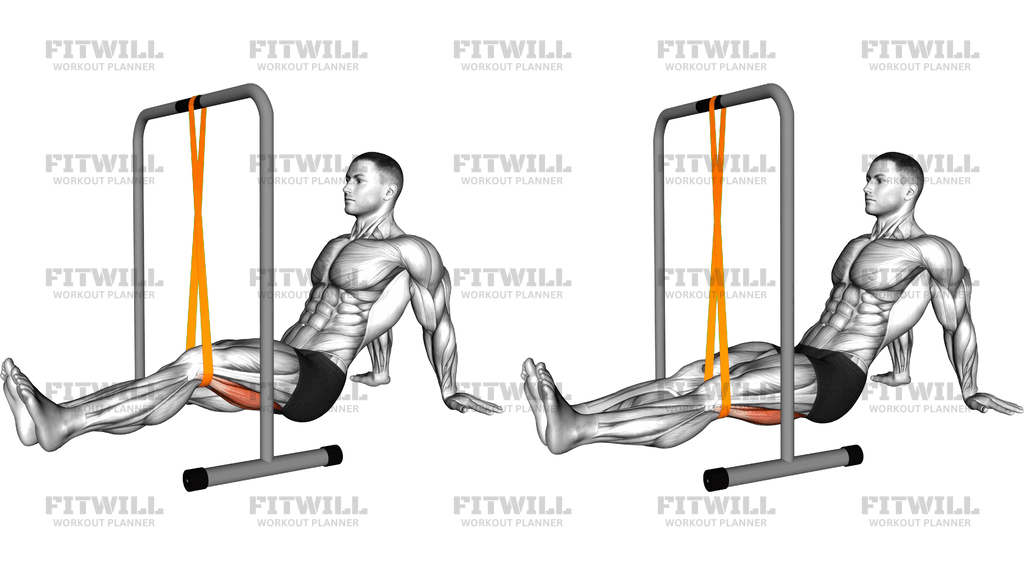
The Resistance Band Seated Single Leg Knee Extension is a unilateral quad exercise performed from the floor. You sit with your torso leaned back and supported on your hands, loop a resistance band around one ankle, and anchor the band to a sturdy bar or rack positioned behind and above you. From there, you straighten the bent knee against the band's pull and lower it back down under control. Because the anchor sits behind your body, the band drags your lower leg backward, and your quadriceps have to fight that pull every inch of the way to full extension.
This movement fits a wide range of lifters. It's a solid pick if you're training at home without a leg extension machine, if you're returning from a layoff and want gentle, joint-friendly quad loading, or if one leg has fallen behind the other and you need to address it directly. Working one leg at a time also stops your stronger side from quietly taking over, which is easy to do on bilateral leg exercises.
The main muscle at work is the quadriceps on the front of the thigh, with the rectus femoris contributing because the hip stays extended while the knee straightens. Your core and shoulders do quiet supporting work too, since you're holding your torso up on your arms for the whole set. Setup matters more than people expect: if the band is looped too high on the leg, or if the anchor is too close, the resistance angle changes and the exercise either becomes too easy at the top or jerkily hard at the bottom.
To execute it well, keep the band seated flat against your ankle, brace your trunk so your lower back isn't sagging, and think about kicking the leg out in a smooth arc rather than snapping it straight. Pause briefly at full extension, then resist the band on the way back instead of letting it yank your heel down. The tempo on the return is where most of the control and benefit lives.
A few practical points will keep this safe and productive. Use a band tension you can extend fully without shrugging or rocking your torso, and keep your non-working leg relaxed and long on the floor so your hips stay level. If your wrists or shoulders complain about supporting your upper body, shift more weight into your palms by moving your hands slightly wider or closer to your hips. Stop short of locking the knee hard if it feels pinchy at full extension — extend fully but don't slam it.
[ Workout Log & Planner ]
Put your next workout in Fitwill
Keep your plan and training log ready when you are.


Instructions
- Anchor a resistance band to a sturdy bar or rack behind and above you, then loop the free end around the ankle of your working leg so the band runs taut when your knee is bent.
- Sit on the floor and lean your torso back, placing your palms flat on the floor beside your hips with fingers pointing forward; extend your non-working leg straight in front of you.
- Bend your working knee so your heel rests near the floor and the band is already pulling your lower leg backward — this is your starting point.
- Brace your core and press lightly through your palms so your torso stays tall and steady instead of slumping.
- Extend your working knee by contracting your quad, sweeping your lower leg forward and up against the band until the leg is nearly straight.
- Hold the extended position for a beat and squeeze the front of your thigh.
- Slowly bend the knee again, resisting the band's pull as your heel lowers back toward the floor rather than letting it snap down.
- Exhale as you extend the knee and inhale as you return it to the bent position.
- Complete all repetitions on one leg, then reposition the band around the other ankle and match the reps on the second side.
Tips & Tricks
- Loop the band around the ankle, not the calf or knee — anchoring too high shortens the lever and makes the set feel easier than it should.
- If the band goes slack at the bottom, move your body slightly closer to the anchor so there's constant tension even with the knee bent.
- Avoid yanking your torso with your arms as the leg extends; if you're rocking backward, the band is too heavy or you're rushing the rep.
- Keep your hips square to the front — the working hip tends to lift and rotate outward as fatigue sets in, which cheats the quad.
- The lowering phase should take about two to three seconds; a fast drop means the band, not your quad, is doing the work.
- Point your toes up toward your shin at full extension to finish the contraction cleanly instead of flicking the foot forward.
- If your wrists ache from supporting your torso, make fists and press your knuckles down, or slide your hands a few inches closer to your hips.
- Check the band for wear before each set — a band slipping off an anchor behind you is the main real hazard of this setup.
Frequently Asked Questions
Which muscles does the Resistance Band Seated Single Leg Knee Extension work?
The quadriceps on the front of the thigh do the main work as the knee straightens against the band. Your core and shoulders support you isometrically since you're holding your torso up on your hands.
Why is the band anchored behind and above me instead of under my foot?
With the anchor behind your body, the band pulls your lower leg backward, so your quad has to work through the entire extension. Anchoring under the foot would push the leg down and change the resistance curve entirely.
Is this exercise suitable for beginners?
Yes, it's one of the more approachable quad exercises because the band gives smooth, joint-friendly resistance. Start with a light band and focus on a slow, controlled lowering phase before adding tension.
Can I do the Resistance Band Seated Single Leg Knee Extension without a rack?
You can anchor the band around any sturdy, stable object behind you at roughly hip height or above, such as a heavy table leg or a fixed squat rack upright. Just make sure it absolutely cannot move or release.
How is this different from a machine leg extension?
The band's resistance is elastic, so it gets harder as the knee straightens, whereas a machine keeps load fairly constant. You also support your own torso on the floor, which adds a small core and shoulder demand the machine doesn't have.
Should my knee lock out fully at the top?
Extend the leg fully and squeeze the quad, but don't snap or hyperforce the lockout. A firm, controlled pause at full extension gives you the peak contraction without hammering the joint.
Why does my lower back feel it instead of my quad?
That usually means your torso is sagging or rocking, shifting work into your hip and trunk. Press evenly through your palms, brace your abs, and slow the tempo down so the leg does the moving.
How many reps and sets should I do per leg?
Two to three sets of 10 to 15 controlled reps per leg works well for most people. Since one leg is always resting, keep the reps matched between sides so any imbalance gets evened out rather than widened.
Can I train both legs at the same time with this setup?
You can, but the single-leg version is worth keeping because it exposes and corrects side-to-side differences. Doing both at once also makes it harder to keep the band seated flat on each ankle.