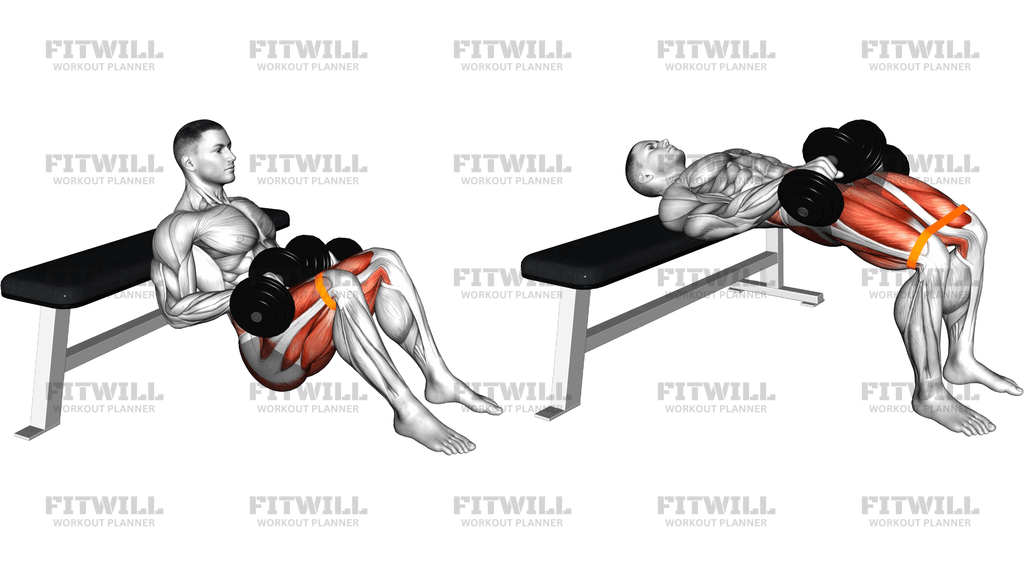
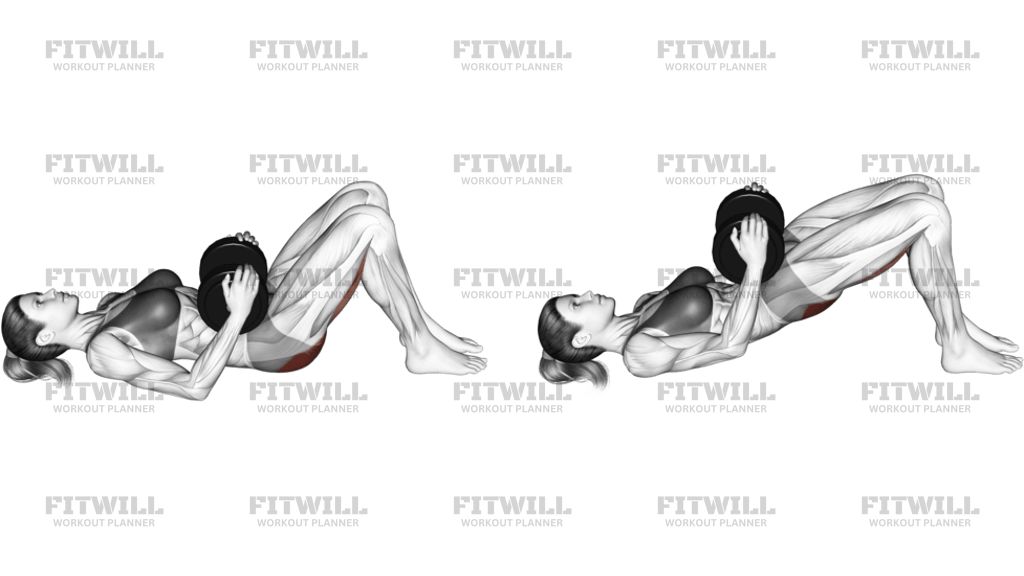
Dumbbell Banded Single Leg Hip Thrust
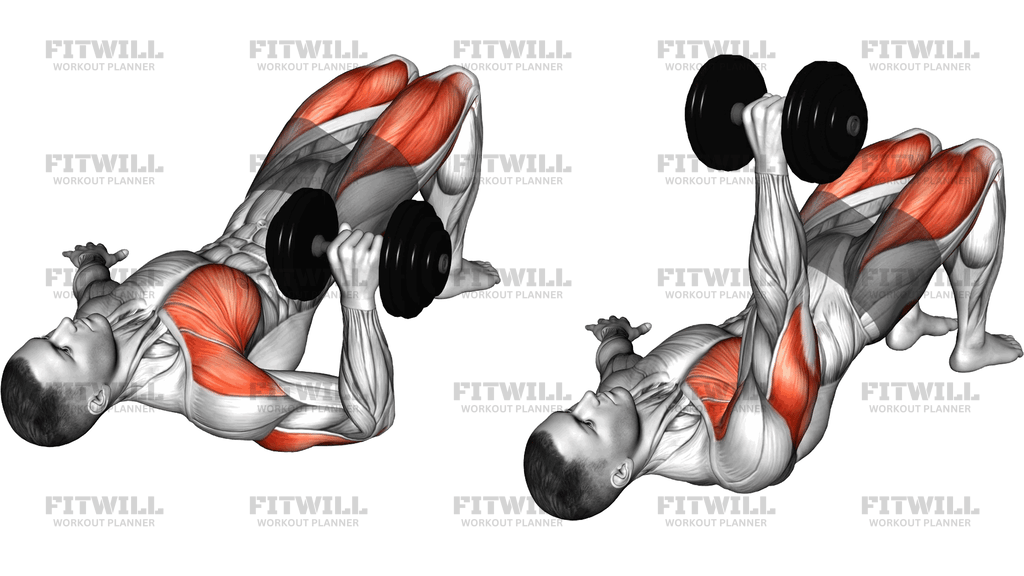
The Dumbbell Banded Single Leg Hip Thrust is a loaded, single-leg version of the hip thrust performed with your upper back supported on a flat bench. A dumbbell rests across the working hip, and a resistance band loops around both thighs just above the knees, pulling your leg inward so your glutes have to actively fight to keep the knee tracking out. One foot drives into the floor while the non-working leg stays bent and lifted, which means the entire bridge is produced by one hip at a time.
This exercise suits lifters who already own the two-leg hip thrust and want more challenge without piling on huge weight. Because you work one side at a time, each glute gets a direct training stimulus, which helps expose and gradually fix left-to-right strength differences. It is popular in glute-focused hypertrophy programs, in rehab-informed lower body training where heavy bilateral loading is not desired, and among runners or field-sport athletes who need strong, stable single-leg hip extension.
The main target is the gluteus maximus, supported by the hamstrings at the top of the drive. The band above the knees adds abduction demand, recruiting the gluteus medius and outer hip musculature as you press the knees apart. Your core and lower back stabilize the ribcage and pelvis throughout, and the standing leg's quads and hamstrings handle balance and support.
Setup matters more here than in most glute exercises. The bench should sit against the bottom of your shoulder blades, the dumbbell must be centered over the working hip crease so it does not tip toward either side, and your front shin should be roughly vertical at the top of the rep. If the working foot drifts too far forward or the band slides off position, the movement turns into a low-back extension rather than a hip thrust.
To perform it well, tuck your chin slightly, brace your ribs down over your pelvis, and drive through the heel of the working foot until your torso and front thigh form a straight, level line. Squeeze the glute hard at the top, pause briefly, and lower under control until the weight nearly touches the floor before the next rep. Keep the band tension live by pressing the knees outward the whole time.
Common uses are as a primary glute builder with moderate dumbbells, or as a finisher after heavier bilateral hip work. A practical safety note: start with a lighter dumbbell than you use for two-leg thrusts, since single-leg balance and anti-rotation control are the limiting factors, not raw hip strength.
[ Workout Log & Planner ]
Put your next workout in Fitwill
Keep your plan and training log ready when you are.


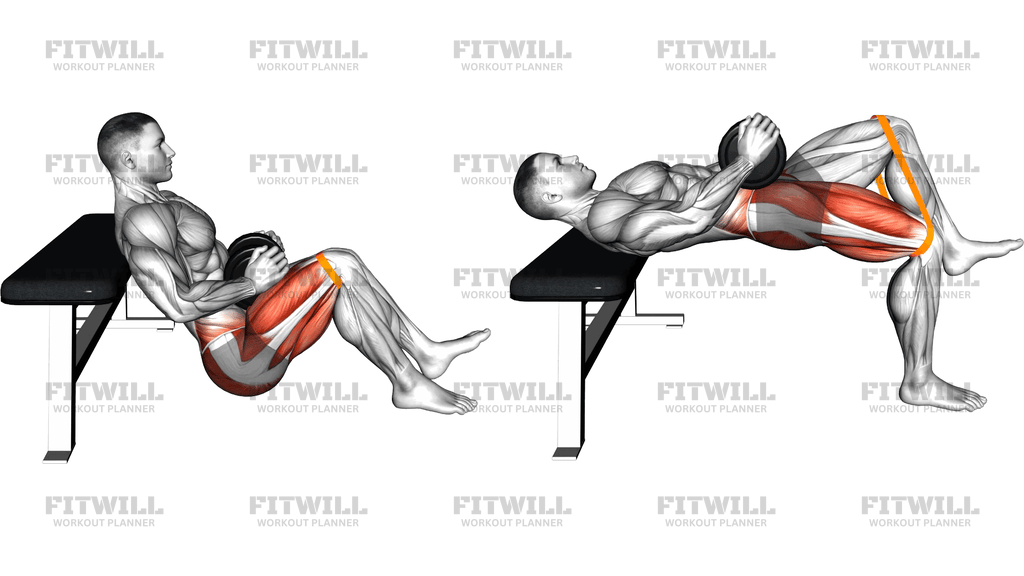
Instructions
- Place a flat bench against a wall or secure it so it cannot slide, then sit on the floor with your upper back against the front edge of the bench.
- Loop a resistance band around both thighs just above your knees, then roll a dumbbell over your working hip crease and hold it steady there with both hands.
- Walk your working foot in so it sits flat on the floor about a foot in front of your hip, keep the knee bent, and let the non-working leg hang bent with its foot off the floor.
- Slide your hips down until your torso is supported by the bench at the bottom of the shoulder blades, grip the dumbbell firmly, and press your knees outward against the band to create tension.
- Brace your core and tuck your chin slightly so your ribs stay stacked over your pelvis.
- Drive through the heel and midfoot of the working leg, extending the hip until your torso and front thigh form a straight line parallel to the floor.
- At the top, squeeze the working glute hard and hold the position for a beat while continuing to press outward against the band.
- Lower with control until the dumbbell and hips approach the floor, keeping tension in the band and your ribs down.
- Exhale as you drive up and inhale as you lower, completing all reps on one side before switching legs and resetting the band and dumbbell.
Tips & Tricks
- If the dumbbell tips toward your torso or knees, it is sitting too high on your thigh; seat it directly over the hip crease and hold it with both hands for the whole set.
- A common fault is pushing through the toes and letting the heel lift, which shifts work to the quad and calf; keep the whole foot down and cue heel drive.
- If your pelvis drops or twists toward the non-working side, reduce the dumbbell weight first, then think about leveling your belt line before each rep.
- Letting the knees cave inward under band tension steals abduction work from the outer glutes; actively press outward for the entire rep, especially during the lowering phase.
- Overextending at the top by arching the lower back is easy to miss with a loaded hip; stop when your torso reaches level and let the glute, not the spine, finish the range.
- Choose a band that challenges knee separation without forcing you to widen your stance; if your working foot slides across the floor, the band is too strong.
- Place a folded towel or pad between the dumbbell and your hip if the plate edge digs in during heavier sets.
- Keep the non-working leg bent and still; swinging or straightening it changes your balance point mid-set and usually causes a hip drop.
- If your upper back slides off the bench edge as you extend, you set up too high; reposition so the bench contacts you at the bottom of the shoulder blades.
Frequently Asked Questions
Which muscles does the Dumbbell Banded Single Leg Hip Thrust work?
The gluteus maximus of the working leg is the primary mover, with the hamstrings assisting at the top of the drive. The band above the knees adds work for the gluteus medius and outer hips, while the core and lower back stabilize the pelvis.
Why does this version use a band around the knees in addition to the dumbbell?
The band pulls the knees inward, so your hips must actively push outward to keep alignment. This trains the gluteus medius and hip external rotators alongside the main hip extension of the thrust, which a plain dumbbell hip thrust does not demand.
Is the Dumbbell Banded Single Leg Hip Thrust suitable for beginners?
Beginners should first master the bodyweight two-leg hip thrust, then the single-leg bodyweight version. Once you can keep the pelvis level and knees pressed out for solid sets, add a light dumbbell before progressing the band tension.
How do I keep the dumbbell from sliding or tipping during the set?
Hold it with both hands over the hip crease of the working leg and keep your hips high and level throughout. If it still shifts, the weight is likely too heavy for single-leg control or your pelvis is dropping on one side.
What is the most common mistake in this exercise?
Letting the knees cave in under band tension, which removes the outer-glute work and often accompanies an arched lower back at the top. Press the knees outward on every rep and stop the lift once your torso and front thigh are level.
Can I do the Dumbbell Banded Single Leg Hip Thrust without a bench?
Yes, you can perform it from the floor with your shoulders on the ground, though the range of motion at the hip is shorter. A bench version places the upper back on the bench edge and gives a fuller hip extension, so use the floor version mainly as a substitute.
How heavy should the dumbbell be?
Pick a weight you can control for 8 to 15 reps per side without the pelvis tilting or the dumbbell shifting off the hip crease. Single-leg balance and anti-rotation control fail before your glutes do, so most people use far less than their two-leg hip thrust load.
What can I use instead of a dumbbell for resistance?
A barbell or a weighted plate held over the hip works the same way, and a weighted vest paired with a heavier band is another option. If no equipment is available, the band alone with a slow tempo and top pauses still provides meaningful single-leg training.
Should the non-working leg be straight or bent?
Keep it bent with the foot off the floor, as shown in the standard setup. A bent resting leg shortens the lever and makes it easier to keep the pelvis square, while straightening or swinging it usually causes a hip drop mid-rep.
Is it safe for the lower back?
When performed with a braced core and a level pelvis, the movement loads the hip rather than the spine. Avoid arching past a level torso at the top and use a weight that does not force your ribcage to flare, since those habits shift stress toward the lower back.