Bodyweight Jefferson Curl
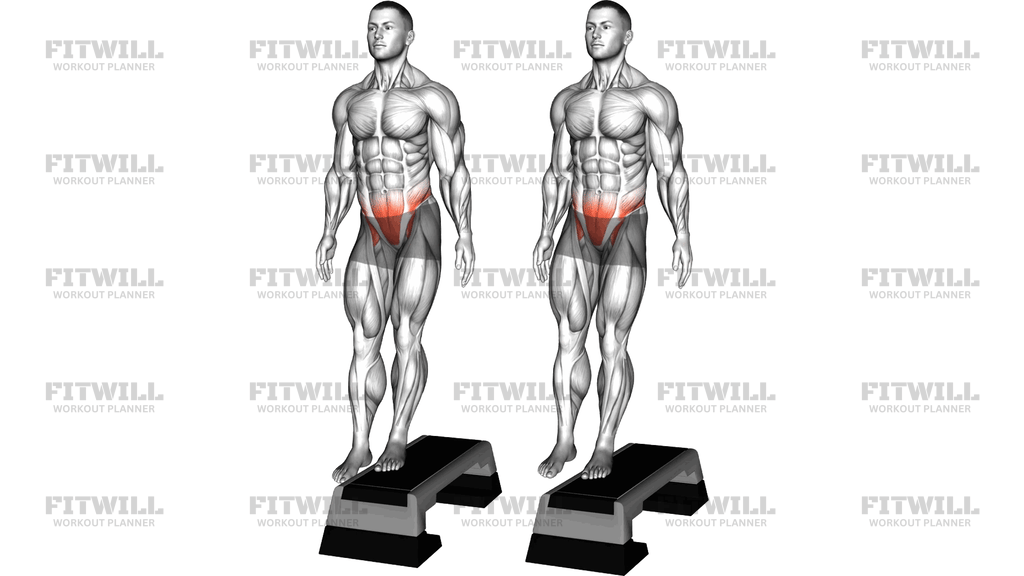
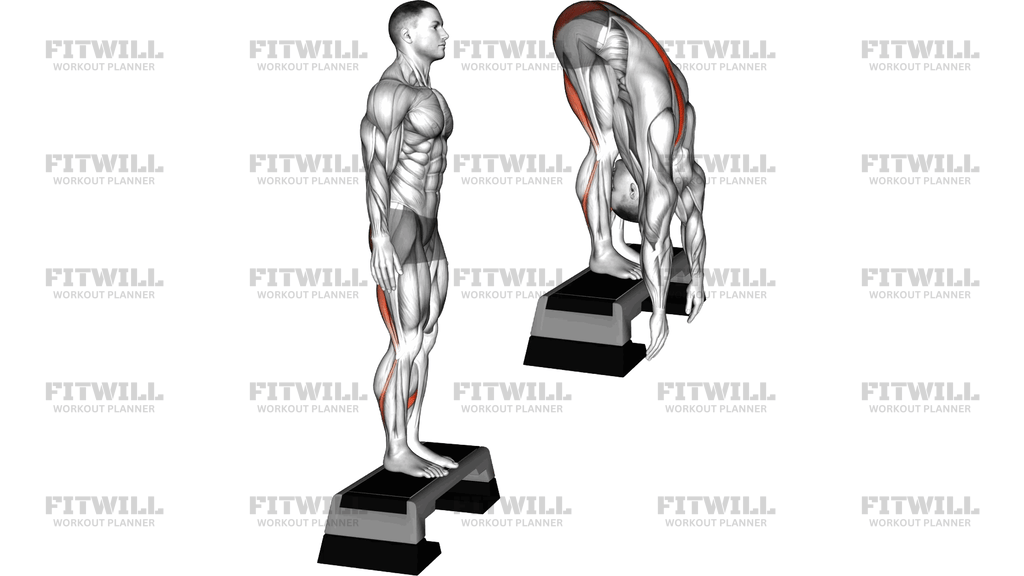
The Bodyweight Jefferson Curl is a deliberate, segmental spinal flexion exercise performed while standing on an elevated step platform. Starting from a tall, upright stance, you roll your spine down one vertebra at a time — chin first, then upper back, middle back, and lower back — until your torso hangs heavy toward your legs and your arms reach toward the floor below the edge of the step. The return is just as controlled: you rebuild the spine from the bottom up, stacking each level back into extension until you are standing tall again.
This movement is best known for building resilience in the lower back. Rather than bracing the spine rigid the way most strength work does, the Jefferson Curl loads the erector spinae and the surrounding tissues through a full, controlled rounded-back range. That makes it a favorite in rehab-adjacent strength settings, gymnastics preparatory work, and programs aimed at people whose spines only ever see straight-backed, hinged positions. Because no external load is used here, it is an accessible way to learn the pattern before adding weight.
Beyond the spinal flexors, the Bodyweight Jefferson Curl delivers a deep eccentric stretch to the hamstrings and calves, since the knees stay essentially straight as the torso folds over. The elevated step matters: it gives your hands somewhere to travel below the level of your feet, which extends the range at the bottom and lets the back and posterior chain lengthen fully without the floor cutting the movement short. The glutes and upper back work isometrically to control the descent and manage the return.
Execution quality depends entirely on pacing. The entire descent should take several slow breaths, with each spinal segment moving separately rather than the whole torso tipping forward as one block. Rushing turns the exercise into a ballistic toe-touch, which defeats its purpose. Keep the weight balanced over the whole foot, the legs relaxed but straight, and the head heavy as you fold.
Common use cases include warm-up prep for deadlifting, restoring lost forward-fold ability in desk-bound lifters, and progressive spine conditioning for athletes in sports that demand rounded-back positions. Because flexion under load is a skill, start conservatively: treat the bodyweight version as your safety check before any loaded variation, and stop the descent at whatever depth you can still reverse smoothly.
[ Workout Log & Planner ]
Put your next workout in Fitwill
Keep your plan and training log ready when you are.


Instructions
- Stand on top of a step platform with both feet fully planted, feet about hip-width apart, and your body tall with arms relaxed at your sides.
- Position yourself so the balls and heels are evenly supported on the step and your hands will clear the edge as you fold down; shift slightly forward or back on the platform until you feel stable.
- Keep your legs straight but not locked, and let your knees stay soft enough that the hamstrings feel a stretch rather than strain.
- Begin the descent by tucking your chin slowly toward your chest, as if nodding down one vertebra at a time.
- Continue rolling down through the upper and middle back, letting your arms hang heavy and drift toward the floor past the edge of the step; do not reach with your hands — gravity should pull them down.
- Keep folding until your spine is fully rounded and your torso hangs close to your legs, feeling a strong stretch through the hamstrings and lower back; hold the bottom briefly for one breath.
- Reverse the movement from the bottom up: first imagine lifting the low back, then the mid back, then the upper back, and finally the head, so you stand up segment by segment.
- Finish tall with your ears stacked over your shoulders and hips before beginning the next repetition.
- Exhale slowly as you fold down and inhale on the way up, keeping your breathing unhurried throughout.
- Reset your balance on the platform between reps, and keep the entire rep slow enough that you could stop at any point in the descent.
Tips & Tricks
- The most common fault is hinging at the hips like a stiff-leg deadlift. The Jefferson Curl is a spinal roll, not a hip hinge — think of your chin leading the motion and your back rounding deliberately.
- If your heels lift or your balance wobbles on the step, narrow your stance slightly and stand closer to the middle of the platform before descending.
- Do not bounce at the bottom to gain depth. A passive bounce at end range is the exact error this exercise is meant to train out of.
- If your hamstrings cramp, that usually means the descent is too fast or your knees are locked hard; soften the knees a fraction and slow the fold.
- Treat depth as earned, not forced. Stopping mid-shin with control is better than touching your toes with a strained, jerky bottom position.
- Keep your arms completely relaxed and dangling. Actively reaching for the floor recruits the shoulders and pulls you past a range you cannot control.
- Expect the ascent to be the hardest part. If you have to heave up with momentum, you folded too deep for your current level — shorten the range.
- Program this early in a session, when you are fresh, rather than as a finisher when fatigue makes the slow tempo hard to hold.
- A mild stretching sensation through the back of the legs and spine is normal; sharp pain, numbness, or tingling means you should reduce the range or stop.
Frequently Asked Questions
What muscles does the Bodyweight Jefferson Curl work?
The primary target is the lower back, specifically the erector spinae, which works through a full flexion and extension range. The hamstrings and calves get a deep eccentric stretch, while the glutes and upper back help control the movement.
Why is the Bodyweight Jefferson Curl performed on a step platform instead of the floor?
The step lowers the floor relative to your hands, so your arms can travel below foot level at the bottom. This extends the range of the fold and lets the spine and posterior chain lengthen fully without stopping at your shins.
Is a rounded back during the Bodyweight Jefferson Curl dangerous?
Controlled spinal flexion is the entire point of this exercise, which is why it is done slowly and without weight at first. Move gradually, stay within a pain-free range, and progress depth over time rather than forcing it.
How is the Bodyweight Jefferson Curl different from a regular toe touch or standing forward fold?
A toe touch folds the torso forward as one block, mostly hinging at the hips. The Jefferson Curl rolls down one spinal segment at a time, which actively trains the back muscles through their full range instead of just stretching the hamstrings.
Can beginners do the Bodyweight Jefferson Curl?
Yes — the bodyweight version is actually the recommended starting point. Beginners should shorten the range, stop at mid-shin or knee height if needed, and only deepen the fold once the slow, segmental pattern feels smooth.
How slow should each repetition of the Bodyweight Jefferson Curl be?
Aim for roughly five to ten seconds down and the same coming back up. If you finish a rep in two seconds, you are relying on momentum rather than controlling the spine through the range.
Should my knees stay straight during the Bodyweight Jefferson Curl?
Keep them essentially straight, but not forcefully locked. Fully locked knees often cause hamstring cramping at the bottom, while bent knees turn it into a hip hinge and remove the hamstring stretch.
What can I use if I do not have a step platform?
Any stable, low elevated surface works — a sturdy bench, a low box, or a bottom stair — as long as it will not shift when you stand on it and gives your hands room to descend past your feet.
How do I know when I am ready to add weight to the Jefferson Curl?
When you can perform slow, balanced bodyweight reps through your full comfortable range with no wobble and no need to heave out of the bottom, you can consider light added weight held in the hands.
How many reps and sets of the Bodyweight Jefferson Curl should I do?
Because the tempo is so slow, low volume goes a long way — around 3 to 6 controlled reps for 1 to 3 sets. It works well as prep before hinging or deadlifting sessions.