Elevanted Goblet Squat
The Elevated Goblet Squat is a front-loaded squat performed with your feet standing on a raised surface such as a step platform or solid plate. Holding a kettlebell (or a single dumbbell) close to your chest in the goblet position, you squat down as deeply as your hips and ankles allow and drive back up to standing. The elevation is the key detail: by lifting your heels and forefoot onto a platform, you give your knees more forward travel room, which lets you reach a deeper bottom position than a flat-ground squat while keeping your torso upright.
This version is especially useful for lifters whose ankles are stiff enough that a flat squat turns into a good-morning, with the chest falling forward and the lower back rounding near the bottom. Because the weight sits right against your sternum, it also acts as a counterbalance, making it one of the easiest squat variations to learn with a straight, tall spine. The main work goes to the quadriceps, with the glutes taking over as you stand back up from a deep bottom, and the calves and ankle stabilizers working harder than usual because your heels are raised.
Setup matters more here than in a regular squat. The platform needs to be low, stable, and wide enough for your whole foot — roughly a 2 to 4 inch rise is plenty. If the surface is wobbly or too tall, you lose balance or shift your weight onto your toes, which is exactly what you do not want. Set your feet about shoulder-width apart with toes turned out slightly, and keep three points of contact with the platform: heel, big toe, and little toe.
To execute it well, hold the weight by the horns against your upper chest with your elbows tucked down, brace your ribcage down over your hips, and sit straight down between your feet rather than pushing your hips far back. Let your knees travel forward over your toes — that forward travel is the point of the elevation — until your elbows brush the inside of your knees or your thighs reach parallel or below. Pause briefly, then push the platform away through your whole foot to stand tall without letting the weight drift away from your chest.
You will see this movement used three ways most often: as a teaching tool for beginners learning what a deep squat should feel like, as a higher-rep quad builder for lifters who find barbell squats hard on the lower back, and as a warm-up or mobility drill before heavier squatting. Because the load is held in front of the body and the range is generous, keep the weight moderate and prioritize depth and control. If you feel your heels lifting off the platform or your lower back rounding at the bottom, reduce the depth or the weight before continuing.
[ Workout Log & Planner ]
Put your next workout in Fitwill
Keep your plan and training log ready when you are.


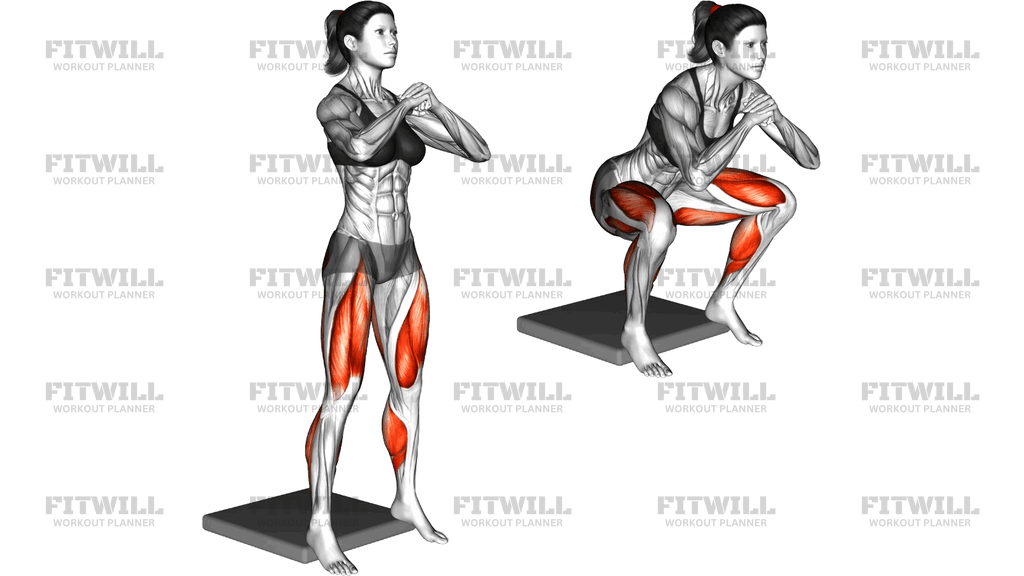
Instructions
- Place a low, stable step platform or solid plate on the floor and stand on it with your feet about shoulder-width apart, toes turned out 15 to 30 degrees.
- Hold a kettlebell by the horns at chest height so it rests against your sternum, with your elbows pointing down and tucked close to your ribcage.
- Keep your whole foot on the platform — heel, big toe, and little toe pressing down — and shift your weight slightly toward your midfoot rather than your toes.
- Take a breath into your belly, brace your core, and pull your ribs down so your chest and pelvis stay stacked.
- Sit straight down between your feet, letting your knees travel forward over your toes while your torso stays upright and the kettlebell stays glued to your chest.
- Descend until your elbows touch the inside of your knees at the bottom or your thighs reach at least parallel, without your heels lifting off the platform.
- Pause for a beat at the bottom, keeping tension in your legs and your spine neutral.
- Drive through your whole foot to push the platform away and stand up, exhaling as you rise.
- Finish each rep standing tall with hips and knees extended, the weight still tight against your chest.
- Reset your brace and foot position before the next rep, and step off the platform carefully when the set is finished.
Tips & Tricks
- If your heels rise off the platform at the bottom, the platform is too high — drop to a thinner plate so your foot stays flat and weight stays in your midfoot.
- Elbows flaring out to the sides let the kettlebell drift forward and pull your chest down; pin your elbows inside your knees' path and against your ribs.
- Do not treat the forward knee travel as a fault here — the elevation exists precisely so your knees can travel further while your torso stays tall.
- Relying on a bounce out of the bottom is the most common way to lose spine position on this lift; a one-second pause teaches you to own the deep position.
- Keep the kettlebell in contact with your sternum for the entire rep; the moment it floats away from your body, your core stops getting work and your lower back takes over.
- Start with a lighter weight than your flat-ground goblet squat, since the deeper range and raised heels expose mobility limits you may not have felt before.
- Turn your toes out only as far as lets you keep your big toe pressed into the platform — excessive flare usually shows up as the arch collapsing inward.
- Place the platform against a wall or on a non-slip surface; a step that slides mid-rep is the biggest safety risk in this setup.
- If your calves cramp because of the raised heels, do a few bodyweight reps first or hold the bottom position briefly before adding load.
Frequently Asked Questions
What muscles does the Elevated Goblet Squat work?
The quadriceps do most of the work, especially in the deep range of motion that the elevated stance creates. The glutes drive you out of the bottom, and the calves and ankle stabilizers work harder than in a flat squat because your heels sit on the platform.
Why are the heels elevated on a platform in the Elevated Goblet Squat?
Raising the heels reduces the ankle mobility demanded by a deep squat, allowing your knees to travel further forward and your hips to drop lower while your torso stays upright. It is a simple way to reach full depth without your chest falling forward.
Is the Elevated Goblet Squat good for beginners?
Yes, it is one of the best beginner squat variations because the front-loaded counterbalance and raised heels make a deep, upright squat much easier to feel. Start with a light kettlebell or even just your bodyweight with hands clasped at your chest.
How high should the platform be under my heels?
A rise of roughly 2 to 4 inches is enough for most people. If your heels lift off or you feel tipped forward onto your toes, the surface is too tall and you should use a thinner plate.
Can I use a dumbbell instead of a kettlebell for the Elevated Goblet Squat?
Absolutely. Hold a single dumbbell vertically against your chest under the top head, or rest it on your upper chest, and keep the same elbows-down position as the kettlebell version.
Is it bad for my knees if they travel past my toes in this squat?
For a healthy knee, controlled forward knee travel is a normal part of deep squatting and is the intended effect of the heel elevation. Descend under control, keep your whole foot on the platform, and stay within a depth you can reverse smoothly.
How is the Elevated Goblet Squat different from a regular Goblet Squat?
The elevated version has your feet on a raised surface, which increases knee travel and depth and shifts slightly more emphasis to the quads and calves. The regular version is flatter through the ankle but demands more ankle mobility to hit the same depth.
What is the most common mistake with the Elevated Goblet Squat?
Letting the weight drift away from the chest and rising onto the toes at the bottom. Both usually mean the load is too heavy or the platform too high — reduce one of them and keep the kettlebell glued to your sternum with your whole foot planted.
How many reps and sets should I do?
For learning the pattern or warming up, 2 to 3 sets of 8 to 12 controlled reps works well. As a standalone quad exercise, 3 to 4 sets of 10 to 15 reps with a moderate weight lets you keep depth and position without breaking down.
Can I do the Elevated Goblet Squat if I have lower back discomfort with barbell squats?
Many lifters find it more comfortable because the load is held in front of the chest and the torso stays more upright, which reduces lower back demand. Move within a pain-free range, keep your ribs stacked over your hips, and stop if discomfort appears.