Weighted Plate Lu Raise
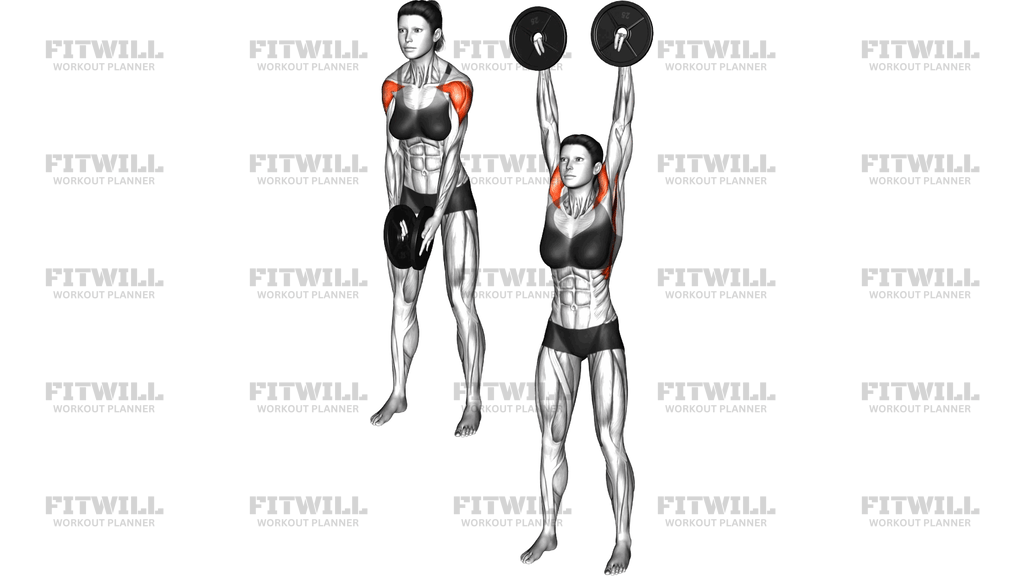
The Weighted Plate Lu Raise is a standing front raise performed by pinching a weight plate between your hands and sweeping it from hip height all the way overhead with straight arms. The plate is held at the 3 and 9 o'clock positions, which means your hands stay relatively close together and your wrists remain neutral throughout the arc. Because the weight travels the full distance from your thighs to above your head, the front delts work through a much longer range than a standard plate front raise that stops at shoulder height.
This movement is popular in overhead athlete circles, and for good reason: it trains the anterior deltoids, side delts, and upper traps in one continuous lift while demanding that your torso stay upright and still. The core works quietly the entire time to stop the plate from pulling your lower back into an arch, especially near the top where the weight sits farthest from your body.
The setup matters more than it might seem. Holding a single plate by its edges forces both arms to share the load evenly, and any side-to-side wobble shows up instantly at the plate. That makes the Lu raise a useful self-checking exercise — if one shoulder is stronger or stiffer than the other, the plate will tilt and you will feel it right away. Stand tall, feet about hip-width apart, and keep the plate flat and level as if it were resting on a shelf that only your hands support.
Execution should feel like a smooth pendulum, not a throw. Lift the plate in a wide, shallow arc in front of your body, letting the arms travel from the thighs up to a fully extended overhead position, then lower it back down under control. The temptation is always to swing, shrug, or lean back to finish the top half of the rep — resist all three, because the top position with straight arms is exactly where this exercise earns its value.
The Weighted Plate Lu Raise fits well as a secondary shoulder movement after pressing work, as a warm-up primer before heavy overhead lifts with a light plate, or as a finisher for higher reps. Start lighter than you think you need. Because the arms are locked out and the lever is long, even a modest plate challenges the delts and the stabilizing muscles around the shoulder blades more than the same weight would in a bent-arm press.
[ Workout Log & Planner ]
Put your next workout in Fitwill
Keep your plan and training log ready when you are.


Instructions
- Stand with feet hip-width apart and hold a weight plate by its edges at the 3 and 9 o'clock positions, letting it hang in front of your thighs with your arms straight.
- Set your grip so the plate sits level — both hands pinching the rim evenly, wrists neutral, shoulders relaxed rather than already shrugged up.
- Brace your abdominals and squeeze your glutes lightly so your ribcage stays stacked over your pelvis before the plate moves.
- Raise the plate forward and upward in a smooth, wide arc, keeping your elbows locked and the plate flat, as if it were sliding up a wall a few inches in front of you.
- Continue the arc until your arms are fully extended straight overhead and the plate is stacked over your shoulders and hips.
- Pause briefly at the top without leaning back or shrugging your shoulders toward your ears.
- Lower the plate along the same arc back to your thighs, taking at least as long on the way down as on the way up.
- Exhale as you raise the plate and inhale as you lower it, keeping your breathing steady rather than holding your breath at the top.
- Reset your brace at the bottom of each rep, check that the plate is still level, and begin the next repetition.
Tips & Tricks
- If the plate tilts to one side as you lift, your stronger arm is taking over — slow the tempo down and consciously drive both hands up together.
- A common error is stopping at eye level and losing the overhead finish. The straight-arm overhead position is what separates the Lu raise from a standard front raise, so chase full elbow extension.
- Watch for the lower back arching as the plate passes head height. If your ribs flare and your hips push forward, use a lighter plate and squeeze your glutes harder.
- Keep the arc in front of your body rather than dragging the plate straight up your midline — letting it drift close to your face usually means the shoulders are rotating internally.
- If your shoulders shrug up at the top, the upper traps are stealing work from the delts. Think of reaching your hands to the ceiling and lengthening your neck instead.
- Grip the plate by the flat rim with confident finger pressure; a slippery or half-hearted pinch will make your forearms fatigue before your shoulders do.
- Warm up with a very light plate or no weight at all for a set of ten before loading — the straight-arm position is demanding on the shoulder at the top range.
- Bending the elbows is the most frequent compensation when the plate gets heavy. If you cannot keep them locked, the weight has outgrown your current strength.
Frequently Asked Questions
Which muscles does the Weighted Plate Lu Raise work?
The front shoulders are the primary movers, with the side shoulders and upper traps assisting as the plate travels overhead. Your core and the muscles around the shoulder blades work to keep your torso upright and the plate level.
How is a Weighted Plate Lu Raise different from a regular plate front raise?
A standard front raise stops around shoulder or eye height, while the Lu raise continues in a full arc until the arms are locked out overhead. This longer range places more demand on the delts at the top and on your core to resist arching.
Is the Weighted Plate Lu Raise suitable for beginners?
Yes, as long as you start with a light plate and prioritize keeping your elbows straight and your torso still. Beginners often progress faster by mastering the overhead arc with minimal weight before adding load.
Why should the elbows stay straight during the Weighted Plate Lu Raise?
Straight arms keep the front delts doing the work through the entire arc. Bending the elbows shortens the lever and turns the movement into a partial press, which reduces the challenge to the shoulders.
How heavy should the plate be for this exercise?
Choose a plate you can lift to full overhead extension without bending your elbows, leaning back, or letting the plate tilt — for most people that is far lighter than what they would press. Higher reps with a small plate are common for this movement.
My lower back arches at the top of the Weighted Plate Lu Raise. How do I fix it?
That arch means the load is pulling your torso backward as the plate passes overhead. Lighten the weight, brace your abdominals, squeeze your glutes, and only work within the range where your ribcage stays stacked over your pelvis.
What can I substitute if I do not have a weight plate?
A single dumbbell held with both hands under the top head, a small barbell, or even a light kettlebell held by the horns can replicate the same overhead arc. The key detail is keeping the hands close together and the elbows locked.
Should I do the Weighted Plate Lu Raise before or after pressing exercises?
As a heavy working set, place it after your main pressing lifts so it does not fatigue the shoulders first. With a very light plate, it also works well as a warm-up to prepare the delts for overhead work.
Is it safe to lift a plate all the way overhead with straight arms?
It is generally fine with sensible loading and control, but the straight-arm overhead position is demanding on the shoulder. If you feel pinching or discomfort at the top, reduce the weight, narrow the arc slightly, or stop just short of full extension.
How many reps and sets work best for the Weighted Plate Lu Raise?
Two to four sets of 10 to 15 controlled reps is a solid starting point. Because the lever is long and the top position is challenging, prioritize smooth, level reps over chasing heavy weight.