Ring Dip
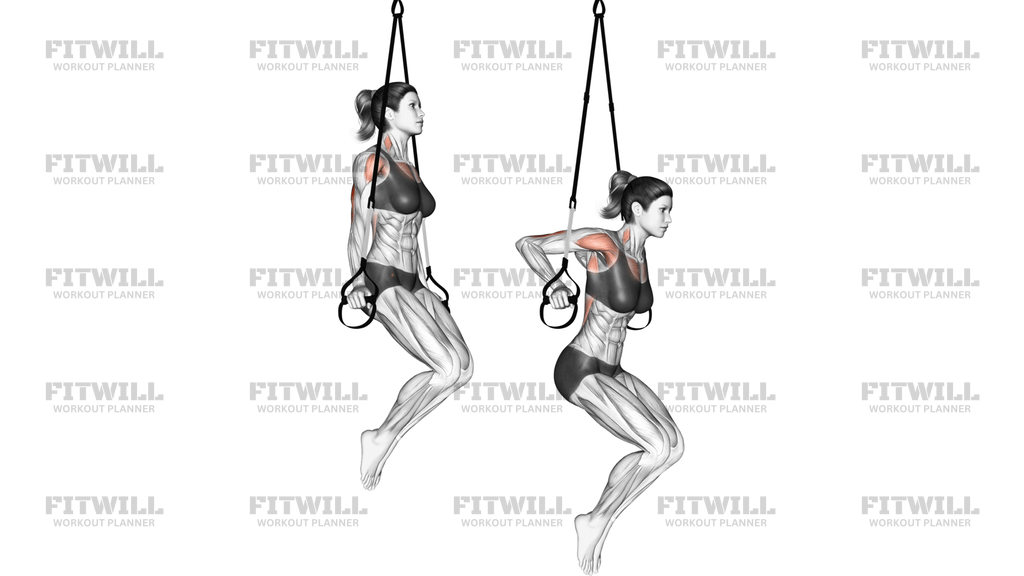
The Ring Dip is a bodyweight pressing movement performed on a pair of suspended gymnastics rings. You start in a supported position above the rings with straight arms, lower your body by bending the elbows until the shoulders drop below the elbows, then press back up to full lockout. Unlike a bar dip, the rings are free to move in every direction, which means your hands, shoulders, and torso have to stabilize themselves the entire time.
The main work comes from the triceps, chest, and front delts, but the real defining feature is the stabilizing demand. Because the rings shift under you, the smaller muscles around the shoulder joint, the serratus anterior, and even the core work overtime to keep your body tracking in one clean line. If you watch the bottom of a well-performed Ring Dip, you'll notice the hands stay turned slightly outward and the elbows stay close to the sides rather than flaring wide.
This is a progression beyond a standard parallel bar dip. Most people should be comfortable performing solid bar dips and a stable ring support hold before attempting full ring dips. It is a staple in gymnastics strength work, calisthenics, and CrossFit-style conditioning, and it builds pressing strength that carries over well to overhead movements and push-ups alike.
Setup matters more here than on a fixed dip station. Ring height, strap tension, and where you place your hands all affect how much the rings want to drift apart or swing forward. Grip the rings with your knuckles facing forward or slightly turned out, keep the straps vertical under load, and let your legs hang beneath or slightly behind you with the body in one straight line.
Execution should be slow and controlled, especially on the way down. Drop the shoulders slightly forward over the hands, bend the elbows until they pass roughly level with the shoulders, then drive the hands down and back to press up. If the rings pull your arms outward at the bottom, that is a sign to reduce depth or use assistance, not to force through it.
Because the shoulders are loaded in a deep, mobile position on an unstable surface, respect the exercise's difficulty. Build up gradually, keep the range within what you can control, and use a band, low rings with foot assistance, or an assisted setup if full ring dips are beyond your current strength.
[ Workout Log & Planner ]
Put your next workout in Fitwill
Keep your plan and training log ready when you are.


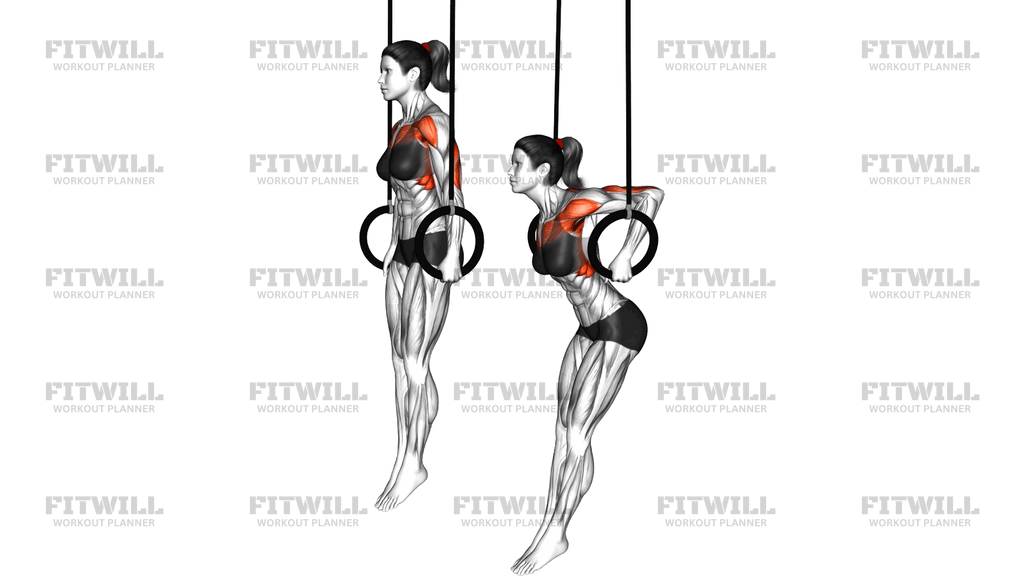
Instructions
- Set the rings to roughly waist height and adjust them so both straps hang evenly with no slack difference between the two sides.
- Grip each ring firmly with your palms facing in toward your body and your knuckles rotated slightly outward, hands about shoulder-width apart.
- Press down through the rings to lift into a support position with straight arms, shoulders stacked directly over your hands, and your legs together beneath or slightly behind you.
- Brace your core and squeeze your glutes so your body holds one straight line from shoulders to ankles.
- Begin the descent by leaning your torso slightly forward and bending the elbows, letting them travel back close to your sides rather than flaring out wide.
- Lower until your shoulders drop to about the level of your elbows, keeping the rings tight against your body and the hands turned slightly out.
- Press powerfully through the rings, driving your hands down and slightly outward to return to the top of the movement.
- Finish each rep with elbows fully locked out and shoulders active, not shrugged up toward your ears.
- Exhale as you press up, inhale as you lower, and avoid holding your breath through the bottom position.
- Between reps, re-stabilize in the support hold before descending again, and step off or lower down safely once the set is finished.
Tips & Tricks
- The most common mistake is losing the turned-out hand position at the bottom. If your palms rotate inward and the rings drift apart, cut your depth until you can keep the rings under control.
- Watch for the torso collapsing forward into the bottom. A small forward lean is natural, but if your chest drops toward the floor, your shoulders are doing the stabilizing instead of your pressing muscles.
- Rings that are set at slightly different heights will make one arm work harder and pull you sideways. Check the straps before every set.
- Do not rush the eccentric. Lowering fast on rings almost always ends with the elbows flaring and the shoulder joint taking the load at the bottom.
- If your feet touch the floor at full depth, raise the rings or bend your knees and cross your ankles behind you to clear the ground.
- Swinging legs usually mean the core has gone quiet. Reset in the support hold, tighten the midsection, and let the next rep come from arm and chest strength.
- Practice static ring support holds before adding dips. Thirty to sixty seconds of a stable hold with straight arms builds the shoulder positioning the dip depends on.
- Band assistance looped through the rings or under one knee is a cleaner progression than cutting depth halfway, because it lets you train the full range while the strength develops.
Frequently Asked Questions
What muscles does the Ring Dip work?
The Ring Dip primarily targets the triceps, chest, and front delts. Because the rings are unstable, the rotator cuff area, serratus anterior, and core also work hard to keep your body and hand position steady throughout the rep.
Why are Ring Dips harder than regular bar dips?
On bars, the equipment fixes your hand path, so your pressing muscles do all the work. On rings, your hands can move in any direction, so your shoulders and stabilizers must control the path while you press, which dramatically increases the demand.
Should my hands be turned out or forward during the Ring Dip?
A slight turn-out, with the knuckles angled outward, keeps the rings close to your body and puts your shoulders in a more comfortable position at the bottom. Letting the hands rotate inward is one of the main causes of shoulder strain on this movement.
How deep should I go on the Ring Dip?
Lower until your shoulders reach roughly the level of your elbows, but only as deep as you can control with the rings held tight to your sides. If your position breaks down before that depth, reduce the range and build back up over time.
I can do bar dips but not Ring Dips. What should I do?
Start with ring support holds to build stability, then add band-assisted ring dips or partner assistance before going for full reps. Most people who can perform bar dips need a few weeks of assisted ring work to close the stability gap.
How high should the rings be set for this exercise?
Set the rings around waist height so you can press into support with straight arms and your feet clear the floor through the entire range of motion. If your feet drag at the bottom, raise the rings slightly or tuck your legs behind you.
Are Ring Dips safe for the shoulders?
When performed with controlled depth, turned-out hands, and elbows kept near the body, the Ring Dip is a well-tolerated pressing exercise. Problems arise from dropping fast, going deeper than you can control, or forcing reps when the rings pull your arms outward, so progress gradually.
What can I use instead of rings for a similar exercise?
Parallel bar dips are the closest substitute and train similar pressing muscles with less stability demand. Push-ups and bench dips also work the same muscle groups, though neither replicates the unstable hand position that makes the Ring Dip unique.
How many reps of the Ring Dip should I aim for?
Quality matters far more than volume here. Start with sets of 3 to 5 clean reps focusing on stable support positions and controlled lowering, and only add volume once every rep finishes with locked elbows and no wobbling.