Weighted Russian Twist (Version 2)
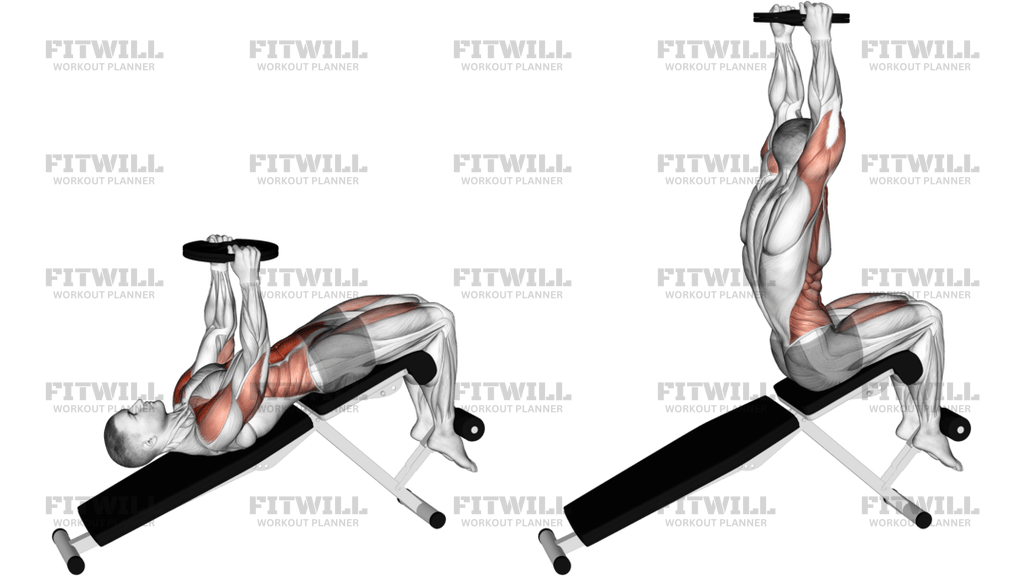
The Weighted Russian Twist (Version 2) is a seated rotational core exercise performed with a weight plate held in both hands while your feet are anchored under the foot pad of an adjustable bench. Unlike the floor-only version where the heels stay down and the legs help stabilize, this setup fixes your ankles in place and removes that assistance, so your trunk has to do more of the work through every rotation. The result is a more demanding twist that targets the rectus abdominis along the front of your torso and the obliques along your sides, with the hip flexors working isometrically to hold your leaned-back position.
This version suits lifters who already handle bodyweight Russian twists comfortably and want a stronger rotational stimulus. Because the feet are locked in, the exercise also challenges your ability to keep the lower back in a safe, neutral-ish position while the upper body turns, which makes it a common choice in combat sport conditioning, golf and tennis training, and general ab work where anti-rotation control matters as much as the twist itself.
Setup matters more than most people realize. Sit on the floor facing away from the bench, slide your feet under the bench's foot rollers, and secure them so your knees stay softly bent. Then walk your heels in slightly and lean your torso back to roughly a 45-degree angle with a long, proud chest. Hold a weight plate with both hands at your chest with arms extended but not locked. If your torso is too upright the twist becomes easy and the abs switch off; if you collapse too far back, your lower back takes the load instead of your core.
Execution is simple but easy to rush. Exhale as you rotate the plate down toward one hip, keeping your arms long and your chest facing forward rather than just swinging your hands across your body. Rotate from the ribs and waist, pause briefly, then drive the plate across to the opposite side in one smooth sweep. Each full pass counts as one rep. The hips stay squared and mostly still, which is exactly what separates a real Russian twist from a side-to-side arm swing.
Expect this version to feel noticeably harder than the unanchored twist at the same weight, so start lighter than you think you need. A 5 to 10 pound plate or even a small dumbbell held by one end is plenty for most people at first. As your control improves, add load gradually, and stop the set the moment your lower back starts rounding or your torso begins sinking toward the floor.
[ Workout Log & Planner ]
Put your next workout in Fitwill
Keep your plan and training log ready when you are.


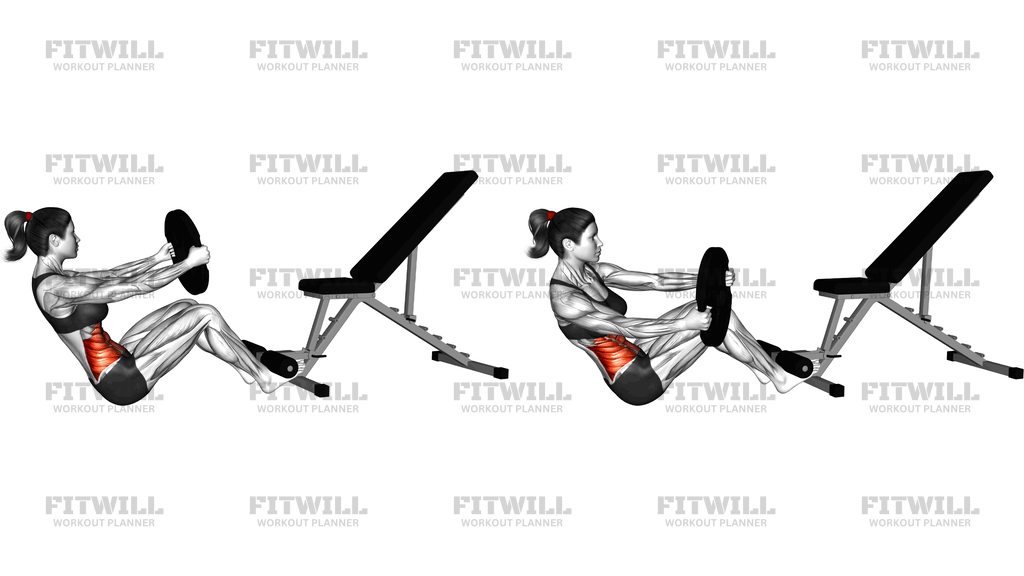
Instructions
- Sit on the floor facing an adjustable bench with its foot rollers positioned near you, and slide your feet under the pads so your ankles are secured and your knees are bent about 90 degrees.
- Hold a weight plate by its edges with both hands, arms extended in front of your chest with a soft bend in the elbows.
- Lean your torso back to roughly a 45-degree angle, keeping your chest lifted and your spine long rather than rounded.
- Brace your abs firmly as if preparing for a light punch, and squeeze your glutes slightly to keep your hips planted.
- Rotate your torso and sweep the plate down toward one hip, turning from your ribs and waist instead of just moving your arms.
- Pause for a moment when the plate reaches its lowest point beside your hip, keeping your torso leaned back the whole time.
- Drive the plate across your body in one controlled arc to the opposite hip without letting your shoulders or hips twist out of line.
- Exhale as you rotate to each side and inhale as the plate travels back through the center.
- Complete your reps, then sit upright, release your feet from the bench pads one at a time, and stand up slowly rather than swinging your legs free.
- Reset your brace and back angle fully between sets instead of starting the next set already slouched.
Tips & Tricks
- If your lower back rounds as you lean back, bend your knees a little more and reduce the backward lean until your spine can stay long.
- The most common mistake is turning this into an arm swing. Watch that your chest actually rotates with the plate, not just your hands.
- Keep your hips glued to the floor. If your whole body rocks from side to side, the load is too heavy or your feet are not anchored securely under the bench pads.
- Start with a lighter plate than you use for unanchored twists. Fixing the feet removes a lot of free stabilization and the movement will feel harder immediately.
- Do not let your elbows flare and collapse toward your ribs at the bottom of each rotation; keeping the plate slightly away from your body lengthens the lever and keeps tension on your abs.
- Slow the sweep down instead of chasing reps. Rushing turns the exercise into momentum work and mostly trains your shoulders.
- If your neck strains forward, imagine holding a small ball under your chin and keep your gaze tracking the plate rather than craning upward.
- Stop the set when your torso starts sinking toward your thighs. Fatigue in this leaned-back position usually shows up in the lower back before the abs give out.
- Place an exercise mat under your sit bones if the floor is hard; discomfort in your tailbone will pull your attention away from your core.
Frequently Asked Questions
Which muscles does the Weighted Russian Twist (Version 2) work?
It primarily targets the abs along the front of your torso and the obliques at your sides, which drive the rotation. Your hip flexors and lower back muscles also work isometrically to hold the leaned-back seated position.
Why are my feet anchored under the bench in this version?
Hooking your feet under the bench's foot pads stabilizes your lower body, which removes the assistance your legs normally provide in a floor-based twist. That forces your trunk to control the rotation and hold the lean entirely on its own.
Is the Weighted Russian Twist (Version 2) suitable for beginners?
It is better saved for people who can already perform bodyweight Russian twists with good control. Beginners should start with the unanchored version, heels on the floor and no weight, before progressing to this setup.
How heavy should the plate be?
Choose a weight you can sweep from hip to hip for 10 to 15 controlled reps without your hips rocking or your back rounding. For most people starting this version, a 5 to 10 pound plate is enough.
Should my hips rotate along with the plate?
No. Your hips should stay squared and planted on the floor while your ribs and torso rotate. If your whole body is rocking side to side, reduce the weight and re-anchor your feet more firmly.
Can I hold a dumbbell or kettlebell instead of a plate?
Yes. Hold a light dumbbell by one end with both hands or cradle a small kettlebell close to your chest. A plate is preferred because its flat shape lets both hands share the load evenly with arms extended.
Why does my lower back feel this more than my abs?
That usually means you are leaning back too far or your abs are disengaging as you fatigue. Sit up slightly, re-brace, and stop the set earlier. A rounded, slumped torso shifts load away from your core and onto your spine.
How many reps and sets should I do?
Two to four sets of 10 to 20 total rotations works well, counting one full sweep left and right as a single rep. Prioritize slow, complete rotations over high rep counts.
What can I use instead of a bench to anchor my feet?
A partner holding your ankles, a loaded barbell set low in a rack, or any stable padded surface you can hook your feet under will work. The key is that your ankles stay fixed so your legs cannot assist.
Is it safe to do this exercise every day?
Daily training is unnecessary because your abs need recovery like any other muscle. Two to four sessions per week, with rest days in between, is a sensible frequency for most training programs.